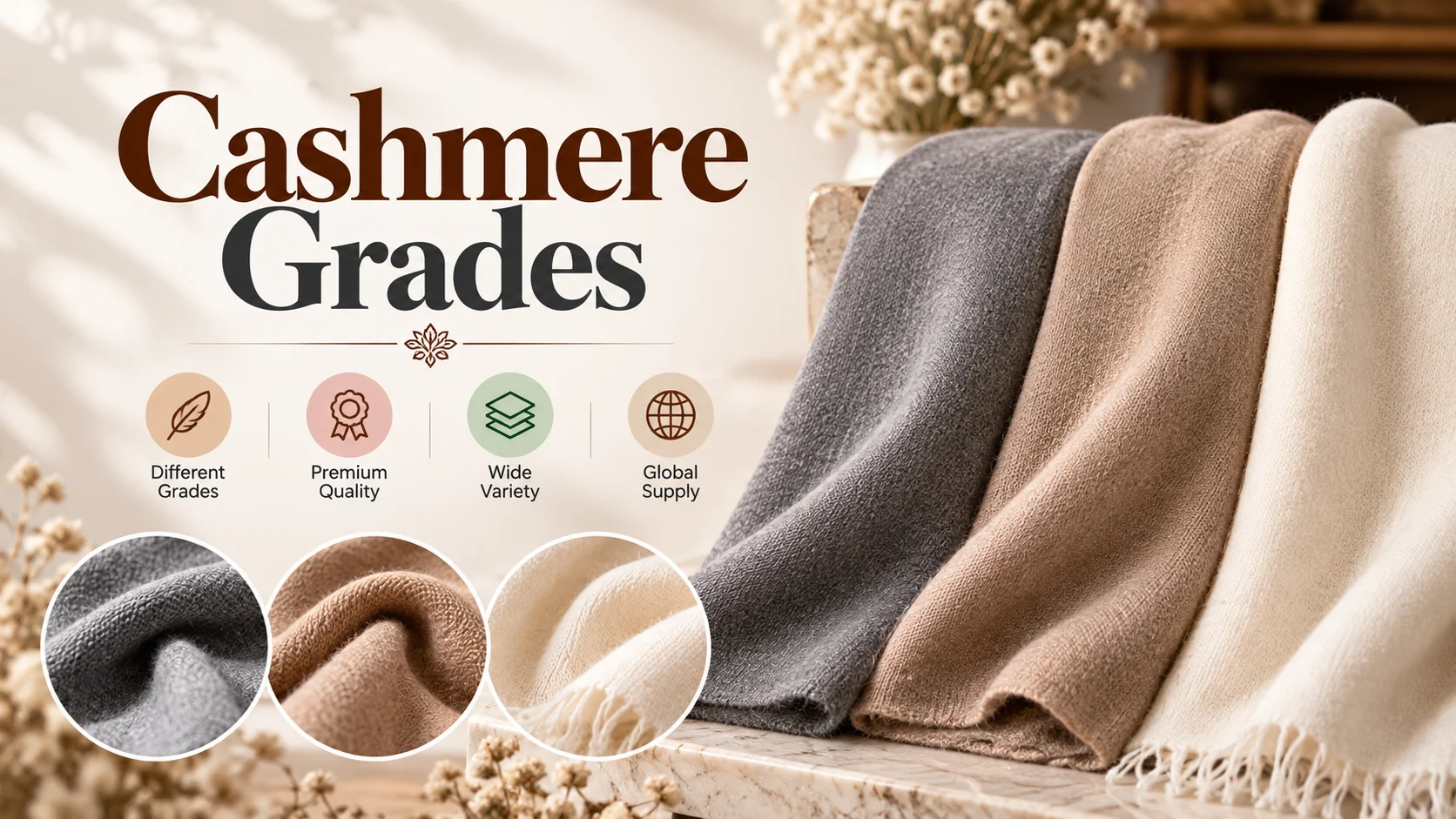
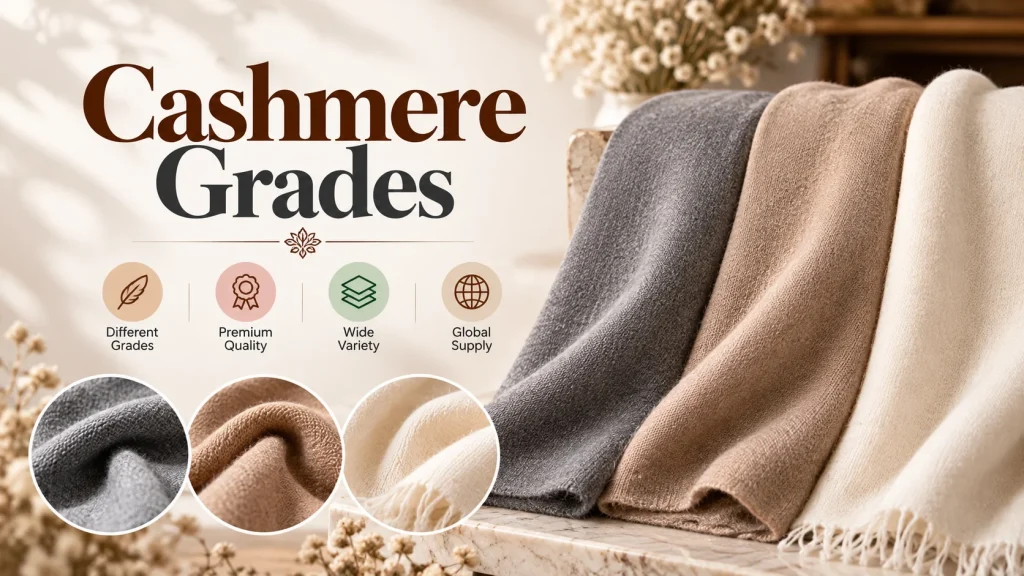
Cashmere grades describe fibre quality, mainly by fineness and length. Grade A cashmere is the finest and longest, usually around 14 to 15.5 microns, and gives the softest, most durable shawls. Grade B is slightly coarser, and Grade C is the coarsest and shortest, so it pills sooner. These grades are trade terms rather than a legal standard, which is why bulk buyers should ask for micron test results and fibre composition reports.
Key takeaways
- Micron count (fineness) and staple length (fibre length) decide most of cashmere’s softness and durability.
- Grade A, B and C are informal trade grades. Ranges vary between suppliers, so ask for test data, not just a grade.
- In the US, a product labelled cashmere must meet a legal fineness definition, so test results protect you.
- Blends and “cashmere feel” fabrics are common. Fibre percentages must be stated on the label.
What decides cashmere quality?
Cashmere is the soft undercoat combed or sheared from cashmere goats, mostly in Inner Mongolia, Mongolia and other high, cold regions of Central Asia. Four properties set its quality:
- Fineness. Measured in microns, the average fibre diameter. A lower number means a softer fibre.
- Length. Longer fibres, often called staple length, spin into smoother, stronger yarn that pills less.
- Colour. Natural white fibre is the most valuable because it can be dyed to any shade. Grey and brown fibres suit darker colours.
- Purity. How well coarse guard hair has been removed during dehairing. Leftover guard hair feels prickly and looks hairy.
Our article on pashmina fibre quality explains the same factors for the finest Himalayan fibre.
Cashmere grade chart: Grade A vs B vs C
| Grade | Typical fineness | Typical fibre length | Feel | Pilling risk | Best use |
|---|---|---|---|---|---|
| Grade A | Around 14 to 15.5 microns | Longest, often 34 mm or more | Very soft, smooth | Lowest | Luxury shawls and stoles, premium gifts |
| Grade B | Around 16 to 17 microns | Medium | Soft | Moderate | Mid-range cashmere and blends |
| Grade C | Around 18 to 19 microns | Shortest | Noticeably coarser | Highest | Value cashmere and blended yarns |
These ranges are widely used in the trade but not fixed by any international standard. Two suppliers can call different fibre “Grade A”, so treat the grade as a starting point and confirm it with test results.
Why is cashmere so expensive?
Each goat produces only a small amount of usable fibre a year. The fine undercoat is gathered once a year, usually in spring when the goats moult, and much of the raw weight is lost when coarse guard hair is removed. The finest, longest and whitest fibre is the scarcest of all, which is why Grade A costs far more than Grade C. Our articles on why pashmina is expensive and the pashmina wool process explain the same journey for Himalayan fibre.
Is there a legal definition of cashmere?
Yes, in some markets. Under the US Wool Products Labeling Act, a fibre can only be labelled cashmere if its average diameter is 19 microns or less, its coefficient of variation is no more than 24 percent, and no more than 3 percent of fibres by weight are coarser than 30 microns. Fibre that fails these limits cannot legally be sold as cashmere in the US, even if it came from a cashmere goat.
Other markets focus on accurate fibre naming and percentages. Our guide to care label requirements for textile export covers labelling rules more broadly.
How does cashmere compare with pashmina?
Pashmina is the name used in India and Nepal for the finest cashmere-type fibre, especially from the Changthangi goats of Ladakh. It typically measures below about 16 microns, which places it at or above the Grade A range, and it is traditionally hand-spun and handwoven in Kashmir.
All pashmina is a type of cashmere, but not all cashmere is pashmina. For a full comparison, read our guide to pashmina vs cashmere vs wool vs acrylic shawls and our explanation of the GI tag for Kashmir pashmina.
How do spinning and ply affect cashmere?
Grade is only part of the picture. The way fibre is spun also changes the finished product.
- Woollen-spun yarn is airy and fluffy, giving a soft, lofty hand that suits knitwear and brushed shawls.
- Worsted-spun yarn uses longer, combed fibres. It is smoother and stronger, and suits fine woven shawls and scarves.
- Ply is the number of strands twisted together. Two-ply yarn is more durable than single-ply and resists thinning and holes.
- Weave density matters too. A loosely woven Grade A shawl can wear faster than a well-woven Grade B shawl.
Our guide to GSM and fabric weight helps you specify weight alongside grade.
Which cashmere grade should you buy?
Match the grade to your customer and price point.
- Luxury boutiques and premium gifting: Grade A pure cashmere, ideally in worsted-spun, two-ply yarn.
- Department stores and mid-range retail: Grade B cashmere or cashmere-silk blends.
- Price-led retail: cashmere-wool blends using Grade B or C fibre, labelled with exact percentages.
Browse our cashmere shawls and read our guides to choosing a cashmere shawl manufacturer and cashmere stoles.
What about cashmere blends and “cashmere feel” fabrics?
Blends are a practical way to offer cashmere softness at a lower price.
| Product | What it contains | What the label should say |
|---|---|---|
| Pure cashmere | 100 percent cashmere fibre | 100% cashmere |
| Cashmere-silk | Cashmere blended with silk for sheen and strength | Exact percentages, such as 70% cashmere, 30% silk |
| Cashmere-wool | Cashmere blended with merino or lambswool | Exact percentages, such as 10% cashmere, 90% wool |
| “Cashmere feel” or “cashmere touch” | Usually acrylic or viscose with a soft finish | The real fibres only. It must not be labelled cashmere |
Compare blends in our article on wool-silk blend stoles vs cashmere, and see our merino wool shawls guide for the most common blending partner.
How can buyers test cashmere quality?
- Micron test. A textile lab measures average fibre diameter and its variation. Ask the supplier for a recent report on your lot.
- Fibre composition test. Microscopy or other lab methods identify cashmere and detect wool, yak or synthetic fibres blended in.
- Pilling test. Rub a sample firmly and compare it with a reference piece. Short fibres pill sooner.
- Hand and look. Grade A feels smooth and cool with no prickle. Visible coarse hairs suggest poor dehairing or lower grades.
- Approved sample. Keep a signed-off sample and compare the bulk delivery against it. Here is how to request samples from a shawl manufacturer.
Savita Shawls provides material composition certificates for international customs needs. Read more about how Savita Shawls ensures quality.
MOQ and ordering cashmere at Savita Shawls
| Term | Savita Shawls standard |
|---|---|
| MOQ | 100 pieces per design, lower on some stock styles |
| Stock styles with your label | 10 to 15 working days |
| Custom woven designs | 45 to 60 working days after sample approval |
| Samples | Delivered internationally in 7 to 10 working days |
| Documents | Material composition certificates and full export documentation |
Order cashmere shawls from Savita Shawls
Savita Shawls has manufactured shawls and stoles in Gurgaon since 1984 and exports to more than 40 countries. Explore our pashmina shawls, ask about private label manufacturing, or request a bulk quote with your preferred grade, blend and quantity.
Frequently asked questions
What is Grade A cashmere?
Grade A cashmere is the finest and longest cashmere fibre, usually around 14 to 15.5 microns. It feels the softest and pills the least, so it is used for luxury shawls, stoles and knitwear.
What micron count is good cashmere?
Cashmere around 14 to 15.5 microns is considered top quality. Fibre around 16 to 17 microns is mid-range, and fibre close to 19 microns is the coarsest that can still be labelled cashmere in the US.
Are cashmere grades an official standard?
No. Grade A, B and C are trade terms, and suppliers may define them differently. Ask for micron test results and fibre composition reports to confirm quality.
Why does some cashmere pill so quickly?
Short fibres work loose from the yarn and form pills. Lower grades, loose spinning and loose weaves all increase pilling, while long Grade A fibre in tight two-ply yarn resists it.
Does white cashmere cost more?
Usually, yes. Natural white fibre can be dyed to any colour, including pale shades, so it is in higher demand than grey or brown fibre, which suits only darker colours.
Is pashmina better than cashmere?
Pashmina is a very fine type of cashmere, usually below about 16 microns. Fine Grade A cashmere and genuine pashmina are close in softness, while pashmina also carries a traditional handwoven heritage.
What is the minimum order for cashmere shawls?
Savita Shawls starts at 100 pieces per design, with lower quantities on some stock styles.