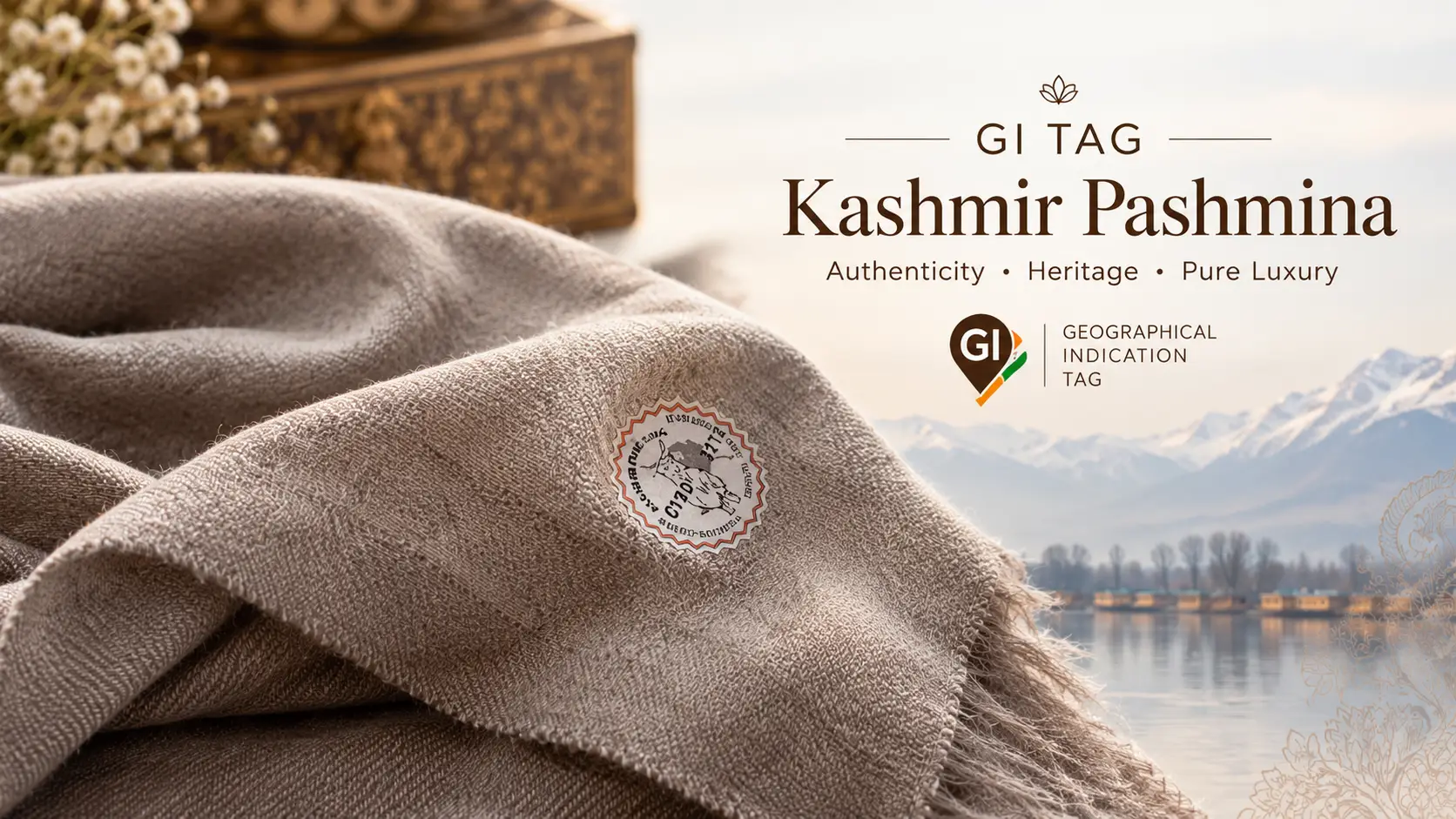
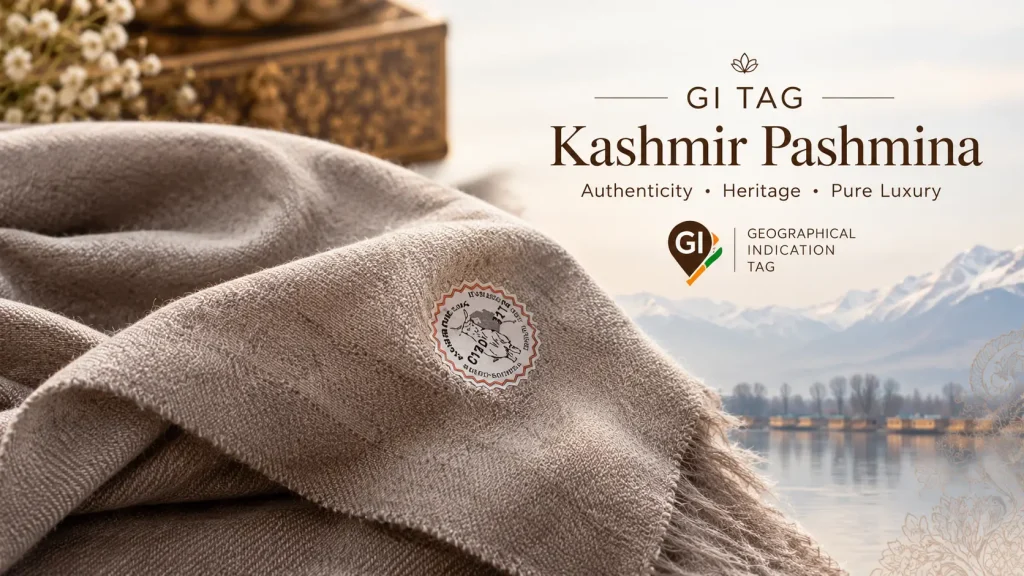
The GI (Geographical Indication) tag for Kashmir Pashmina is a legal certification issued under India’s Geographical Indications of Goods (Registration and Protection) Act, 1999. It confirms that a shawl is made from genuine Changthangi goat fibre, hand-spun and hand-woven in the Kashmir Valley using traditional techniques. For B2B buyers, the GI tag is the single most reliable way to verify authenticity, avoid blended or synthetic substitutes, and protect a private label brand from mislabeling claims in international markets.
If you import, wholesale, or private-label pashmina shawls, understanding how this certification works, and how to verify it on a supplier’s paperwork, directly affects your margins, your compliance exposure, and your brand’s credibility with end customers.
What Is the GI Tag for Kashmir Pashmina?
A Geographical Indication tag is a form of intellectual property protection tied to a specific region. It tells buyers that a product’s qualities, reputation, or characteristics are essentially linked to its place of origin. Kashmir Pashmina received its GI tag in 2008, registered by the Craft Development Institute (CDI), Srinagar, on behalf of Kashmiri weavers and artisans.
The registration legally defines Kashmir Pashmina as a product that must:
- Use fibre from the Changthangi (Capra hircus) goat, reared at altitudes above 12,000 feet in Ladakh
- Be hand-spun on a traditional charkha, not machine-spun
- Be hand-woven on a traditional handloom within the Kashmir Valley
- Meet a minimum fibre diameter of around 12-16 microns, which is what gives genuine Pashmina its characteristic softness
Any shawl marketed as “Kashmir Pashmina” without meeting these criteria is, strictly speaking, a mislabeled product, regardless of how soft or expensive it looks.
Why the GI Tag Exists: Protecting an 800-Year-Old Craft
Pashmina weaving in Kashmir traces back to the 15th century, and the industry has faced sustained pressure from cheaper machine-made imitations, often using merino wool, viscose, or wool-silk blends marketed under the Pashmina name. The GI tag was introduced specifically to:
- Legally distinguish authentic hand-woven Pashmina from machine-made lookalikes
- Give Kashmiri artisan communities a protected market position
- Provide export documentation that buyers in the US, EU, Gulf, and other markets can use to verify origin claims
For a deeper look at how the raw fibre becomes a finished shawl, see shawl manufacturing process and how weavers turn raw fleece into finished cloth.
How GI Certification Works for Kashmir Pashmina
GI status is a collective right, meaning individual manufacturers do not “own” the tag the way they would a trademark. Instead, registered users (authorized manufacturers, cooperatives, and exporters who meet the defined production standards) are permitted to use the GI logo and certification mark on their products.
In practice, this means:
- The fibre is tested at accredited labs, typically checking for micron count, and confirming it originates from Changthangi goats rather than cheaper cashmere-blend or wool sources.
- The production process is verified to confirm hand-spinning and hand-weaving took place within the designated Kashmir region.
- A GI certification mark and number is issued, which can be printed on labels, hangtags, and export documentation.
- Registered exporters are listed with the Geographical Indications Registry, and buyers can cross-check a supplier’s registration status.
This is a meaningfully different process from generic “Made in India” labeling, and it’s why GI-certified Pashmina commands a premium in wholesale pricing compared to non-certified alternatives.
How to Identify Authentic GI-Certified Pashmina
For B2B buyers evaluating suppliers, here is a practical checklist:
- Ask for the GI certification number and cross-reference it against the manufacturer’s registration, not just a generic “GI Approved” claim on packaging
- Request a burn test or micron report for the batch, since genuine Pashmina fibre burns slowly with a faint hair-like smell, unlike synthetic blends which melt
- Check the weave under magnification. Hand-woven Pashmina shows minor irregularities in the weft; machine-made shawls are unnaturally uniform
- Confirm the weight and drape. Authentic Pashmina typically falls between 70-140 GSM depending on weave density, and drapes softly rather than holding a stiff shape
- Review supplier documentation, including export invoices that reference the GI mark explicitly, not just “100% Pashmina” claims
For more detail on separating genuine product from imitations, see 8 ways to identify a real Pashmina shawl and how to spot fake Pashmina online before you buy.
Why the GI Tag Matters for B2B Buyers and Wholesalers
1. Regulatory and Customs Protection
Several importing countries, particularly in the EU and the US, have increased scrutiny on textile origin and fibre-content labeling. A GI certification number on your export documentation gives you a defensible paper trail if customs or consumer protection authorities ever question your product claims.
2. Protecting Your Private Label from Liability
If you sell shawls under your own brand and label them as “Kashmir Pashmina” without GI-backed sourcing, you carry the legal and reputational risk if the claim is challenged. Buyers running private label Pashmina programs in particular should insist on GI documentation as part of their supplier vetting, not as an optional add-on.
3. Justifying Premium Pricing to Retail Customers
Retailers and boutique buyers can use the GI certification as a genuine selling point rather than a marketing claim. “GI-certified Kashmir Pashmina” carries more credibility with end consumers than an unverifiable “authentic Pashmina” tagline, particularly for bridal and wedding shawl collections and gifting lines where provenance matters to the buyer.
4. Reducing Return and Dispute Risk
Non-GI shawls sold as genuine Pashmina are a common source of B2B disputes, particularly when end customers test the product and find it doesn’t match the softness or warmth of authentic fibre. Sourcing GI-verified stock reduces this risk at the point of sale.
5. Differentiating in a Crowded Wholesale Market
With so many suppliers offering “Pashmina-style” or “Pashmina-feel” products at lower price points, GI certification is one of the few objective differentiators a wholesale buyer can point to when comparing quotes.
GI Tag vs. Non-GI Pashmina: What’s the Real Difference for Bulk Orders
| Factor | GI-Certified Pashmina | Non-GI / Pashmina-Style |
|---|---|---|
| Fibre source | Changthangi goat, Ladakh | Often merino wool, viscose, or blended fibre |
| Production | Hand-spun, hand-woven in Kashmir | May be machine-made, anywhere |
| Documentation | GI certification number, verifiable | Generic labeling, no verifiable trail |
| Price point | Higher, reflects certified sourcing | Lower, but higher compliance risk |
| Best suited for | Premium retail, bridal, corporate gifting, export brands | Value-tier fashion accessories |
This isn’t to say non-GI stoles and scarves don’t have a place in a balanced product catalogue. Many buyers run a tiered strategy, using GI-certified Pashmina for premium SKUs while stocking wool-silk blend stoles or viscose stoles for accessible price points. The key is disclosing the difference accurately to your own customers.
How Savita Shawls Ensures GI-Compliant Sourcing
Savita Shawls works directly with Kashmiri artisan networks and maintains documentation for GI-eligible Pashmina lines, alongside a broader catalogue that includes cashmere, Kani, Jamawar, and embroidered shawls for buyers who need product variety across price tiers. You can review sourcing practices on the company profile page and about us page, or browse the current Pashmina shawls manufacturer and Kashmiri shawls manufacturer collections for wholesale-ready stock.
Frequently Asked Questions
Is every shawl labeled “Pashmina” GI-certified?
No. The word “Pashmina” is used loosely across the market, including on machine-made or blended products. Only shawls that meet the registered production and fibre standards, and carry a verifiable GI certification number, are legally entitled to the GI mark.
Can a buyer verify GI certification independently?
Yes. Registered users and GI application details are recorded with India’s Geographical Indications Registry, and buyers can request the certification number from suppliers to cross-check registration status.
Does GI certification affect wholesale pricing?
Generally yes. GI-certified Pashmina involves hand-spinning and hand-weaving, which is more labour-intensive than machine production, so it typically carries a price premium over non-certified alternatives.
Is GI-certified Pashmina the same as cashmere?
No. Pashmina refers specifically to fibre from the Changthangi goat processed through traditional Kashmiri methods. Cashmere is a broader category of fine goat-hair fibre that can originate from various regions and breeds, and is often machine-processed.
What documentation should I request from a supplier claiming GI status?
Ask for the GI certification number, any accompanying lab test or fibre report, and export invoices that reference the certification explicitly rather than relying on marketing copy alone.
Can non-GI shawls still be good quality?
Yes. Non-GI shawls, including wool, viscose, and blended stoles, can be well made and suitable for many retail and gifting price points. The distinction matters most when a buyer is marketing a product specifically as authentic Kashmir Pashmina.
Looking to place a bulk order or verify sourcing documentation before you commit? Get a wholesale quote from Savita Shawls and request GI certification details for your selected product line.