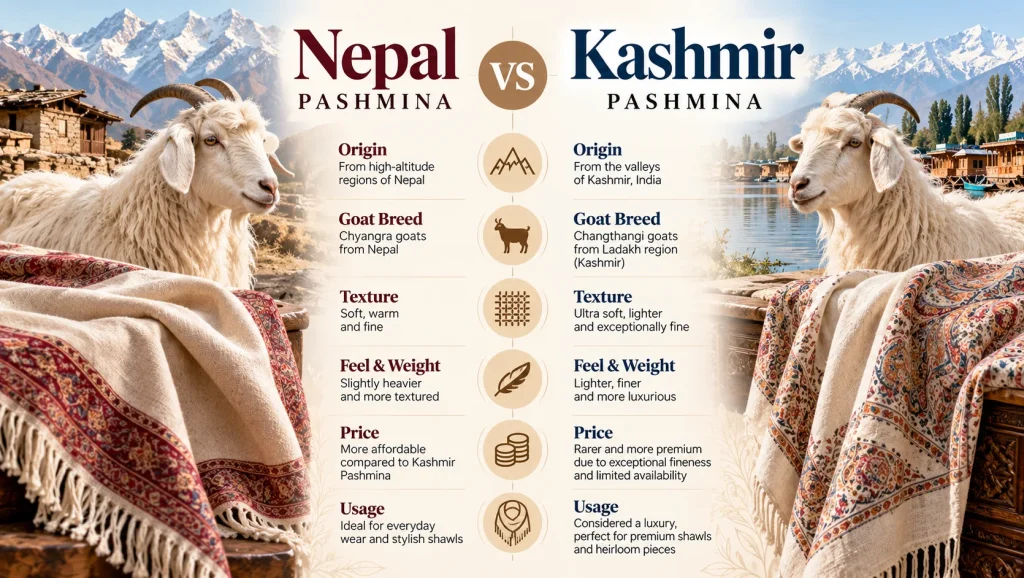
Kashmir pashmina is best known for fibre from the Changthangi goats of Ladakh, traditionally hand-spun and handwoven in the Kashmir valley, and its handmade form is protected by a Geographical Indication. Nepal pashmina is sold under the Chyangra Pashmina trademark and is known for consistent solid-colour shawls, blends and knits, but most of the raw fibre used in Nepal is imported. For importers, Kashmir suits heritage, handwoven and embroidered ranges, while Nepal suits uniform plain and knitted ranges.
Key takeaways
- Both regions produce genuine pashmina products. The differences lie in fibre origin, spinning, weaving style and certification.
- Kashmir is the home of hand-spun, handwoven pashmina and crafts such as sozni embroidery and Kani weaving.
- Nepal’s industry relies heavily on imported raw fibre, and is strong in machine-woven solids, ombre shawls and knitwear.
- Whichever source you choose, ask for fibre composition reports and confirm whether yarn is hand-spun or machine-spun.
Where does pashmina fibre come from?
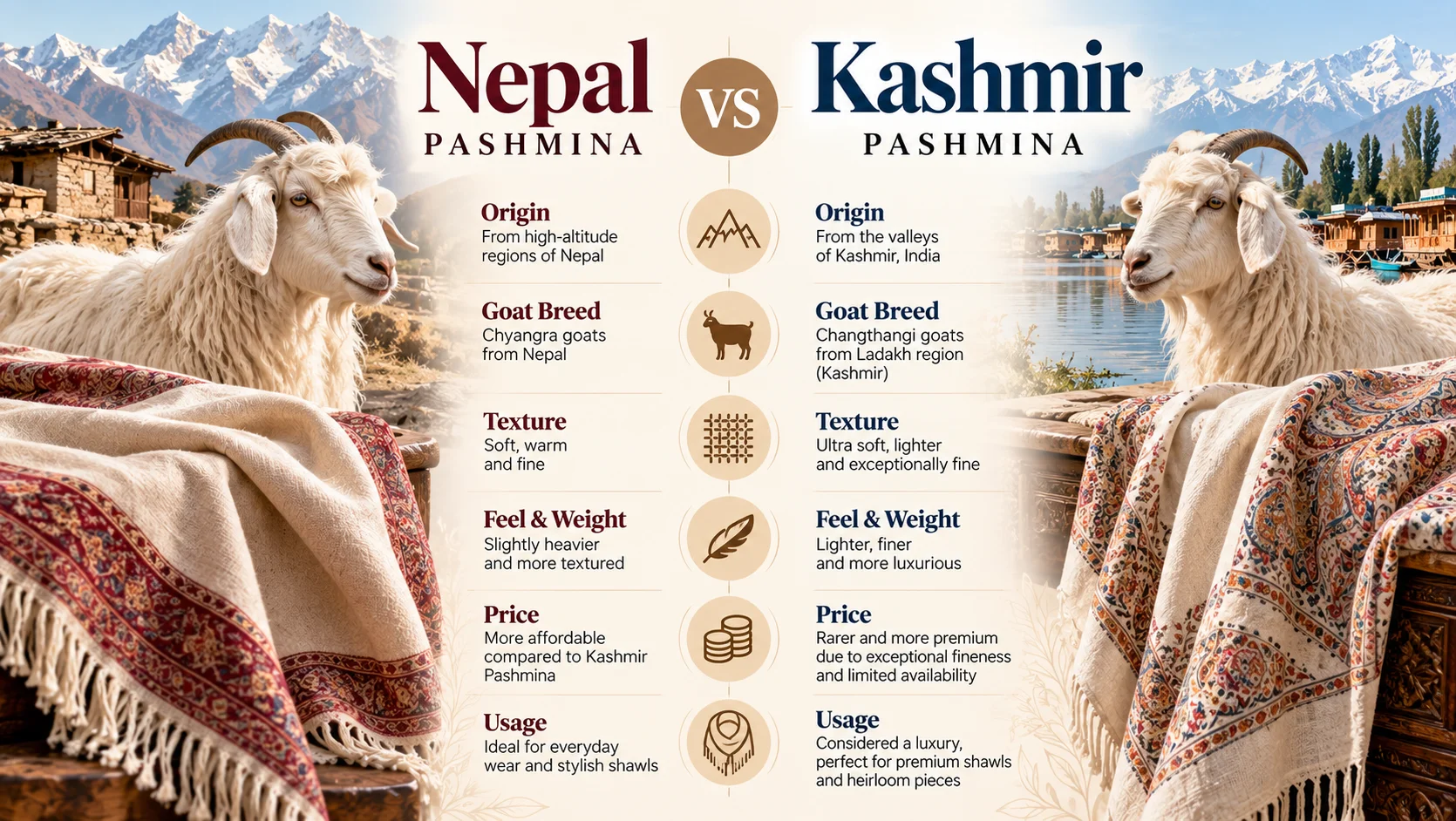
Pashmina is the fine underfleece of goats raised at high altitudes across the Himalaya and Central Asia. The cold climate makes the goats grow a dense, soft undercoat, which is combed out each spring. In India, the best known source is the Changthangi goat of the Changthang plateau in Ladakh, herded by the nomadic Changpa community. In Nepal, the local breed is the Chyangra goat of the high mountain districts.
The same type of fibre is called cashmere in most international markets. The word pashmina is used for the finest grades and for the traditional Himalayan craft. Our articles on the pashmina wool process and the journey of a pashmina shawl explain how fibre becomes a finished shawl.
What makes Kashmir pashmina distinctive?
Kashmir has woven pashmina for centuries, and its craft remains the reference point for the trade.
- Fibre: mainly from Ladakh’s Changthangi goats, typically below about 16 microns.
- Spinning: the finest pieces use yarn hand-spun on a traditional spinning wheel, which keeps the fibre soft and lofty.
- Weaving: handlooms in the Kashmir valley produce plain, diamond and twill weaves, as well as Kani shawls woven with small wooden bobbins.
- Embellishment: sozni needle embroidery, tilla metallic work and other hand techniques.
- Protection: handmade Kashmir pashmina holds a Geographical Indication registration, and the Craft Development Institute in Srinagar runs testing for pashmina products.
Read more about what makes Kashmiri pashmina so special, the GI tag for Kashmir pashmina and Kashmiri weaving techniques.
What makes Nepal pashmina distinctive?
Nepal built a strong export industry around pashmina from the 1990s, centred on the Kathmandu valley.
- Branding: Nepal promotes its products under the Chyangra Pashmina collective trademark, introduced in 2011 and approved in 47 countries by 2018, according to the Kathmandu Post.
- Fibre: the Nepal Pashmina Industries Association has said about 90 percent of the wool used is imported, because local Chyangra fibre is limited.
- Production: a mix of handlooms and powered looms, with a strong focus on solid colours, dip-dyed and ombre shawls, pashmina-silk blends and knitwear such as sweaters and wraps.
- Markets: Europe, including Germany, France, Italy and the UK, is among Nepal’s largest export markets.
Nepal vs Kashmir pashmina: side-by-side comparison
| Factor | Kashmir pashmina | Nepal pashmina |
|---|---|---|
| Main fibre source | Changthangi goats of Ladakh, plus traded fibre | Mostly imported fibre, plus local Chyangra fibre |
| Spinning | Hand-spun for heritage pieces; machine-spun also used | Mainly machine-spun |
| Weaving | Handloom tradition, Kani and fine twill weaves | Handlooms and powered looms |
| Signature products | Handwoven plain shawls, Kani, sozni and tilla embroidery | Solid and ombre shawls, pashmina-silk blends, knits |
| Branding and protection | Geographical Indication for handmade Kashmir pashmina | Chyangra Pashmina collective trademark |
| Consistency across a lot | Natural variation in handmade pieces | High consistency on machine-made pieces |
| Price position | Highest for GI handwoven and embroidered pieces | Wide range, often competitive for plain shawls |
| Best for | Heritage, bridal, luxury and craft ranges | Uniform plain ranges, knitwear and blended shawls |
Where else does pashmina-type fibre come from?
Kashmir and Nepal are the best known pashmina names, but most of the world’s fine goat fibre comes from Mongolia and Inner Mongolia, where it is usually sold as cashmere. Smaller amounts come from Afghanistan, Iran and other parts of Central Asia. Much of this fibre is traded internationally, which is why fibre origin and shawl origin are not always the same place. Our guide to the best destinations in India to buy authentic pashmina covers the Indian side.
What drives the price of each?
Price depends more on how a shawl is made than on its country of origin.
- Fibre purity and fineness. Pure, fine pashmina costs far more than blends.
- Spinning method. Hand-spun yarn takes much longer than machine-spun yarn.
- Weaving method. Handwoven shawls cost more than power-loom shawls.
- Embellishment. Hand embroidery and Kani weaving can multiply the price.
- Certification. GI-labelled Kashmir pashmina carries a premium for its verified origin.
Our comparison of handwoven vs machine-made pashmina explains the cost difference in detail, and our guide to wholesale pashmina shawls covers pricing and margins.
How should pashmina from either source be labelled?
Origin names do not replace fibre labelling. Whether a shawl comes from Kashmir or Nepal, its label must state the real fibres and percentages, such as 100% cashmere or 70% cashmere and 30% silk. In the European Union, pashmina fibre is usually declared as cashmere. Use “Kashmir pashmina” or “Chyangra Pashmina” only for products that genuinely qualify for those names.
Does sourcing choice affect sustainability?
It can. Ladakh’s Changpa herders and Kashmir’s spinners and weavers depend on pashmina for their livelihoods, so traceable Kashmir sourcing supports a traditional craft economy. In both regions, ask suppliers how fibre is sourced, how workers are paid and which chemical and labour standards they follow. Our article on sustainable pashmina shawls explains what to look for.
Which source should importers choose?
| If you need | Consider |
|---|---|
| Handwoven heritage shawls with a craft story | Kashmir |
| Kani or hand-embroidered pashmina | Kashmir |
| Bridal and luxury gifting pieces | Kashmir |
| Large runs of identical solid shawls | Nepal or machine-woven Indian supply |
| Pashmina knitwear | Nepal |
| Mixed ranges of pashmina, wool, silk and viscose in one order | A multi-fibre Indian manufacturer |
Many buyers combine sources. An Indian manufacturer that works across pashmina, cashmere, wool and blends can often cover several of these needs in one shipment. Our guide to pashmina shawl manufacturers in India explains what to look for, and our comparison of sourcing from India vs China covers the wider picture.
What should buyers check before ordering?
- Fibre composition report from a recognised lab for every new quality.
- Yarn type: hand-spun or machine-spun, in writing.
- Weave type: handloom or power loom, and the weave pattern.
- Origin claims: GI documentation for Kashmir pashmina, or the right to use the Chyangra Pashmina mark.
- Approved sample for colour, hand feel and size.
Our guide on how to identify real pashmina lists practical checks.
MOQ and ordering at Savita Shawls
Savita Shawls sources pashmina from verified suppliers in Ladakh and Kashmir and tests production batches for fibre composition.
| Term | Savita Shawls standard |
|---|---|
| MOQ | 100 pieces per design, lower on some stock styles |
| Stock styles with your label | 10 to 15 working days |
| Custom woven designs | 45 to 60 working days after sample approval |
| Samples | Delivered internationally in 7 to 10 working days |
| Documents | Material composition certificates and export documentation |
Order pashmina from Savita Shawls
Savita Shawls has manufactured shawls and stoles in Gurgaon since 1984 and exports to more than 40 countries. Explore our pashmina shawls, Kashmiri shawls and Kani shawls, ask about private label manufacturing, or request a bulk quote.
Frequently asked questions
Is Nepal pashmina the same as Kashmir pashmina?
Both are pashmina products, but they differ in fibre origin, spinning and weaving. Kashmir is known for hand-spun, handwoven and embroidered shawls, while Nepal is known for consistent machine-woven solids, blends and knitwear.
Where does Nepal’s pashmina fibre come from?
The Nepal Pashmina Industries Association has said about 90 percent of the wool used is imported, with a smaller share from Nepal’s own Chyangra goats.
What is Chyangra Pashmina?
Chyangra Pashmina is the collective trademark Nepal uses to promote its pashmina products. It was introduced in 2011 and had been approved in 47 countries by 2018.
Is Nepal pashmina cheaper than Kashmir pashmina?
Often, for plain machine-woven shawls. Handwoven and embroidered Kashmir pashmina sits at the top of the price range because of the hand spinning, weaving and craftwork involved.
Which is softer, Nepal or Kashmir pashmina?
Softness depends on fibre fineness, spinning and weaving rather than country. Fine, hand-spun Kashmir pashmina is often considered the softest, but a fine machine-spun shawl from either region can feel very soft.
Is Kashmir pashmina protected by a GI tag?
Yes. Handmade Kashmir pashmina holds a Geographical Indication registration in India, which protects the name for products made in the traditional way.
What is the minimum order for pashmina shawls?
Savita Shawls starts at 100 pieces per design, with lower quantities on some stock styles.