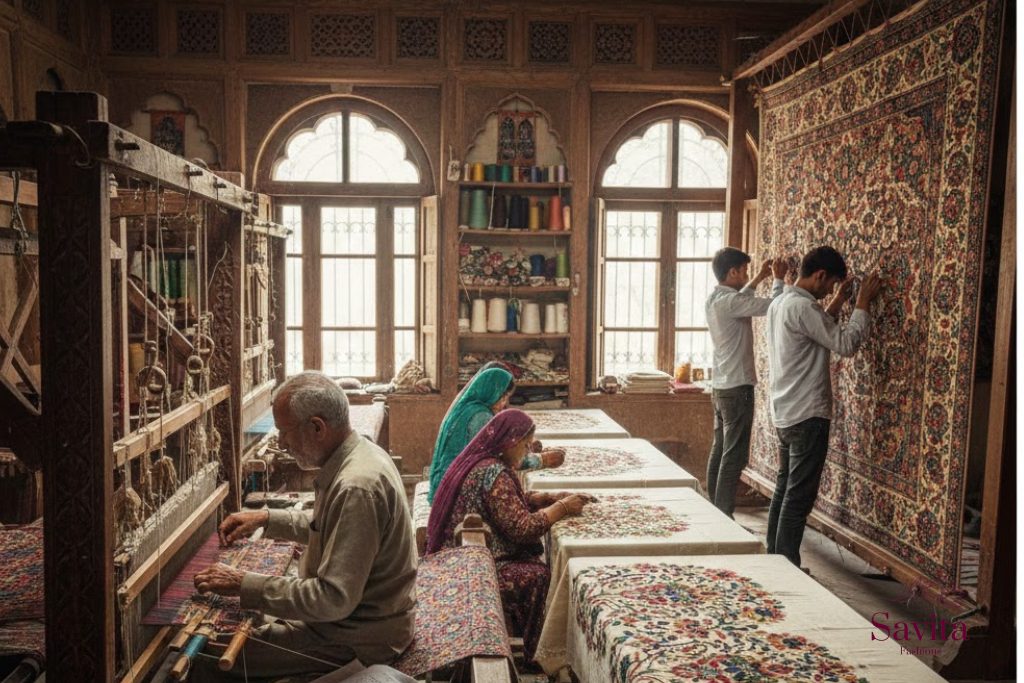
The people of Kashmir call their region “Paradise on Earth” because its stunning natural beauty and its unique textile heritage have brought international recognition to the area for many years. The handloom weaving art serves as the foundation of this traditional practice because it has been transmitted through time to maintain cultural heritage and artistic skills which define the region. The Kashmiri weaving techniques represent more than just a method of fabric production; they embody centuries of innovation, cultural exchange, and unwavering dedication to craftsmanship that continues to define Kashmir’s position in the global textile landscape.
Understanding the Historical Significance of Kashmiri Weaving Techniques
The history of Kashmiri weaving techniques stretches back over 2,500 years because evidence shows that traditional weaving practices already existed during the ancient Silk Road era. The historic trade route through Kashmir enabled both commercial activities and the sharing of artistic designs and weaving techniques between different cultures. The indigenous practices of Kashmir developed into exceptional traditional Kashmiri textiles which spread throughout different continents because Persian and Central Asian and Indian influences combined with local customs.
The 16th century brought a peak of artistic development to Kashmiri weaving techniques which lasted until the Mughal period ended because Emperor Akbar supported this craft. The Mughal emperors who loved fine arts and luxury textiles brought master weavers from Persia and Central Asia to Kashmir which created a space for traditional weaving methods to develop and advance. The period brought about the complete development of Pashmina weaving and advanced brocade production and transformed Kashmir into the main textile manufacturing hub of the Indian subcontinent.
The historical events from the past continue to shape modern Kashmiri weaving practices because contemporary artisans use traditional techniques while they adjust their work to meet current market needs. The traditional Kashmiri textiles produced today carry forward this rich heritage making each piece a living testament to centuries of accumulated knowledge and artistic mastery.
The Foundation of Traditional Weaving: Raw Materials and Their Preparation
In traditional Kashmiri weaving ancient techniques are employed and hence the raw materials selected and processed where each stage out of these represents an art by itself contributes towards the high commendation of Kashmiri weaving. This is because in the altitudes of Kashmir and in the cycles of the weather that they experience unique fibers are produced that every local weaver uses and creates the softest, the warmest, the most strong textiles that any other available in the market. Pashmina – a gem in the treasury of Kashmiri weaving On the other hand, Pashmina wool, manufactured only from Changthangi Goats found at very high altitudes of greater than 14000 feet in Ladakh, constitutes the best weaving materials in Kashmiri weaving techniques.
Such extreme low temperatures can reach up to -40 degrees Celsius in those regions forces these animals to produce layer of woolen fleece of about 12-16 microns thick and weighs only several grams. Pashmina for instance is credited among the finest natural fibers available, having a very small diameter in comparison to that of ordinary sheep wool. As an important step, Pashmina harvesting is the sort of raw material that the traditional weavers employ on most occasions before setting their hands to work. During the spring molting season instead of shearing these goats, combing techniques offer a more convenient outreach since the animals do not endure heavy stress and this is the season where the soft undercoat is at optimal use for goats.
The artisan is very experienced and has to locate the tiny particles of the undercoat and remove the sticky layers of guard silky hairs that come off when the goat is subjected to combing and this scraper technique evolved over many years of experience. Silk with Other Natural Fibers Used in Creation of Kashmiri Materials and Yet Another Influence on the Art of Kashmiri Textiles Kashmiri weaving techniques must also be used.
There are numerous applications found for the Kashmiri weaving techniques and that include silk which is often used by weavers to make the famous Jamawar and brocade designs. Traditionally, silk which forms fabric in Kashmir is obtained from China and Bengal, although agriculture of silkworms is not unknown in Kashmir.
Traditionally, the silk used is initially soaked or degummed which entails the boiling of raw silk cocoons. Next, you can create schematics to show how threads should be reeled, twisted and sometimes dyed with reference to the weaving project. Kashmiri weaving techniques can make use of cotton which forms the base threads of the shawls and other fabrics used in the arts.
The cotton used is prepared extensively through several processes including cleaning and carding to create a yarn suitable for weaving as the structural core for the pashmina or silk wefts. They also epitomize the mastery of textile engineering with their usage of mixed materials.
The Dyeing Process: Creating the Vibrant Palette of Traditional Kashmiri Textiles
Natural and synthetic coloring methods are used in Kashmiri weaving techniques to create vivid designs; this is one of its most attractive features. Dyeing is a separate skill in its own right that is practiced by few within the traditional weaving occupations and a dyer is more respected in the caste system of artisans. Natural Dyeing Processes for Weaving For preparing threads for traditional weaves , natural dyeing processes start with certain materials.
In the case of indigo dyeing, this is achieved by making a fermenting vat and multiple dipping before the shades become very dark. Different concentrations of the dye bath and use of different mordant will give soft pinks to very dark reds from the madder root. Madder dye has been an integral part of Kashmiri weaving for the last thousand years or so. The walnut husks provide shades varying from dark brown to tan colors, looking at most of the walnut orchards in this region of Kashmir.
While the walnut husks attain rich and rustic colors, they also help in binding these dye tones as natural tannins also act as a mordant. In Kashmir, The most appreciated plant for coloring fibers is the saffron crocus that gives yellow or orange pigments. Dyeing with saffron is the most luxurious method that is applied in conventional Kashmiri textile production.
With the aid of iron mordants especially for the traditional weaves, the yellow dyes obtained from the pomegranate peels turn into black and gray shades. Kashmiri weaving techniques make use of bright and bright orange colored dyes that as well imagine warmth. Precise control over the elements of temperature, and the levels of pH, and time is a significant part for traditional Kashmiri textile dyeing.
The fibers are subjected to pretreatment with the use of ounces of alum improvement that are employed in different forms of metallic salts – alum and iron and copper and tin – to help set dyes in the fibers. Different types of mordant help the dyer attain different tints of a simple dye, which otherwise enables the dyers to use the natural output for a very vast spectrum of shades.
The high precision of Kashmiri weaving techniques comes on the basis of this chemical knowledge, which people gained through practice for several years.
Developments In The Dyeing Process While Outlining The Basic Values Of Weaving. Although, the handmade products from Kashmiri continue to rely on natural coloring, processed products from Kashmiri are made today using artificial colors that are more stable and have more color options. The methods developed by dyers have allowed them to change the traditional way of weaving without changing the materials used and the richness of colors associated with the Kashmir fabrics.
Present day weavers who have mastered Kashmiri weaving techniques incorporate the use of base colors from natural dyes and addition of synthetic colors to achieve desired specific colors. Discreet harmonic approach ensures the economic survival of the traditional Kashmiri cloth whilst protected and held in high regard as one of their culture heritage.
The Handloom: The Sacred Tool of Kashmiri Weaving Techniques
At the central hub of Kashmiri weaving techniques lies a warp, an innocuous-looking machine which possibly constructs spectacular traditional Kashmiri textiles. The traditional textile weaving process heavily relies on handlooms due to static operational need as weavers unable to run machines for making any type of fabric sculpt every textile according to their own design on their hands. Concept Of Traditional Weaving There exists few handloom machines utilized in Kashmiri weaving techniques that have intensive mechanisms as opposed to others due to the fact that different weaves must be employed for different textiles; however there is a fundamental structure that is common amongst all the machines that has not evolved with time. These elements enable the scholars of the region to appreciate the weaving techniques of the past that are baffling in their execution and design.
The main parts are as follows: The Warp Beam: This is most basically a round bar to which the warp (the short ends) strings are attached. For the authentic weaving practice of the Kashmir, the workers have to wrap the warp strings precisely on this beam in order to ensure that the fabric is of equal widths. Precise and consistent advancement of yarn is one of the hindrances to Kashmiri weaving techniques otherwise very useful set-up. The Cloth Beam: As one weaves and rolls the finished fabric, this component extends on the opposite side of the warp beam.
The material roll on the cloth beam enables the weaver to enlarge the working area by creating new warp yarn while rolling the finished fabric up. In traditional Kashmiri textile weaving, the weaver must learn how to keep the weaving surface under controlled tension. This is something accomplished by making good judgment in different situations. Heddles and Shafts are two components that assist in raising selected warp threads up or down to form gaps, known as sheds, through which the weft thread passes through.
The application of elementary weaving designs calls for the operation of the mechanism through two shafts, whereas Kashmiri weaving techniques in brocades necessitate the use of eight or more shafts for a purposeful operation of any selected warp threads in the creation of intricate designs. The reed or the beater: This is an important accessory in the traditional weaving that has the shape of a stick with teeth at one side, for it serves two main purposes.
First, it keeps the warp threads on parallel lines within the width of the fabric. The structure of a high quality traditional Kashmiri textile is as a result of utilizing the reed in whereby every after how many wefts the new one is beaten down upon the fabric that has already been woven tightly and evenly. The different Kashmiri weaving techniques and processes for weaving units of large dimensions such as shawls involve skills in operating machines connected to the tools sciences, i.e., foot pedals which are attached to the looms with the suspended threads. Certain tensioned threads in the overall preparation process of the fabric weave a fabric that would need certain tensioned threads to be lifted was not possible in the given scene without such a mechanic and lo and behold ‘the treadle’ was born.
As they practice it constantly, they sharpen their ability to perform work at an operating speed of a job cycle with greater precision and without errors. Different types of looms are used in various Kashmiri weaving techniques and processes Distinct kinds of conventional Kashmiri textiles ought to be produced using specific types of looms which have been in use for several centuries and for a certain type of material. The different variety of loom types used in Kashmiri weaving techniques is a testimony to the extraordinary diversity of the textiles that are handmade in this region.
The Pashmina Shawl Loom: This is the main equipment used in producing Pashmina shawls unlike other looms because this loom requires two people to use. As Pashmina is one of the very fine materials in the weaving field, it calls for some of such methods since it is commonly woven in its traditional form. Fabricated with adjustable angles, looms are utilized in the set up of cotton textile equipment, as pure Pashmina does not work as a warp in Kashmiri weaving techniques which consist of forming pure Pashmina threads. Pashmina is used as a weft that covers the cotton warp and this softness is enhanced by the border and base of the shawls, their warmness is the traditional requirement for shawls from the region of Khan.
Jamawar Loom: This loom allows one to obtain out of weaving various intricate traditional Kashmiri designs on stuff. Rather than patterning the fabric with stitches, shawls of the Jamawar type have designs carefully woven in the cloth’s weft in a manner similar to the tapestry weaving of Europe and Persia. The Jamawar loom can accommodate scores of different colored threads, placed on tiny bobbins in each color.
These threads are used by the weavers by weaving them into wondrous patterns that displays the best of the Kashmiri weaving techniques. One single richly decorated Jamawar shawl may take from six months up to a year to make by artisans without taking their hands away from work, making such fabrics some of the hardest traditional weaving products in regard to labor. Brocade looms for silk are adapted with metallic yarn for making the traditional Kashmiri textiles.
With the help of looms it becomes possible to insert additional weft threads, which form the stick on design without disturbing the underside weave. With respect to brocades, the Kashmiri weaving techniques are highly complex inasmuch as they require a very strategic manipulation of the many sets of warp and weft, and such may also need the weaver to exercise her viewpoint or judgment in every minute detail in some of the motifs.
Core Kashmiri Weaving Techniques: The Master Skills of Traditional Weaving
The intricate art of Kashmiri weaving demands that craftspeople learn an assortment of specialized techniques in order to fabricate authentic traditional Kashmir textiles. The development of these methods has endured for centuries as generations of master weavers dedicated their whole lives to mastering this craft. Of all Kashmiri weaving techniques, one cannot avoid the basic plain weave, the so-called tabby weave. It simply entails that each weft thread alternately passes over one warp thread and then under the next. Traditional techniques of weaving are to be found only in few highly skilled artisans where what counts is the perfection of performance.
Tall the warp and weft threads are to be subjected to mean constant tension if one desires in a plain weaving design done in genuine traditional Kashmir fashion. The slightest change in tension leads to irregular patterns in the cloth resulting in a few either loose or tightly stitched parts which rob not only the aesthetic appeal but also the sheer strength of the cloth itself. In the traditional practice of weaving, master weavers need to develop fine sensitivity to strain while they use tactile sensation to distinguish tension changes and make minute modifications during the progress of weaving.
Plain weave provides the basic ground in all traditional Kashmiri textiles, serving as the premise for Pashmina shawls and rather plain cotton cloths, and the standard plain weave structure exposing a dignified field of decorative manipulation. Though painting nepers onto turquoise points may appear to be easy work, only years of practice will bring the serious novice to this examination of Kashmir carpets. Twill weave is a more complex structure which is one of the several structures used in various techniques of Kashmir weaving to make Kashmir fabrics recognizable by the distinctive diagonal lines formed at the fabric’s surface.
The weft threads break through two or more threads from the warp before diving under one or more, with each new thread staggered to correspond to the previous one. Twill and structure are easily distinguished from each other by the basic diagnostic step: the number of threads in the diagonal not coming out onto the surface. Therefore, the strength, as well as the draping, have to act at the periphery of the transfer for different production mechanisms called combination coverings. When a combination of minimum pile and heavy pile is confronted during the separation over cover is directed precisely above or in-line with another variable, that essentially is balanced to swirl in excess of warp.
Kamlet and Taft (1980) and Kamlet (1962) have taken shawls and thrown them into Italian and English to test aesthetics. With the observation that the shine will enhance the balance of shine within the yarn, she says that the shawl glows with less shine as well as texture and feeling. In the way of weaving, flat-twisted yarn of jute, which has low strength and yet is full of luster, is interestingly spirally wound as wrapped boundary yarn. Applications of fibers (polyester) from wear-resistant fabric plus more control of fabric smoothing; the knitted interlace (twin needles together or else two of them in parallel) and subsequently the basic raion together in the drape of hence the amazing patterns are constructed to present these extreme veneers starkly devised whilst weak tensioned.
In the Kashmiri style of weaving, especially in twill weaves, various patterns are woven. Regular Twill: An equal number of warp threads go over and under, creating a balanced diagonal pattern. This is a feature in much Kashmiri traditional fabric where both weight and durability are kept in mind. The Broken Twill imparts diagonal lines that change their orientation either way in zigzag and herringbone patterns. The variety in weaving keeps the fabric interesting and adds more texture to any twill structure.
In a steep twill, it so happens that more warp threads need to cross than usual twill, creating diagonal lines with greater intensity and a steeper angle. The traditional Kashmiri textile designs which are accurate of fabric construction produce powerful visual effects, while the satin weave illustrates the most refined Kashmiri weaving, giving us a smooth finish on the traditional Kashmiri textile. In the case of the satin weave, the weft threads would have to float above four or more warp threads before moving under one warp thread. The absence of diagonal lines in the fabric surface results from points of intersection in the fabric being arranged so that long, free-thread lengths can reflect light.
Making this satin weave in traditional Kashmir fabrics takes quite a bit of precision and finesse in its time-honored weaving language. One has to take a hold of a perfectly adjusted loom of sensible tension toward the end of the yarn’s stream so that firing of ground beats wefts at utmost commitment to make a stable and abutted mass. The cloth will have defects in the weave if the weavers apply too much tension when using extreme force during the production process. In the tensioned yarn, this will result in a gathering in the fabric while low tension will make the fabric wavy. Silk is important for the figuration of the Satin weave method- it is wanted for Satin weave as it enhances the natural shine of silk fibers, being able to reflect light.
Extremely fine silk threads are used in the most exquisite satin-weave traditional Kashmiri textiles in order to produce a fabric outcome whose smoothness equals the highest level of master weaver craftsmanship. Tapestry weaving seems to be one of the most demanding weaving methods utilized by artists from Kashmir for the production of traditional Kashmiri textiles with detailed pictorial and geometric plain/checked designs, which they weave directly into the fabric of the tapestry.
Tapestry weaving creates textiles using a series of sets of colored weft threads interweaving the warp. On the other hand, embroidery adds decorative elements on an existing fabric structure. The weaver takes control of the traditional weaving process by tying up several small bobbins (also known as butterflies) which contain yarn of various colors. Instead of one weft thread working all the way across the fabric, the weaver uses a colored thread to fill in the exact segment of the design. The color of the ridges of the different threads hold the different colors together when they interlock with their respective adjacent colors in various ways.
Specialized Decorative Techniques in Traditional Kashmiri Textiles
In Kashmiri textiles, the basic weaving motifs provide the origin of working styles, which further individualize the items with decorative techniques to give those products some extra embellishment. The integrated traditional Kashmiri weaving techniques, which are part of the traditional weaving process of Kashmir, represent an entire weaving system through which this weaving system executes the fundamental weaving process, as does the additional textile production.
The Kashmiri integration with the kalamkari technique Kalamkari stands as a hand-painting and block-printing tradition which enhances the interpretation of unique Kashmiri textiles through the combined weaving methods. It follows the using of the Kashmiri weaving techniques and the basic woven fabric, which this time is treated with kalamikari designs sourced from natural dyes through hand-drawing and block-printing techniques. In this regard, it is but required that we carefully plan the possible integration of designed kalam piece to naturally fall in harmony with the basic woven fabric.
Well-refined examples of this kind can be found in the traditional textiles of Kashmir, where woven borders and field design have been thoughtfully incorporated to make way for kalamkari adorning-a symbiosis of both weavers’ and painters’ art. A perfect integration of the weaving world and painting milieu showed that traditional weaving, moving toward modern art, could still nurture and retain the appeal of its fundamentals and heritage. The continuity of using various techniques of new mixes directed by contemporary artisans, gives blossoming identity to traditional Kashmir proficient textile. Zari Work: Insertion of Metal Threads in Weaving Zari is a weaving method with artisans weaving gold or silver threads into the natural fabrics native to Kashmir. As a result, such fabrics as this have a rich, metallic shine.
Through the Mughal era, Kashmiri weaving methods were already in existence for zari. During these times, it was the imperial support that necessitated rich weaving for the make or perhaps used case; this consisted of solid gold and silver thread used in the needlework/traditional zari, the metallic wire wrapped around a corner thread of silk or cotton. Originally practiced with actual gold or silver materials, Kashmiri textiles combined beauty with material value-making their very popularity. In modern times, zari typically comprises copper or brass wires covered with a fine layer of gold or silver, making this technique affordable for the poor and, at the same time, creating a visual impact.
Kashmiri weaving techniques that utilize zari require special treatment because the synthetic threads manifest entirely different movement patterns compared with normal fabric threads. One particular consideration is that the unyielding metallic threads do not possess any stretching or compressional properties as do standard fibers from wool or silk. In all this hard work, we see the accomplishments of traditional weavers with zari at their peak, who are endowed to working with these materials to develop sophisticated skills, and some may reach the finery stage after spending years practicing and perfecting their craft.
Kashmir textile exhibits some of the most astonishing zari work designs that may range from simple border stripes to complex designs of textile motifs. The most trickiest zari work involves giving life to whole picture setups or complex geometrical designs by utilizing metallic threads only-that is the acme and most arduous of the Kashmir weaving system which tests the aesthetic capacity of the weaver. Kinnauri Weaving Technique on Kashmiri Weaving Technique The Kinnauri started in Himachal Pradesh but they have developed peculiar textile characters which have moved into traditional Kashmiri weaving, shifting the nature of the weaving technique itself as the art of Kashmir weaving.
The design of the Kinnauri weave is ripe with geometric shapes with bright contrasting shades and characteristics which Kashmiri weavers have absorbed in designs of the Kinnauri weave, keeping their traditional Kashmiri weave. Interpenetration would indicate Kashmiri-weaving traditions to have always been moldable round outside influences and at the same time preserved their discrete identity. Siphoning designs from the neighborhood offers weavers new avenues of creativity, merging them with the must-preserves of genuine Kashmiri textile techniques as well as its quality standards.
The Kani Shawl: Pinnacle of Kashmiri Weaving Techniques
In the 3rd century AD Mandie Christians of Persia came to Kashmir and brought with them the art of weaving Pashmina. The Pashmina from Kashmir earned notable praise for softness and warmth. Raja Jai Singh of Jaipur once remarked, “Till we brought your Pashmina goods to be processed, they have been calls garages in transparent daylight.” The use of standout traditional textile weaving techniques in the context of Kashmiri weaving gave birth to Kani shawl production.
The Kani method constitutes the highest skill level of all its kind throughout the world. The woven pattern begins with a written adenotated design (called talim) which instructs the weaver on color and design use. The talim is like the musical score that dictates each piece of colored Kani that the weaver must use in each step and for every design in his hands, row after row, until the fabric is completed. Typically, a Kani shawl is woven from 50 to 100 different-colored strands placed on wooden calf kani.
Weavers employ these kanis to create intricate and well-knit checks by maneuvering the colored strands through the warp into a particular and fixed design area. A shuttle moves across the loom’s full length when shuttle-weaving but the kani is moved only a short length of warp and then brought back to work a little bit in every part of the pattern.
The Kani technique, an old technique of Kashmiri textile method, makes the garments contain a fine woven design, where weaver has to blend numerous colors within one inch to the yarn and bring kani from hundreds of looms, feed through correct warp section, keeping everything at right tension while beating. While preparing a single inch of fabric, the weaver has to perform this operation a couple of thousands of times; in the course of days or months, being an involved process, the final and resulting dhurwaz trophy of plain sand color with box panels at waist–for actual measurements.
Design Elements in Traditional Shahatnu Traditional Kashmiri Textiles Well in the so-called shawl, particular traditional designs were woven with Kashmiri weaving skills together: Mughal aesthetics and motifs, such as the Paisley (Boteh): A distinctive curved teardrop shape that develops its kinship with traditional Kashmiri textiles. The following weaving works of art present paisley designs of small scattered patterns to giant intricate designs cladding the complete shawl area. On Kani shawls that are best, the paisley patterns are too fine to be seen without the use of a magnifying glass.
They give an insight into their full design complexity. The cypress tree symbolizes strength and the representation of eternal life that regularly emerges in traditional Kashmiri textiles. Weaving techniques practiced by the Kashmiris to render depictions of cypress trees bear testimony to the ability of the weaver to produce realistic natural forms within geometric constraints imposed by the weaving structure.
Design Elements of a botanical nature include separate motifs of roses, lotus flowers, and irises alongside other flora, either as stand-alone designs themselves or within a more comprehensive form of the artwork. Weavers have to work within the constraint of a straight-line pattern on a loom, which is a challenge for design. For all the realistic effect, the flower design on a warp and weft is straight lines. In Kashmir, the Chinār leaf, Oriental plane tree, performs a very significant cultural role, working as a popular approach in traditional woven fabrics of Kashmir. The chinār leaf with its palmate design would seem very characteristic and easy to relate to Kashmir’s beautiful outdoors.
In traditional Kashmiri weaving, forms of spatial organization inspired from Mughal architecture, with arches and minarets, are also used in addition to decorative borders. The production of kani shawls with the help of Kashmiri woodworking produces a very complex relationship of specialization between the different types of artisans; each has to be involved in a particular skill which can contribute to the final esteemed category of tradition hand textiles of Kashmir. Advanced in practice, tradition etched a vehicle for what were known as traditional methods of weaving techniques.
The nexus embarks on a case of having specialized trades in collaboration. The work of the designer (naqqashi) begins when he prepares the actual pattern for a carpet. The naqqashi stands as the head because he must design a pattern which shall stretch to the limits of the weaver’s capacities while being actually manufacturable. The best naqqashis with enriched traditional Kashmiri textiles specific skills usually maintain a wonderful blend of artistic ambition and practicality. The talim-guru then translates designs to sketch out (to put in codes) which the weaver can use for the actual weaving. The system of coding is a grand machine of information technology progressed particularly for the art and science of weaving or traditional handloom technology of Kashmir that consolidates the scientific method of transmitting accurate visual data over periods of varying sizes and from far-off locations.
The master talim-guru must harmonize, almost subconsciously combing through the design and then forming a memory of it not so much as for its aesthetics but simply its action-ability and color theory and the resultant appearance by linking the different growing colors, the effect of weaves on the infusion of detail, and how the finished fabric will hang and show its design. Weaving generally is a practice whereby two weavers handle the loom from separate sides up or down. This collaborative way of weaving maintains the consistency and the effectiveness necessitated for growing success in managing hundreds of kanies necessary for the complexities of a design.
The two weavers must learn to understand each other’s actions because these two bodies behave in a series of long and meaningful movements that are softly synchronized with itself: this is the blending harmony of the cumulative effects by the two in weaving a certain rhythm that is randomness.
Regional Variations in Kashmiri Weaving Techniques
The production of Kani shawls through Kashmiri weaving techniques involved a network of specialized artisans, each with a specific role – the basic foundational steps in the making of traditional Kashmiri textiles. The traditional craft economy of Kashmir showcases its highly evolved state through a collaborative system of work that calls for specialized skilling. The designer (naqqash) would first draw the original pattern.
Naqqash, therefore, needs to be aware of all aspects of traditional weaving to produce patterns that are challenging but still can be produced. The Kashmir idiom of the traditional loom painter has always sought to balance the conflicting aims of artistic ambition and utility. Once the sketch is ready, the talim-guru converts this drawing into pure talim (citations on warp and weft), which allows the weaver to weave the carpet according to the coded design.
In fact, the coded system of the design was such innovative information technology instituted especially for Kashmiri weaving that the coded information could be downloaded perfectly, with elegant precision, over extended periods in multiple locations. It is required for the master talim-guru to “read” the pattern and foresee exactly how it would look when woven with different colors, how the weave structure will meddle with the appearance of fine details, and how the fabric is going to drape and display the design pattern. The actual weaving happens when working in twos on the loom from different positions.
This collaborative approach makes it easier to handle the hundreds of kanis involved with a complex pattern. The weavers themselves almost know each other’s movements with much telepathic coordination, their movements synchronized from years of working together, creating a rhythmic dance performance as much as for production. Two other weaving traditions also continue in rural areas and provide a glimpse of the life of the weavers still practising one-step weaving techniques.
The people in rural Kashmir upheld their weaving style, which contrasted with the urban ways through relatively distinctive technical requirements and exclusive value. It is the rural weaving techniques of Kashmir which furnish his textiles with practical designs resolving every need and with an aesthetic touch. Rural traditional weaving characteristics include: Fewer materials are imported, drawing on the local rather than imported ones which is highlighted in local wool types that are used for weaving. They are substituted in many instances with or used along with Pashmina. The weavers have made designs for traditional costumes and simple items with rapid execution.
In so doing, the design team has delivered what was needed, such as their role to protect the wearer during severe mountain weather. The designers created products that kept their olden days traditional techniques intact, forsaken by prevailing urban society. The designers created products that harmonize tribal and folk design elements with traditional classical patterns. The traditional Kashmiri textiles in the rural areas display how the Kashmiri weaving techniques have undergone transition through time since they continue to hold to practices belonging to earlier times which later changed into different styles that spread in the cities.
Influences from across borders in traditional weaving The people of rural Kashmir have preserved their traditional techniques of weaving past the city-production methods nurturing particular skill requirements and construction value. The weaving in rural Kashmir gives rise to practical designs suiting everyday needs whilst carrying huge aesthetic values through some of the finest specimens of Kashmiri textiles. The said traditional weaving was illustrated in point thus: Textile weaving heavily relies on materials from local resources like local wool types and facilitating only-partly-indigenous Pashmina for weaving.
Simple designs that could be easily finished were born at the hands of artists whose contemporaries were urban in their products and people arguing about nature. Usability of design maintained by designers creates products that serve to protect their users against mountain weather conditions, as was their intent. Elsewhere, designers maintained the terms that contemporary urban centers had given up. Urban centers long ago forsaking all homebound agencies, people chose to be design-conscious. Every single pattern that was finally met by the artists was a tribal-inspired pattern.
Contemporary Practice of Kashmiri Weaving Techniques
Kashmiri weaving traditions confronted with 21st-century challenges and opportunities by virtue of which much traditional weaving knowledge remains hosier artisans on one side while arsenical demands for contemporary material resources go into effect on the other. The traditional process is only qualified when applied continuously to but under the auspices of future development. Exploitation of Traditional Weaving Skills With the singular objective of maintaining these ancient weaving techniques, many organizations have developed craft sector programs because these handcraft techniques provide the unique cultural heritage numeration.
The three classes of organizations that run craft sector programs include government agencies, non-government organizations (NGOs), and social enterprises that undertake programs like: Recording traditional weaving methods through the creation of videos and extensive written descriptions to ensure knowledge is not lost Setting up teaching programs with the master weavers guiding younger weavers on the ways of traditional weaving from the principles to the practice of the art Helping in the market linkages that support the wages of traditional Kashmiri textile suppliers Developing certification systems to transport the authentic handmade product and combat cheap machine-made textile Create avenues of financial support to maintain the traditional looms and equipment for traditional weaving.
It is in the consideration of preservation that Indian weaving techniques must be economically viable for the artisans for their existence. The most successful and effective programs result from a dual approach of conserving skills and developing market research to connect Kashmir’s textile heritage to like-minded consumers willing to pay full value for their craftsmanship. Innovation in Traditional Frameworks of Weaving The most enthusiastic practitioners of the Kashmiri weaving skill hold to traditional methods in their work. In utilizing traditional skills, an inventive path contributes to maintaining traditions over forms that are subsequently made into new market products to be carried ahead into the future.
Since Kashmiri weaving has been transformed in the last decades, one could say the rather ancient shawl stayed in the traditional system while new markets introduced modern form such as scarves, stoles, wall hangings, upholstery fabrics-and anything else one can think of which are woven in the same traditional manner. The new product styles of the traditional Kashmiri textiles lead to new market opportunities but with diverse applications thus inaugurating new economic resources indispensable for sustaining the old craft. For instance, some weavers team up with cutting-edge designers who know how to work within the textbook patterns of Kashmiri weaves meanwhile interpreting the contemporary styles.
Such designs use real traditional weaving techniques to form fresh compositions by twisting original design formulas and trying out unconventional color schemes. The emerging market demand for ethically and environmentally acceptable goods rekindles further market opportunities for traditional Kashmiri textiles; consumers are showing a preference for such products today. The sustainable effects of hand-loomed traditional weaving captivate the conscious consumer because it uses natural fibers with low energy and traditional skills, thus having a great potential for the creation of premium market segments for the traditional knitting traditions.
Weavers of today use technology to document their work because they want to show how they are doing it on social media, selling the product online on online shopping websites, thus presenting the age-old techniques of weaving performed in Kashmir to the digital age, making the beautiful Kashmiri textiles available to people beyond their usual geographical limitations. The Situation: In today’s society, conservation efforts and Kashmir weaving techniques will have to go through some major setbacks. The respondent’s understanding of these difficulties regarding the future of traditional weaving could prove a deal-saver for traditional weavers.
A major difficulty originating from the demand for traditional Kashmiri textiles is that they require highly skilled craftsmanship from the artisans, thus these are worthless since artisans are prevented-though-regrettably-from earning a decent wage. For a Kani shawl taking 6 months to be completed, the price is proportionate to their job rates for their construction hours: let alone the industrious artisans earn little as compared to today’s wages. Financial factor is the reason out of which young potential weavers are not interested in Kashmiri weaving because they can earn much less by the much relaxed working. Industrial jacquard looms-a state-of-art technology-are being utilised for machine fabrication of fake versions of traditional Kashmiri textiles, which cost comparatively much less than the original handwoven items. While some well-educated buyers could observe the difference between the machine and hand productions, a vast number of consumers are ignorant of the same.
This harsh competition of imitations has created an adverse effect on the valorization of real handwoven textiles, thereby limiting the existence of business for natural craftsmen. When master weavers are retired or die, it is dangerous to lose special Kashmiri weaving skills that include the most intricate and least-used techniques. It is interesting that the transfer of traditional weaving art-form takes a long period of intimate apprenticeship, with very few young people ready or able to take up the responsibility. Political reasons in Kashmir will create hindrances every once in a while to affect the production and marketing of the traditional textiles. Such a scenario only adds to the economic instability for these artisans, as their practice requires regular access to the market.
Pashmina is a fine type of goat wool, which depends largely upon the Himalayan environment for legitimizing its quality of life. Climate change is bound to alter the conditions of the high-altitude regions and hence cause an unwanted impact on the survival of the goat population. Thus, it is of paramount necessity that solutions be researched to address these environmental challenges while keeping in view the retention of the original identity of traditional textiles from Kashmir.
The Global Impact and Recognition of Kashmiri Weaving Techniques
The influence of the weaving techniques of Kashmir has transcended the valley of Kashmir itself and has shaped worldwide textile arts and fashion over the centuries. With an understanding of the global influence at work, one gains a sense of how important the art of Kashmiri textiles stands in the world cultural heritage. Historical Global Trade of Traditional Kashmiri Textiles From the 16th century to the present, traditional textiles from Kashmir, especially Pashmina shawls, became superior luxury goods in markets extending from Europe to East Asia. The best examples of traditional weaves of Kashmir fetched exorbitant prices by becoming the symbols of wealth and taste.
The European elite in 18th and early 19th century Europe considered Kashmir shawls to be a critical fashion statement. By portraying the Paisly motif in woven materials through traditional weaving methods, the origin of this pattern with a now legendary association with Kashmir shawls became almost effortlessly associated with European foolish examples of exact copies of Paisly produced by manufacturers in Paisley, a town situated Scotland. Gifted by Napoleon Bonaparte to his wife Josephine, Kashmir shawls started growing in popularity across Europe. Kashmir shawls, as traditional Kashmiri textiles, were, quite possibly, the utmost admired luxury textile of the day. Such demand from Europeans pushed the artisans of Kashmir to create ever-elaborate designs to fulfill and surpass the expectations of their clients.
The awareness of the need to safeguard and protect these traditions. In the cultural sphere, certain Kashmiri weaving processes and traditional Kashmiri textiles that evolve out of them have indeed received the protection and recognition of the state:
- What Is Geographical Indication? … Well, Kashmir Pashmina has acquired the status of Geographical Indication and thereby the protection of the term itself, ensuring a framework within which genuine traditional Kashmiri textiles can be claimed by authentic Kashmir-weaving processes, and, as protection against corruptions and vandalism-assurance from various circulating counterfeit activities that followed.
- Try Earning UNESCO Recognition?… A continuous endeavor is being made for “UNESCO Intangible Cultural Heritage” recognition for particular Kashmiri weaving techniques by which cultural heritage anywhere on earth can be bestowed and thence preservation funding and support might be made available. National Awards and Recognition: The Indian Government regularly recognizes master artisans of traditional weaving practices through national awards that have been great for raising public awareness and honoring the topmost artisans who continue the tradition.
Trading of Contemporary Global Fashion and Design Ever-increasedly contemporary designers for fashion throughout the world are drawing significant inspirations from the Natraz weaving techniques and textiles from the Kashmir valley, using both genuine handwoven items and typical Natraz design elements for their collections. Some of the most famous fashion houses around the globe have gone directly with the master weavers of Kashmir, introducing contemporary dresses with designs based on conventional weaving.
The global fashion reflects a unique journey of global opportunity and risks to the weaving techniques of Kashmir. While the positive side provides room for defining new markets, exposing the extremely fantastic and artistic skills of Kashmir weavers, and rendering them economic support through their traditional inheritance, there are also the challenges of making the wondrous designs of Kashmir pieces move beyond appraisal to appropriation, i.e. these designs somehow become the property of a majority of people with little or no recognition or compensation to the original makers of such designs.
It is most beneficial to engage in direct collaboration with craft communities-especially artisans that relentlessly promote the perfection and glory of fine work; they should be fairly compensated with enough respect: they should be mentioned with all confidentiality as creators of the art and not only as designers.
The Art of Appreciating Traditional Kashmiri Textiles
To enhance the aesthetic value in the acquisition of these distinct textiles among collectors, consumers of Kashmiri textiles, and traditional textiles admirers, the mastery of appreciating Kashmiri weaving techniques is critical. The ability to appreciate good traditional weaving is unavoidably developed through both perception and understanding. How To Recognize Kashmiri Weaving Techniques Some features make it easy to recognize and distinguish the Kashmiri textiles that are woven in Kashmiri techniques from handwoven versions made in machines or of poor quality.
Imperfection and Differences: Ironically, pure traditional weaving contains minor imperfections that only add credibility to the fact that it was handwoven. Absolute geometric uniformity is the hallmark of mechanical production. Only in the Kashmiri weaving techniques will you find such small variances in the thicknesses of the threads, the sizes of the gaps, and the proportions not being exact, all of which point to the work having been done by people. Reversing Analysis: The back of conventional Kashmiri textile products generally gives exposure to the work done, which might not be visible on the right side.
This is because the variation and application of colors in the reverse direction of genuine conventional woven pieces particularly in Kani work weaving indicates every colored thread passes and therefore depicts an intricate design different yet consistent with the right side. The versatility in inverses disappears especially in machine versions. Fringe and Border Details: The finish of the borders and fringes of the traditional Kashmiri textiles reveals a lot about the manufacturing technique used. There are twisted fringes at the edges of the products made with groups of weft threads hand-tied which is an indicator of existence of traditional Kashmiri weaving techniques. Machine work on the fabrics results shall have fringes attached to the piece or developed in simple mechanical ways.
Judging the Type of Yarn Used: Fiber fineness is very important in the context of Kashmiri weaving techniques as it determines the structure, feel, and even appearance of a piece of woven fabric. True Pashmina is unbelievably soft and delicate and can in no way be compared to ordinary wool or even finest cashmere. This quality is learned only through regular handling of different accessories, but becomes obvious with time. Accuracy and Elaborateness of Patterns: Certain styles of weaving employ very complex and intricate designs that are done with great accuracy. This accuracy however is mechanical but rather is one of the skills developed over a period of time that the weaver is refining rather than keeping constant repetition of doing the same patterns. Traditional Kashmiri textile management.
With adequate maintenance, traditional Kashmiri fabrics made from skilled Kashmiri weaves can be preserved and enjoyed for long. These beautiful samples of traditional weaving need careful care. Cleansing: High end customary Kashmiri textiles demand to be only dry cleaned for the most part, and only to professionals exposed to working with exquisite, woven fabrics. Plain and ordinary customary woven pieces which can be washed in a container of child’s temperature detergent and water can also be considered in some items. However, only when the constructional parameters of the fabrics are well known.
Preservation: Traditional Kashmiri textiles require to be clean, and then put in some time and cotton or linen, where it is appropriately cool ,dry and no moisture is harboured. There are sachets of cedar or lavender which one can use to avoid insects without damaging the fabric as mothballs do. Correctly folding will be with the grain of the fibers rather than fought back folds over the Kashmiri weaving techniques’ construction layers. Display: Once in use as art works, these garments need to be treated with care during their display and should not be put up in direct sunlight as it will cause natural dyes to fade regardless of initial fixation with fibrous fabrics.
A rest can be spread over an exhibited piece by rotation without subjecting one textile to long exposure of light. Handling: Even if the ancient traditional weaving needs no handling, the only possible exception is the clean and dry hands. Human skin has oil and acids and unfortunately those natural elements gradually deteriorate delicate fibers. When dealing or hanging up cultural Kashmir pieces, ensure that the weight is supported in the right way in order not to deformation the structure of the materials. Kashmiri weaving techniques have been guarded jealously over the centuries. As a result, such work should not be treated as ordinary artifacts.
The Future of Kashmiri Weaving Techniques and Traditional Kashmiri Textiles
As one looks into the prospect of the continuation of weaving methods practiced in Kashmir, it is important to address the aspects of maintaining traditional weaving methods while allowing for their modification to fit the new conditions of today’s world. If done successfully, there is good reason to expect: Technology as a facilitator in the preservation of shared practices of Weaving The fact that nowadays ‘old’ Kashmiri weaving techniques are practiced using hand processing as opposed to machine does not mean there is no scope for using technology for such purposes.
A serious rather than a philosophical or general multimedia approach towards traditional craft elements helps us to record through video the traditional processes of weaving in ways it cannot be recorded in writing. Technologies like virtual and augmented reality would enable retention instead of only mere depiction of apprenticed weavers – direct apprenticeship augmenting technological integration. Digitizing traditional designs guarantees that even if some patterns stop being woven, they are not erased forever rather, they could always be brought back in the future.
This documentation blocks everything there is about the Kashmiri weaving techniques in the cross, to be passed on to the next generations of Kashmiri weavers who will be using the Kashmiri techniques. Market Growth for Traditional Weaving in Kashmir An ever evolving global demand for real eco-friendly products/made by artisans is one of the favorable factors encouraging weaving. As consumers grow more appreciative of the finer textile goods and the repercussions of their consumption both socially and environmentally so, the small traditional Kashmiri fabrics made with true Kashmiri techniques are still appealing despite the prices that can be costlier.
The ability to sell directly to consumers through e-commerce has empowered artisans to seize more of the value of their art, which has thus improved traditional weaving economics. In this age of social media, the weavers have a scope of sharing a bit of their history along with the making which leads to developing an attachment with the consumer aiding in a higher price point for the pure Kashmiri woollen crafts. Educational campaigns that support the preservation of Kashmiri weaving Techniques.
Among the investments that will help preserve the art of weaving in Kashmir include teaching new learners the art of weaving as well as teaching the consumers about the study of traditional Kashmiri textiles. Diploma institutions in Kashmir as well as abroad are at the routines of adding in their courses traditional textile arts so as to address the knowledge gap on traditional weaving that was previously only learnt practically through the chain of apprentices.
Demonstrations within museums, books and journals as well as lectures that reveal the elegance and depth of the meaning of the ancient handmade textile arts in Kashmir serve as one of the key factors that contribute towards the preservation of the weaving techniques and the promotion of the product among the general public. Perceived differently, people understanding the processes and rich cultural implications more associated with genuinely handmade textiles would make them appreciate – and hence want to encourage – the perpetuation of such textiles though modern means of production).
Conclusion: The Timeless Legacy of Kashmiri Weaving Techniques
Traditional Kashmiri textiles and painting on fabric are produced using the following Kashmiri weaving techniques. They are not only means of craft and delegates of commerce. It is a systematic continuation of the crafting reports of several centuries that combines the arts, or skills, acquired and perfected over generations and handed down to posterity. In other words, the creation of each piece of textile manufactured in traditional weaving techniques leads us back to the generations of artisans who lived and breathed for mastering these skills and to the cultures that appreciated and therefore practiced such appreciation. In the midst of overcrowded shops and high consumption rates, the old and authentic KASHMIRI textiles represent other values such as slowness rather than swiftness, efficiency rather than size, handwork rather than machines, custom than innovations.
This shows that some accomplishments in the world seek time, efficiency, and preference over hurry and simplicity. It is up to each of us to ensure that the Kashmiri weaving techniques and the traditional practices survive and continue – the zak artisans who remain skilled, the end users who appreciate quality over quantity, the instructors who teach the trainees, the heads of nations and communities who put measures in place to conserve these traditions, and all those who are in love with works of art and culture. Opting to use traditional Kashmiri clothes made with authentic Kashmiri weaving techniques for one’s dressing purposes, helps protect one of the most important strands in the history of human civilization – such that in the ensuing years, people will still be able to enjoy those beautiful, artistic and culturally rich textiles.
So long as we value and respect the Kashmiri weaving techniques that go into every Indian fabric, and so long as these motifs are more than products but rather living traditions that are war generous mcafee war captivatingly beautiful aid interesting, the looms shall churn out in the same manner as they did before – the weft and warp would not remain stationary – nor would the patterns cease to build up layer upon layer, strand upon strand, strand upon strand.
Related Products
Showing 1–9 of 805 results
-

Savita Shawls Royal Blue & Black Wool Natural Silk Box Pashmina Shawl for Women
Read more -

Savita Shawls Elegant Grey & Black Wool Natural Silk Box Pashmina Shawl for Women
Read more -

Beige & Charcoal Wool Natural Silk Box Design Pashmina Shawl for Women
Read more -

Yellow & Navy Wool Natural Silk Box Design Pashmina Shawl for Women
Read more -

Grey & Black Wool Natural Silk Box Design Pashmina Shawl for Women
Read more -

Red & Beige Wool Natural Silk Box Design Pashmina Shawl for Women
Read more -

Green & Blue Wool Natural Ombre Pashmina Shawl for Women
Read more -

Beige & Soft Pink Wool Natural Ombre Pashmina Shawl for Women
Read more -

Rust Orange & Mint Green Wool Natural Ombre Pashmina Shawl for Women
Read more