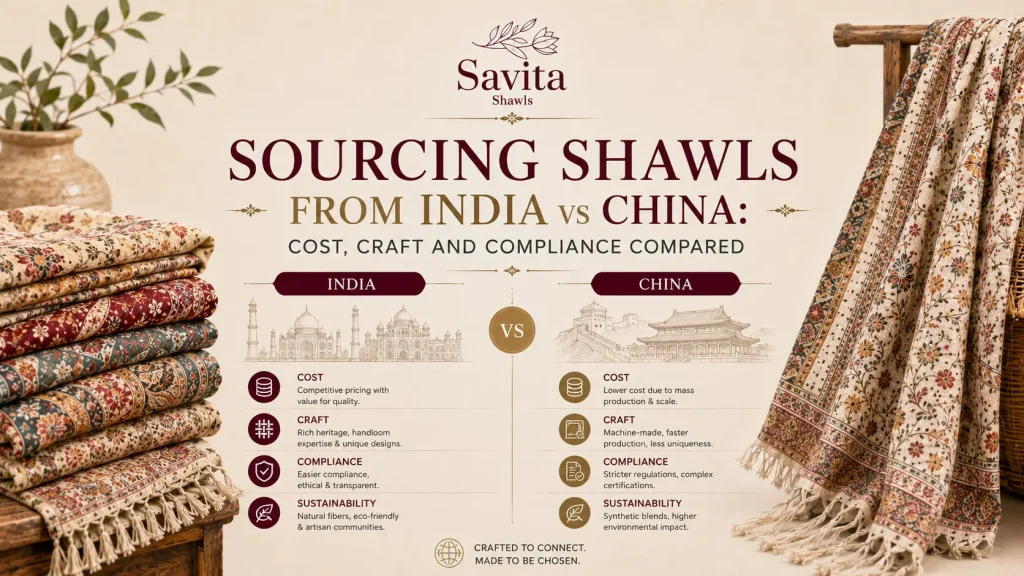
The honest answer to which origin is better is that they are good at different things, and a buyer who picks by unit price alone usually ends up in the wrong one. China wins on synthetic volume, speed and consistency at scale. India wins on natural fibre, hand technique and low minimums. Anyone sourcing shawls from India vs China should decide based on what their product actually is rather than on a generalised assumption about cost. This guide compares the two across the factors that decide a sourcing decision, written by an Indian manufacturer and therefore worth reading with that in mind.
Where each origin genuinely leads
China’s strength is scale manufacturing of synthetic and blended textiles. Polyester, acrylic and synthetic blends produce at volumes and consistency levels that are difficult to match. Automated production, large integrated mills and mature logistics support fast turnaround on high quantity orders.
India’s strength is natural fibre and hand technique. Pashmina, cashmere, silk, cotton and wool with hand embroidery, handloom weaving and traditional craft techniques concentrate here because the artisan base and the fibre supply do. Kani weaving, sozni embroidery and kantha stitch have no comparable production base elsewhere.
Neither statement is absolute. China produces cashmere at significant scale, and India produces synthetic textiles in volume. The generalisation holds at the level of comparative advantage rather than exclusivity.
The practical implication: if your product is a printed polyester scarf at 20,000 pieces, China is likely the better answer. If it is a hand embroidered pashmina at 200 pieces, India is.
Minimum order quantities compared
This is the difference that matters most to smaller buyers and the one least discussed.
Indian manufacturers commonly work from 100 to 300 pieces per design. Chinese manufacturers of comparable product frequently start at 500 to 1,000, and larger factories higher still, because their cost structure assumes volume.
For a boutique, an emerging brand or a buyer testing a new line, that gap decides the question before any other factor. Committing 1,000 pieces to an unproven design is a materially different risk from committing 100.
The reverse applies at scale. A buyer placing 20,000 pieces will generally find better pricing and tighter consistency from a large Chinese factory geared for that volume.
Indian MOQ conventions across product types are set out in the guide to wholesale stole supply.
Cost, and why the comparison is not simple
Unit price comparisons between origins mislead more often than they inform, for three reasons.
Product is rarely equivalent. A quote from each origin usually differs in fibre grade, GSM or finish, and comparing them as though they are the same product produces a false conclusion.
Landed cost differs from unit cost. Freight, duty, and any preferential trade access into your destination market can shift the comparison substantially. Duty rates depend on classification and origin, covered in the guide to HSN codes for shawls and stoles.
Order size changes the answer. At 200 pieces India is usually cheaper because the Chinese supplier is quoting below their efficient scale. At 20,000 the position frequently reverses.
The useful comparison is landed cost per piece at your actual order quantity for genuinely equivalent specification, and buyers who do that arithmetic reach different conclusions from those who compare headline quotes.
Compliance and documentation
Both origins export at scale and both have mature documentation practices, but the details differ.
Trade access varies by destination. Some markets hold preferential arrangements with one origin and not the other, and duty differences can exceed the unit price gap entirely. Check the current position for your own market rather than assuming.
Certification is available from both, and verification matters equally in each. The approach to checking a claim is set out in the guide to Oeko-Tex certified sourcing.
Documentation sets are broadly similar, covering commercial invoice, packing list, bill of lading, certificate of origin and inspection certificates. The Indian process is covered in the guide to stole export from India.
Trade policy shifts. Tariff arrangements, anti dumping measures and trade agreements change, and a comparison based on last year’s rates may be wrong this year. Verify with a customs broker before committing to a sourcing decision on duty grounds.
Lead times and logistics
Chinese suppliers frequently quote faster on stock synthetic product, supported by larger finished goods inventories and denser shipping schedules.
Indian lead times run 10 to 15 working days for stock styles with a label, rising to 45 to 60 for custom woven work and longer for heavy handwork. Hand technique does not compress regardless of origin, so a comparison on speed only holds for machine made product.
Sea freight timings from both origins to Europe and North America are broadly comparable, with route and port congestion mattering more than country.
For buyers running seasonal ranges, the planning question matters more than the origin question. The calendar arithmetic is set out in the guide to woolen stole sourcing.
Craft capability and product differentiation
This is where sourcing shawls from India vs China stops being a cost comparison.
Pashmina from Changthangi goats in Ladakh, sozni and aari embroidery, kani weaving, kantha running stitch, block printing and handloom production are concentrated in India because the artisan traditions and training pipelines are. A buyer wanting these specific techniques is not really choosing between origins.
Geographical Indication registration for Kashmir pashmina attaches to Indian production, which matters for buyers whose retail positioning depends on provenance. The detail is in the guide to pashmina stole sourcing.
For a brand competing on differentiation rather than price, craft capability is often the deciding factor, since a hand embroidered piece cannot be replicated quickly by a competitor buying machine made product.
Conversely, a brand competing on price at volume in synthetic product gains little from any of this.
Choosing between them, practically
Choose India when your product involves natural fibre, hand technique or craft provenance, when your order quantity sits between 100 and 2,000 pieces, when you need low minimums to test designs, or when your positioning depends on artisan production.
Choose China when your product is synthetic or blended at high volume, when you need very large quantities with tight consistency, when speed on stock product matters more than technique, or when your order size clears the minimums comfortably.
Consider both when your range spans categories. Many established buyers source natural fibre and craft product from India and synthetic volume lines from China, which is a rational split rather than a hedge.
Whichever origin, the supplier evaluation questions are the same: verify registrations, order paid samples, check whether a manufacturer or a trader is quoting, and test response time before committing. The framework is set out in the guide to choosing a stole manufacturer.
What Savita Shawls offers
Savita Fashions LLP, trading as Savita Shawls, has manufactured stoles, shawls and scarves from Gurgaon, Haryana since 1984 and supplies buyers in more than 20 countries including the UK, USA, UAE, Germany, France, Italy, Spain, Netherlands, Sweden, Denmark, Australia, Japan and Canada. GST registration is 06AFPFS3876N1Z0 and IEC is AFPFS3876N, verifiable on the GST portal and the DGFT portal. The company is registered with FIEO and AEPC.
Terms are 100 pieces per stock design and 200 pieces per custom or OEM design, with corporate gifting from 50 pieces with branding, which suits buyers testing designs at quantities below typical large factory minimums. Samples dispatch within 5 to 7 business days with the cost credited against the bulk order.
The range covers pashmina, cashmere, merino, fine wool, silk, modal, viscose, cotton and linen, with hand embroidery, jacquard weaving, digital and screen printing and kani weaving available. Production runs 10 to 15 working days for stock styles with your label to 45 to 60 working days for custom woven designs. Shipping is available on FOB, CIF or DDP terms, compared in the guide to FOB and CIF terms.
Frequently asked questions
Is sourcing shawls from India cheaper than China?
It depends on order size and product type. At 100 to 2,000 pieces India is often cheaper because Chinese suppliers quoting below their efficient scale price accordingly. At very high volumes in synthetic product the position frequently reverses. Compare landed cost per piece at your actual quantity for genuinely equivalent specification rather than headline quotes.
Which origin has lower minimum order quantities?
India, generally by a considerable margin. Indian manufacturers commonly work from 100 to 300 pieces per design while comparable Chinese factories frequently start at 500 to 1,000. For boutiques, emerging brands and buyers testing new designs, this gap often decides the sourcing question before any other factor is considered.
Which is better for cashmere and pashmina?
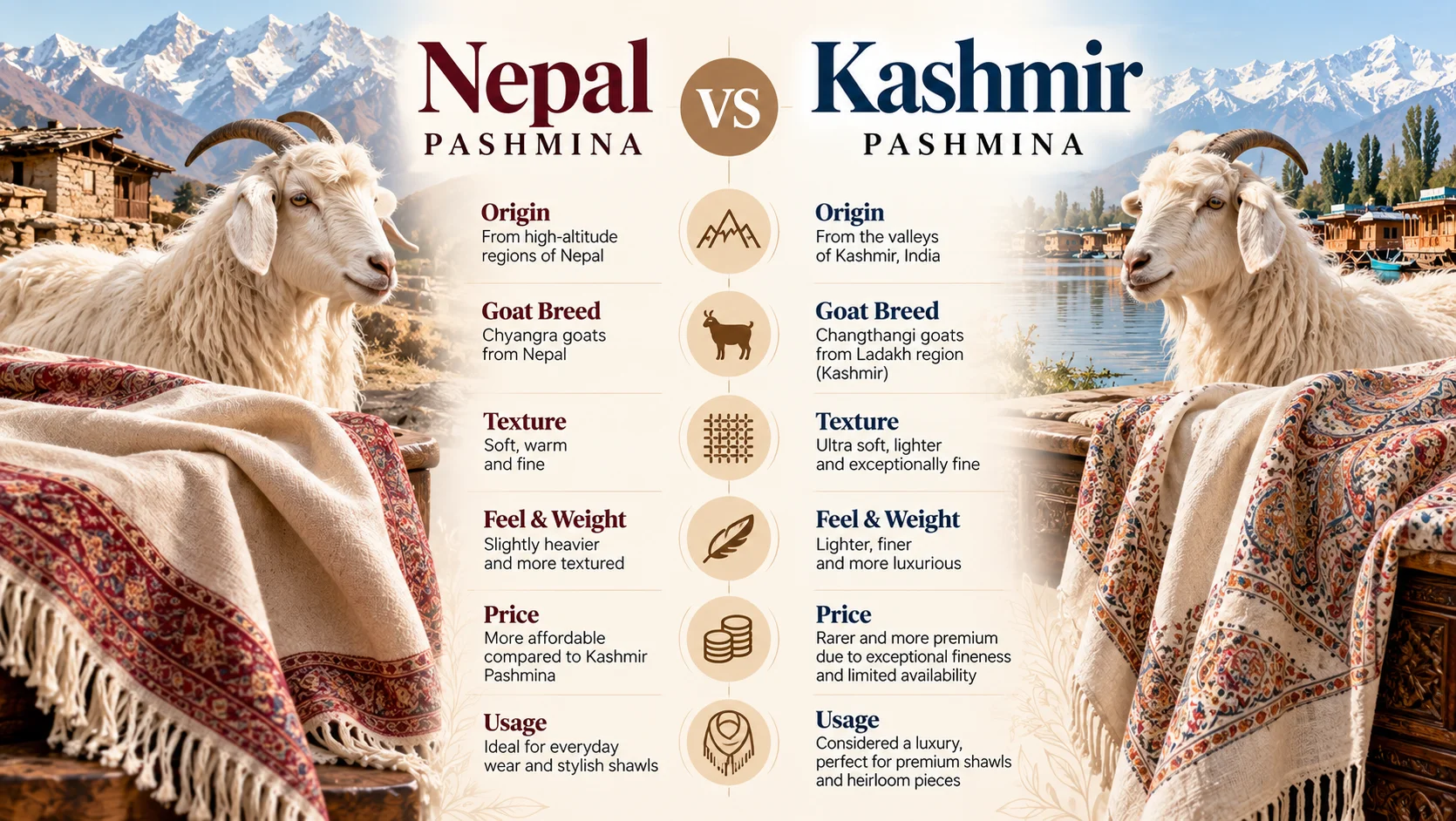
Both produce cashmere, with China operating at greater scale. Pashmina specifically, meaning fine Changthangi fibre from Ladakh and Kashmir, is Indian, and Geographical Indication registration attaches to Indian production. For buyers whose positioning depends on pashmina provenance, the question does not really arise.
Which origin is better for hand embroidered work?
India, without much argument. Sozni, aari and tilla embroidery, kani weaving, kantha running stitch and handloom production are concentrated in India because the artisan traditions and training pipelines are. A buyer wanting these specific techniques is choosing a capability rather than comparing two suppliers of the same thing.
Are lead times faster from China?
Often on stock synthetic product, supported by larger finished goods inventories and denser shipping schedules. On custom and hand made work the comparison does not hold, since hand technique takes the same time regardless of origin. Sea freight timings to Europe and North America are broadly comparable between the two.
Do duty rates differ between India and China?
They can, depending on your destination market and any preferential trade arrangements in force. Duty differences occasionally exceed the unit price gap entirely, which makes them worth checking before deciding on price grounds. Trade policy changes, so verify the current position with a customs broker rather than relying on prior shipments.
Should I source from both origins?
Many established buyers do, taking natural fibre and craft product from India and synthetic volume lines from China. This is a rational split by product category rather than a hedge. It does mean managing two supplier relationships, two document sets and two lead time patterns, which suits larger buyers better than small ones.
How do I evaluate suppliers in either country?
The same way. Verify business registrations on official portals, order paid samples rather than free ones, establish whether a manufacturer or a trading intermediary is quoting, ask technical questions about specification and note whether answers are specific, and time the response to a small enquiry as a predictor of responsiveness under pressure.
Ready to order
If your product involves natural fibre, hand technique or quantities between 100 and 2,000 pieces, send your requirement with fabric, dimensions and quantity, and Savita Shawls will return pricing, confirmed lead times and sample availability. Samples ship within 5 to 7 business days with the cost credited against your order. Start with a sourcing enquiry, email sales@savitashawls.com or call +91 7696677766.