Two quotes for the same goods can differ by fifteen percent and both be honest, because one is FOB and one is CIF. Buyers comparing them side by side without adjusting are comparing different things. Understanding FOB vs CIF textile export India terms takes ten minutes and saves an argument on every shipment afterwards, because the choice decides who arranges freight, who insures the goods, and who carries the loss if a container goes over the side. This guide covers what each term actually includes, where risk transfers, and which suits which kind of buyer.
What Incoterms are and why they matter
Incoterms are standardised trade terms published by the International Chamber of Commerce, revised periodically, and used worldwide to define exactly where a seller’s responsibility ends and a buyer’s begins.
They cover three things: who arranges transport, who pays for it, and at what point risk of loss or damage passes from seller to buyer. They do not cover payment terms, title transfer or product quality, which are separate contractual matters buyers sometimes assume are included.
Always state the Incoterm with a named place. FOB Nhava Sheva means something specific. FOB alone does not. The current rule set is published by the International Chamber of Commerce.
FOB explained
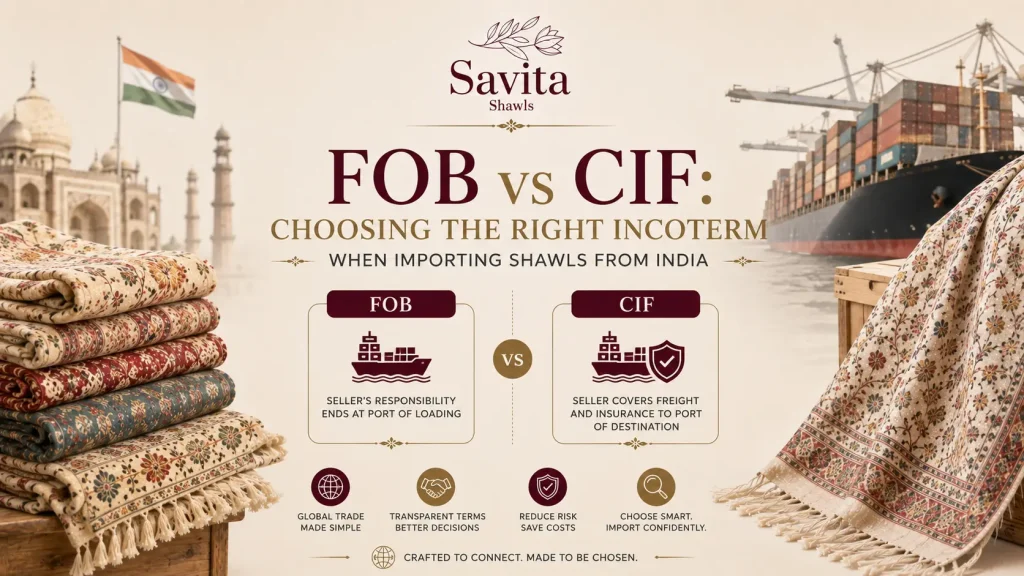
FOB means Free On Board. The seller delivers the goods to the named Indian port, clears them for export, and loads them onto the vessel. From that moment, risk and cost transfer to you.
Under FOB textile export India arrangements you arrange and pay for ocean or air freight, marine insurance, destination port charges, customs clearance and inland delivery at your end.
FOB gives you control. You choose the carrier, you see the actual freight rate, and you can consolidate shipments from several suppliers.
It also gives you work. You need a freight forwarder, an understanding of destination charges, and someone to manage the process. For a buyer already importing regularly, none of that is a burden.
The exporter’s quoted price under FOB is the lowest of the three terms, which is why FOB quotes look attractive next to CIF ones until you add freight.
CIF explained
CIF means Cost, Insurance and Freight. The seller arranges and pays for ocean freight to your named destination port and provides marine insurance covering the voyage.
Here is the part that confuses most buyers: under CIF, risk still transfers when the goods are loaded in India, exactly as under FOB. The seller pays for freight and insurance but does not carry the risk during the voyage. If goods are damaged in transit, you claim on the insurance policy, not from the seller.
CIF suits buyers who want one number covering delivery to their port without managing freight themselves. It is the most commonly used term for repeat textile buyers.
The trade off is visibility. You do not see the freight rate the exporter negotiated, and there is often a margin built into it. Whether that margin exceeds what you would pay arranging freight yourself depends on your own volumes.
Note that CIF applies properly to sea freight. For air shipments the equivalent term is CIP, though many suppliers and buyers use CIF loosely for both.
DDP as the third option
DDP means Delivered Duty Paid. The seller handles everything including import clearance, duty and delivery to your address, and carries risk throughout.
It is the highest quoted price and the least work for you. For a first shipment from a new market, or for a buyer without a customs broker, it removes an entire learning curve.
The cost is control and visibility. You see one number and cannot see what sits inside it. Most buyers use DDP for a first order and move to CIF or FOB once they understand the actual costs.
DDP also shifts classification responsibility to the exporter, which matters given that duty depends on correct coding. The detail is covered in the guide to HSN codes for shawls and stoles.
Comparing quotes honestly
To compare FOB and CIF quotes properly, add the missing pieces to the FOB number.
Ocean or air freight from the Indian port to your destination port. Marine insurance, typically a small percentage of cargo value. Destination terminal handling charges. Customs brokerage. Import duty, which applies under both terms. Inland transport to your warehouse.
Only after adding those does an FOB quote become comparable to a CIF one. Buyers who skip this consistently conclude that FOB suppliers are cheaper, then discover otherwise at the destination port.
Ask any exporter quoting CIF which port the quote covers and what is excluded. Destination charges are excluded under CIF and they surprise first time buyers regularly.
Textile specific point: stoles and shawls are light and bulky, so freight is priced on volumetric weight rather than actual weight. A carton of wool stoles costs more to ship than its mass suggests. The seasonal implications are covered in the guide to woolen stole sourcing.
Which term suits which buyer
First time importers should use DDP. The premium buys you a shipment that arrives without you learning customs procedure under time pressure.
Second and third orders suit CIF. You have seen the process, you want the exporter to handle freight, and you are ready to manage import clearance yourself.
Regular importers with a freight forwarder should use FOB. You get the real freight rate, you control the carrier, and you can consolidate across suppliers.
Small ecommerce sellers importing modest quantities usually find DDP or CIF simpler, since the fixed costs of managing freight do not amortise across small consignments.
Anyone shipping high value cargo should think carefully about insurance regardless of term. Under both FOB and CIF you carry the voyage risk, and under FOB you must arrange the cover yourself. Silk and cashmere consignments justify this attention more than viscose does, as covered in the guide to cashmere stole sourcing.
Common mistakes with FOB vs CIF textile export India
Assuming CIF means the seller carries risk during the voyage. It does not. Risk transfers at loading under both terms.
Comparing FOB and CIF quotes without adding freight and insurance to the FOB number.
Using CIF for air freight, where CIP is technically correct. It rarely causes practical problems but it can matter in a dispute.
Not naming the port. FOB Mumbai and FOB Nhava Sheva are different, and an unnamed term is ambiguous.
Assuming the Incoterm covers payment terms. It does not. Payment staging is separate, and the standard arrangement across Indian exporters is set out in the guide to stole export from India.
Forgetting that duty applies under FOB and CIF alike. Only DDP includes it.
What Savita Shawls offers
Savita Fashions LLP, trading as Savita Shawls, has exported stoles, shawls and scarves from Gurgaon, Haryana since 1984 to more than 20 countries including the UK, USA, UAE, Saudi Arabia, Germany, France, Italy, Spain, Netherlands, Sweden, Denmark, Australia, Japan and Canada. GST registration is 06AFPFS3876N1Z0 and IEC is AFPFS3876N, verifiable on the GST portal and the DGFT portal. The company is registered with FIEO and AEPC.
Shipping is quoted on FOB, CIF or DDP terms, and buyers are welcome to request the same order priced on more than one basis to compare properly. Every consignment ships with a commercial invoice, packing list, bill of lading or airway bill, certificate of origin, GST invoice and shipping bill, with a pre-shipment inspection certificate available on request.
Air freight runs 3 to 5 working days to the Gulf, 5 to 7 to the UK and Europe and 7 to 10 to North America from dispatch. Sea freight runs 15 to 20 days to the Middle East and 25 to 35 days to the UK and Europe. Payment terms are 30 to 50 percent advance with the balance before shipment, with letters of credit and 30 day terms available to established repeat buyers. Quotes are issued in USD, GBP, EUR or INR. Buyers new to sourcing should read the guide to choosing a stole manufacturer.
Frequently asked questions
What is the difference between FOB and CIF?
Under FOB the seller delivers to the Indian port and clears goods for export, then you arrange and pay for freight and insurance. Under CIF the seller arranges and pays for ocean freight and marine insurance to your destination port. Under both, risk transfers to you when goods are loaded in India.
Does CIF mean the seller carries risk during shipping?
No, and this is the most common misunderstanding in FOB vs CIF textile export India arrangements. Under CIF the seller pays for freight and insurance but risk still transfers at loading in India. If goods are damaged in transit you claim against the insurance policy rather than against the seller.
Which Incoterm should a first time importer use?
DDP, where the seller handles everything including import clearance, duty and delivery to your address, and carries risk throughout. It costs the most and removes an entire learning curve. Most buyers use DDP for a first shipment and move to CIF or FOB once they understand the actual cost structure.
How do I compare an FOB quote with a CIF quote?
Add ocean or air freight, marine insurance, destination terminal handling charges, customs brokerage and inland transport to the FOB number. Import duty applies under both so it does not affect the comparison. Buyers who skip this consistently conclude FOB suppliers are cheaper and discover otherwise at destination.
Are destination charges included in CIF?
No. CIF covers freight and insurance to your destination port only. Terminal handling charges, customs brokerage, import duty and inland delivery from the port are all yours. These surprise first time buyers regularly, so ask the exporter to confirm in writing exactly what the CIF quote includes and excludes.
Does FOB or CIF affect who pays import duty?
Neither. Import duty is payable by the importer under both FOB and CIF terms. Only DDP includes duty in the seller’s responsibility. Duty depends on correct customs classification, so the fibre composition and HSN code on your documentation matter regardless of which Incoterm you choose.
Is CIF correct for air freight?
Technically no. CIF applies to sea freight, and CIP is the correct equivalent for air and multimodal transport. Many suppliers and buyers use CIF loosely for both, which rarely causes practical problems but can matter in a dispute. If precision matters to your contract, use the correct term.
Why does freight cost more than the weight suggests?
Because freight on light bulky cargo is priced on volumetric weight rather than actual weight. Stoles and shawls, particularly wool, occupy considerable space relative to their mass. This is why buyers who plan far enough ahead to use sea freight rather than air protect several points of margin on a bulky order.
Ready to order
Send your requirement with destination port or address, quantity and preferred shipping basis, and Savita Shawls will quote on FOB, CIF or DDP terms, or on more than one so you can compare properly. Samples ship within 5 to 7 business days with the cost credited against your bulk order. Start with an export quote request, email sales@savitashawls.com or call +91 7696677766.