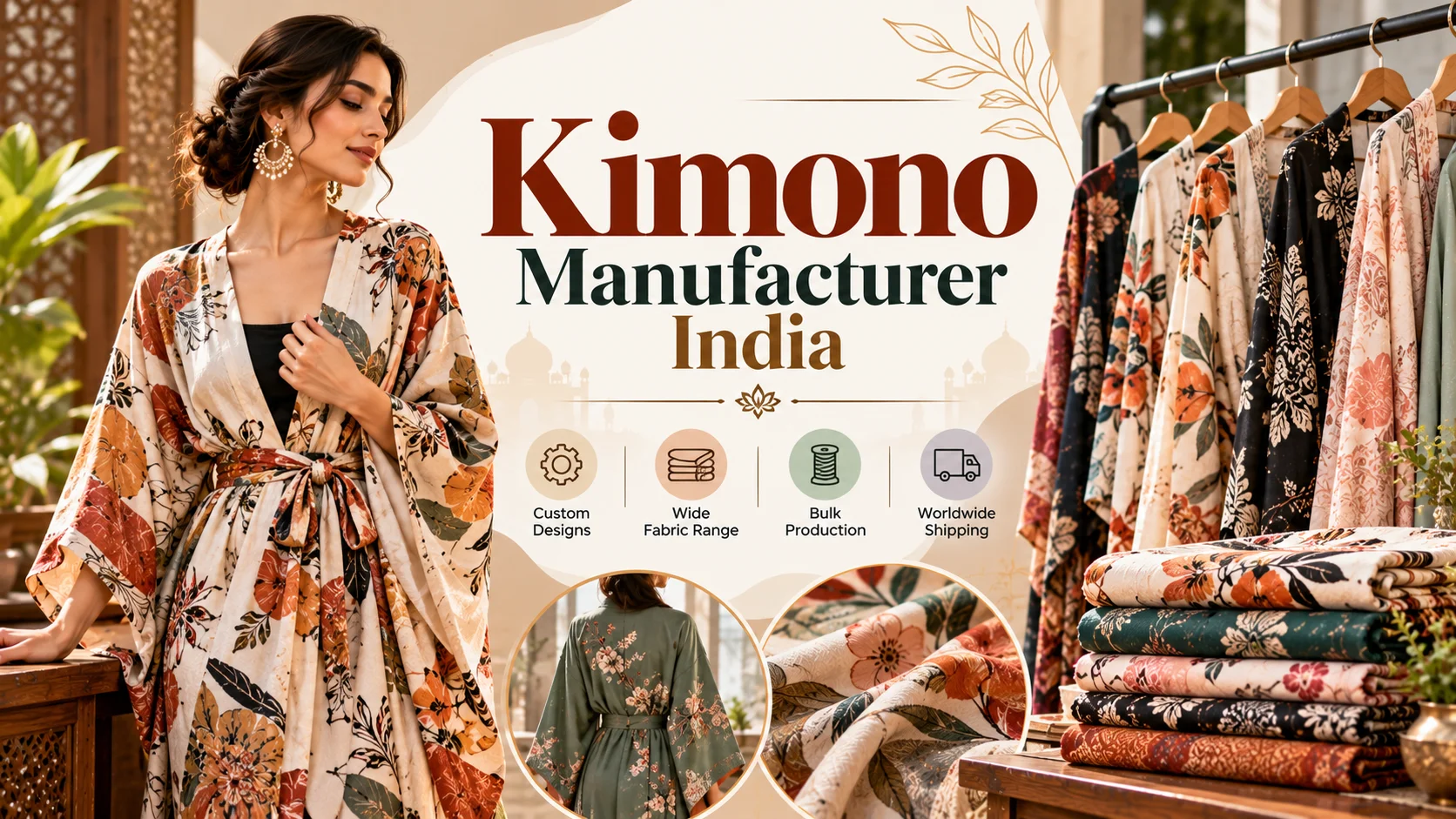
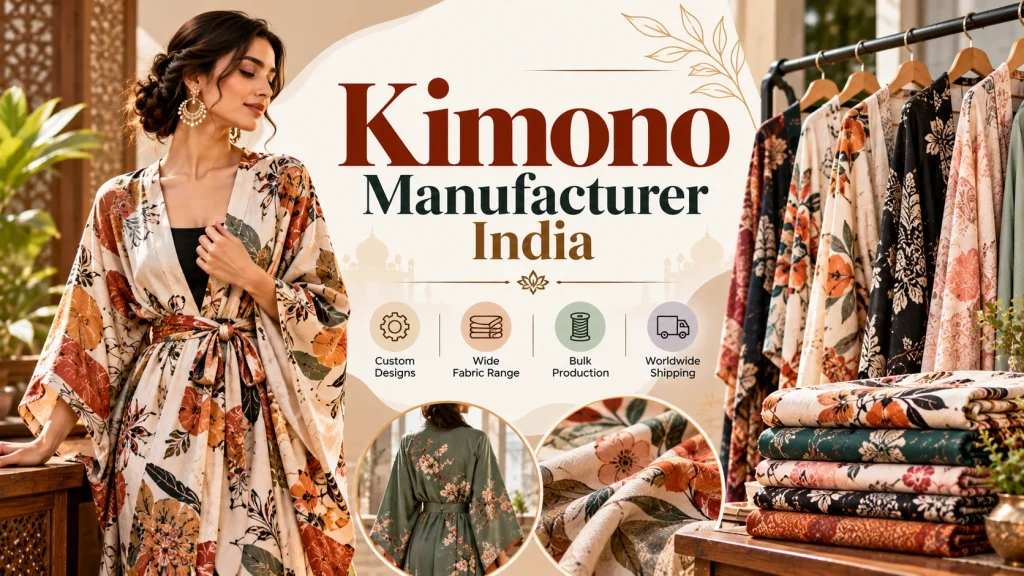
In fashion wholesale, a kimono is a loose, open-front cover-up with wide sleeves, worn over swimwear, dresses or jeans. A kimono manufacturer in India can supply these in printed viscose, cotton, silk and chiffon, using digital, screen or hand block printing, with trims such as tassels and lace. Buyers choose India for its printing skills, natural fabrics and workable minimums for resort and boutique ranges.
Key takeaways
- Fashion kimonos are cover-ups and jackets, not traditional Japanese garments. Describe the style clearly in your brief.
- Viscose is the most common base for its drape and print quality. Cotton and linen suit beach and casual ranges, and silk suits premium lines.
- A tech pack with measurements, print placement and trims prevents most sampling delays.
- Check seams, hems and colour fastness on a washed sample, and confirm garment labelling rules for your market.
What is a kimono in fashion wholesale?
In Western retail, a kimono is an open-front garment with wide, dropped sleeves and a straight, loose body. It is worn as a beach cover-up, a light summer layer or a lounge robe. The name borrows from the shape of the Japanese garment, but the product itself is a simple cover-up.
Related products often sold alongside kimonos include kaftans, which pull over the head, and ponchos. Many buyers source all three from the same manufacturer, since they share fabrics, prints and finishing.
Which kimono styles should you stock?
| Style | Length | Typical fabric | Best for |
|---|---|---|---|
| Short kimono jacket | Hip length | Viscose, georgette | Everyday layering, boutiques |
| Long duster kimono | Calf to ankle | Viscose, chiffon, silk | Festival, resort and evening wear |
| Beach cover-up | Thigh to knee | Cotton voile, chiffon, crochet trim | Swimwear and beach stores |
| Tassel-trim kimono | Hip to knee | Viscose, cotton | Boho and holiday ranges |
| Belted robe kimono | Knee to calf | Satin, modal, cotton | Loungewear and gifting |
Start with two lengths in the same print family. This gives customers a choice of price and coverage without spreading your order too thin.
Which fabrics work best for kimonos?
Kimonos depend on drape, so fabric choice matters more than for structured garments.
- Viscose challis and crepe: soft, fluid and excellent for prints. The most popular kimono base. Our guide to viscose stoles covers the same fabric family.
- Cotton voile and mul: light, breathable and easy care, ideal for beach cover-ups. See our cotton stoles guide.
- Linen and linen blends: a natural, textured look for premium resort wear. Read our linen stoles guide.
- Chiffon and georgette: sheer and floaty, often polyester for price and durability.
- Silk and satin: a premium sheen for evening kimonos and robes. See our silk stoles guide.
For lightweight fabrics in general, our summer stoles guide explains weights and finishes.
Which print methods suit kimonos?
| Method | How it works | Strengths | Best for |
|---|---|---|---|
| Digital print | Design printed directly from a file | Unlimited colours, photo detail, small runs | Fashion and trend-led prints |
| Screen print | One screen per colour | Strong colour, low cost at volume | Repeat prints in larger orders |
| Hand block print | Carved wooden blocks pressed by hand | Artisan look, natural variation | Boho, craft and premium ranges |
| Tie-dye and shibori | Fabric tied or folded before dyeing | Unique, hand-made patterns | Festival and resort ranges |
Hand block printing is closely associated with Rajasthan, especially around Jaipur, and gives kimonos a craft story many boutiques value. Our digital printed shawls and printed scarves show the print quality you can expect, and our printed stoles guide explains each method in more detail.
Who buys wholesale kimonos?
- Swimwear and beach stores: short cover-ups in cotton and chiffon, sold next to swimsuits.
- Resort and hotel boutiques: long printed kimonos and kaftans in viscose and silk.
- Online sellers: trend-led digital prints with strong photography and one-size fit.
- Boho and festival retailers: tassel-trim, tie-dye and block-printed styles.
- Loungewear and gifting buyers: belted robe kimonos in satin, modal or cotton.
Northern hemisphere summer ranges are usually ordered between January and March, while Australian buyers order mid-year for their summer. Matching a kimono print to a scarf or stole lets a store sell a coordinated set. See our summer shawls and scarves in cotton and modal.
What should a kimono tech pack include?
A clear tech pack shortens sampling and protects your bulk order. Include:
- Flat sketch of front and back, showing sleeve shape and any belt or slits.
- Measurements for length, sleeve opening, across body and shoulder drop, with tolerances.
- Sizes such as one size, S/M and L/XL, with a grading rule.
- Fabric name, composition and weight.
- Print artwork as high-resolution files, with placement and repeat marked.
- Trims such as tassels, lace, buttons or ties, with colour references.
- Labels and packing instructions, including hang tags and polybags.
Then follow our guide on how to request samples from a manufacturer to approve fit and print before bulk.
What should buyers check on a kimono sample?
- Seams. Sheer fabrics need French seams or neat overlocking so the inside looks finished.
- Hems. Rolled hems should be even and flat, without puckering.
- Print alignment. Check that the print matches at the centre front and that the main motif sits where planned.
- Colour fastness. Wash the sample in cold water and check for bleeding, especially on dark grounds with light motifs.
- Shrinkage. Viscose can shrink after washing. Measure before and after, and ask for pre-shrunk fabric if needed.
- Trims. Tassels and lace should be securely stitched and colour-matched.
- Chemical compliance. For Europe and the US, ask for Oeko-Tex or equivalent results. Our Oeko-Tex guide explains what to request.
What labelling do kimonos need?
Kimonos are garments, so most markets require a sewn-in label showing fibre content, country of origin and care instructions, and some require the importer or brand identity. Rules differ by country, so confirm them before production. Our guides to care label requirements for textile export and HSN codes for textiles cover labelling and invoice classification. In the US, light and sheer fabrics also fall under general apparel flammability rules, so ask your supplier about testing.
Why source kimonos from India?
India combines strong printing skills, a wide range of natural and cellulose fabrics, and flexible minimums. Hand block printing, cotton voile and viscose crepe are all widely available, and many manufacturers can move from fabric to finished garment in one supply chain. Our comparison of sourcing from India vs China sets out cost and craft differences, and our overview of the fashion accessories manufacturing market in India gives wider context.
MOQ and ordering with Savita Shawls
Savita Shawls manufactures shawls, stoles, scarves and kimonos in Gurgaon and has exported to more than 40 countries since 1984.
| Term | Savita Shawls standard |
|---|---|
| MOQ | 100 pieces per design, with mixed colourways possible |
| Samples | Delivered internationally in 7 to 10 working days |
| Production time | Confirmed per style after sample approval |
| Payment | 30 to 50 percent advance, balance before dispatch |
| Shipping | FOB, CIF or DDP with export documents |
Kimonos pack flat and light, so they combine well with scarves and stoles in one shipment. Our export packaging guide covers retail-ready options.
Order kimonos from Savita Shawls
Share your sketch, fabric and print through our bulk quote form, or ask about private label manufacturing with your own labels and packaging. Browse our summer scarves for prints that can be developed into matching kimonos.
Frequently asked questions
What is a kimono cover-up?
A kimono cover-up is a loose, open-front garment with wide sleeves, worn over swimwear or summer outfits. It is usually made in light, printed fabrics such as viscose, cotton or chiffon.
What is the best fabric for kimonos?
Viscose is the most popular because it drapes well and holds prints clearly. Cotton voile suits beachwear, linen suits premium resort wear, and silk or satin suits evening and lounge styles.
What is the difference between a kimono and a kaftan?
A kimono opens at the front like a jacket. A kaftan is a loose garment that pulls over the head, usually with a slit or V-neck.
Can kimonos be made with my own print?
Yes. Send high-resolution artwork and the print can be produced by digital or screen printing, or adapted for hand block printing. A sample is approved before bulk production.
What sizes do wholesale kimonos come in?
Many kimonos are sold as one size because of their loose fit. Some brands offer S/M and L/XL. Fix measurements and tolerances in your tech pack.
When should resort wear buyers order kimonos?
For a northern hemisphere summer, place orders between January and March so stock lands before the season. Australian buyers usually order mid-year for their summer.
What is the minimum order for kimonos?
Savita Shawls starts at 100 pieces per design, with mixed colourways possible within an order.