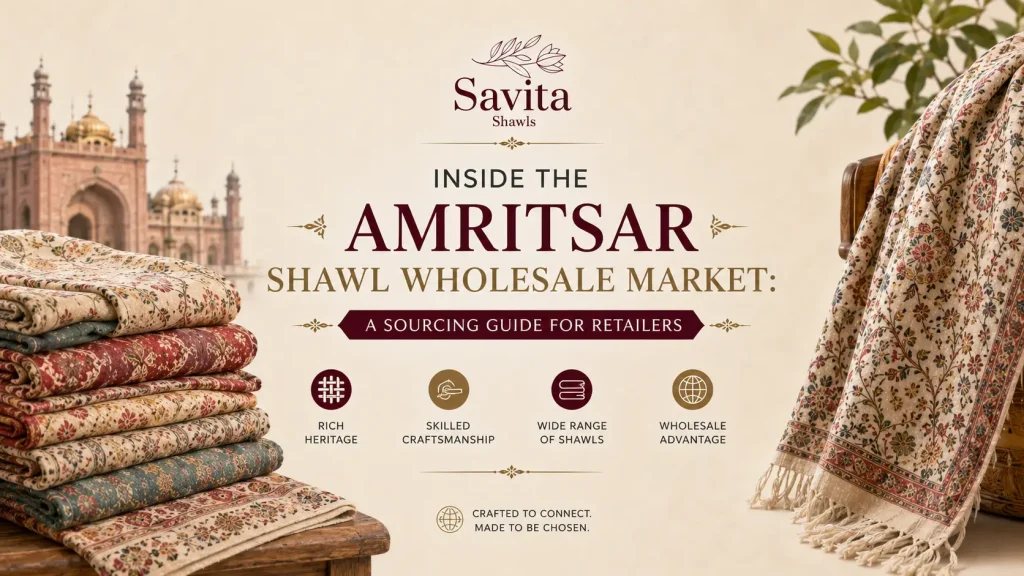
Amritsar has traded textiles for centuries and the trade still works largely the way trading works: relationships, cash, stock on hand and prices agreed in a conversation rather than a quotation. For a buyer who can visit, inspect and carry goods away, the shawl wholesale market in Amritsar is fast and flexible in a way factory sourcing is not. For an importer working remotely on documented terms, it presents difficulties that have nothing to do with the quality of what is on the shelves. This guide covers both sides honestly, written by a Gurgaon based manufacturer.
What the Amritsar trade offers
Amritsar sits in Punjab with a long textile trading history, and the market functions as a distribution hub as much as a production centre.
Stock availability is the headline advantage. Goods are physically present, which means you can see what you are buying and take it immediately rather than waiting on a production cycle.
Variety across many suppliers in one place suits a buyer building a mixed range, since a day of walking covers what would otherwise be a dozen supplier conversations.
Low quantity flexibility is real. Traders holding stock will sell in quantities no factory would accept, which suits small retailers and buyers testing lines.
Price negotiation happens face to face and moves in ways a quotation does not, particularly for a buyer paying immediately.
Woollens and shawls for the domestic winter market form a large share of what circulates, alongside stoles, scarves and blankets.
What the market cannot easily give you
Repeat consistency is the structural limitation. A trader sells what they hold. When that stock is gone, the identical piece may not be available again, which makes building a repeating retail range difficult.
Customisation is largely unavailable. Your own labels, dimensions, colours and designs need a manufacturer, as covered in the guide to custom stole development.
Fibre documentation is frequently absent. Goods circulating through trading channels often carry no composition record, which is a problem when your customs declaration requires percentages, as covered in the guide to HSN codes for shawls and stoles.
Export documentation usually runs through a third party agent, adding cost and diluting accountability if something goes wrong.
Trading margin sits in every price. A trader buys from a manufacturer and sells to you, and that layer is the service you are paying for. At small quantities it is worth it. At volume it is money leaving your margin for nothing.
Destination market labelling is rarely handled, since domestic trade does not require it. The requirements are set out in the guide to care label requirements for export.
Sourcing from the shawl wholesale market in Amritsar successfully
If the market suits your buying, approach it with the same discipline you would apply anywhere.
Visit if you can. The market’s advantage is physical inspection, and buying remotely from a trading operation forfeits the main reason to use one.
Verify GST registration for anyone issuing you an invoice, on the GST portal, and IEC on the DGFT portal if export is involved.
Establish who actually made the goods. A trader may know or may not, and if fibre content matters to your listings, an answer of probably wool is not sufficient.
Test fibre yourself. A burn test on a fringe thread distinguishes animal fibre from synthetic in a minute, and the full checks are in the guide to requesting samples from a manufacturer.
Buy a small quantity first even where a trader offers a better price on more, since stock quality can vary within a single supplier’s holding.
Get an invoice with fibre composition stated. If a seller will not put composition in writing, treat that as information about what is in the product.
When factory direct suits better
Five situations where a manufacturer relationship works better than market trading.
You need the same product again next season. Manufacturing reproduces to specification. Trading stock does not.
You need your own branding. Woven labels, care labels and hangtags require production minimums and cannot be applied to bought in stock.
You are exporting. Documentation, labelling and fibre records come as standard from an export manufacturer and are arranged through third parties in trading channels.
You are buying at volume. The trading margin that is worth paying at 50 pieces is money wasted at 2,000.
You need fibre certainty. Where price depends on grade, as in cashmere and pashmina, documentation matters, as covered in the guide to cashmere stole sourcing.
The other Punjab manufacturing centre is covered in the guide to shawl manufacturers in Ludhiana, and the manufacturer versus trader distinction generally in the guide to choosing a stole manufacturer.
A practical hybrid approach
Many buyers use both, and there is nothing inconsistent about it.
Trading channels suit small quantity, immediate need, one off lines and testing what sells in your market without committing to production minimums.
Manufacturer relationships suit core range, repeat lines, branded product and export volume.
A retailer might buy a varied one off assortment through trading channels while running their core branded programme with a manufacturer. That is a rational split rather than a compromise, and the bulk side is covered in the guide to wholesale stole supply.
What Savita Shawls offers
Savita Fashions LLP, trading as Savita Shawls, has manufactured stoles, shawls and scarves from Gurgaon, Haryana since 1984 and supplies buyers in more than 20 countries including the UK, USA, UAE, Germany, France, Italy, Spain, Australia, Japan and Canada. GST registration is 06AFPFS3876N1Z0 and IEC is AFPFS3876N, both verifiable on the respective government portals. The company is registered with FIEO and AEPC.
Manufacturing direct means the things trading channels cannot easily provide come as standard: reproducible specification across seasons, fibre composition documentation, destination market labelling, full export document sets, and private label branding covering woven inner labels, care labels, hangtags and packaging.
Terms are 100 pieces per stock design and 200 pieces per custom or OEM design, with corporate gifting from 50 pieces with branding. Samples dispatch within 5 to 7 business days with the cost credited against the bulk order. Production runs 10 to 15 working days for stock styles with your label, rising to 45 to 60 working days for custom woven designs. The range spans pashmina, cashmere, merino, fine wool, silk, modal, viscose, cotton and linen. Shipping is available on FOB, CIF or DDP terms, compared in the guide to FOB and CIF terms.
Frequently asked questions
What can I buy at the shawl wholesale market in Amritsar?
The trade centres on woollens and shawls for the domestic Indian winter market, alongside stoles, scarves and blankets, held as physical stock by traders rather than produced to order. Stock availability, variety across many suppliers in one location and flexible quantities are the main advantages over factory sourcing.
Can I buy small quantities from the Amritsar market?
Yes, and this is one of its genuine strengths. Traders holding stock will sell in quantities no manufacturer would accept, which suits small retailers and buyers testing lines. The trade off is that repeat availability of an identical piece is uncertain, since a trader sells what they hold rather than reproducing to specification.
Can I get my own branding on goods from the market?
Generally no. Woven inner labels, printed care labels, custom hangtags and branded packaging require production minimums and are applied during manufacturing rather than to bought in stock. Buyers needing their own branding should work with a manufacturer, where private label is standard at moderate minimum quantities.
Is fibre composition documented in market goods?
Frequently not. Goods circulating through trading channels often carry no composition record, which becomes a problem when your customs declaration requires percentages and your care label must state them accurately. Ask for composition in writing on the invoice, and treat a refusal as information about what is in the product.
How do I verify a trader in Amritsar?
Verify GST registration for anyone issuing you an invoice, and IEC registration if export is involved, both on the relevant government portals. Establish who actually manufactured the goods. Test fibre yourself with a burn test on a fringe thread. Buy a small quantity first, since quality can vary within one seller’s stock.
Is market buying cheaper than factory direct?
At small quantities, often yes, since no production minimum applies and you avoid development costs. At volume, no, because every trading price includes a margin for the layer between you and the manufacturer. That margin is worth paying for the service at 50 pieces and is money leaving your margin at 2,000.
Can I export goods bought from the Amritsar market?
Usually through a third party export agent rather than directly, unless the seller holds IEC registration themselves. This adds cost and dilutes accountability if a problem arises. Export manufacturers handle documentation, destination labelling and fibre records as routine practice rather than as an arrangement made per shipment.
Should I use market trading or factory sourcing?
Both have a place. Trading channels suit small quantities, immediate need, one off lines and testing demand. Manufacturer relationships suit core range, repeat lines, branded product and export volume. Many buyers run a varied assortment from trading channels alongside a core branded programme from a manufacturer.
Ready to order
If you need reproducible specification, your own branding, fibre documentation or export ready shipping, send your requirement with fabric, dimensions and quantity, and Savita Shawls will return pricing, confirmed lead times and sample availability. Samples ship within 5 to 7 business days with the cost credited against your bulk order. Start with a wholesale enquiry, email sales@savitashawls.com or call +91 7696677766.