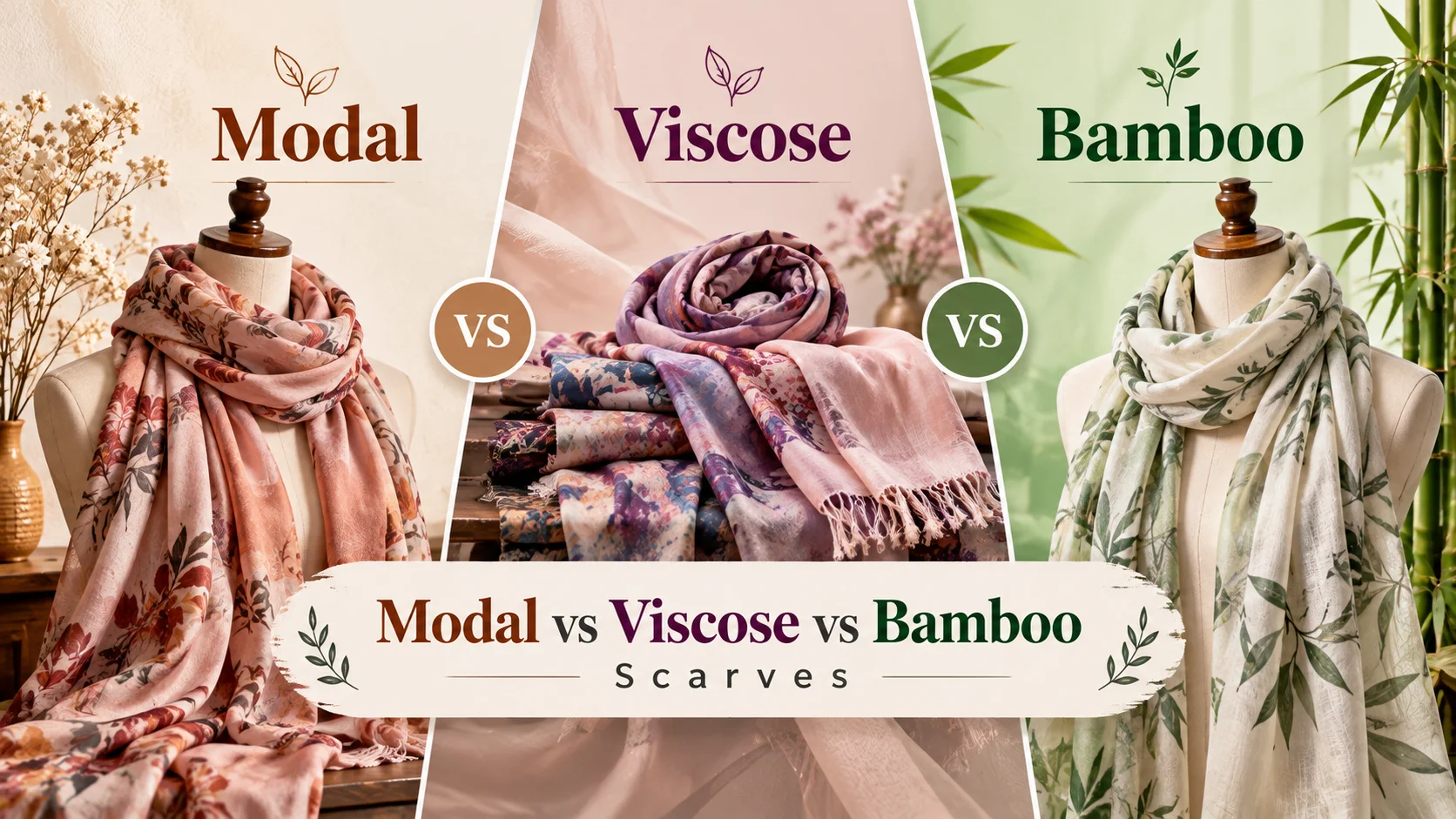
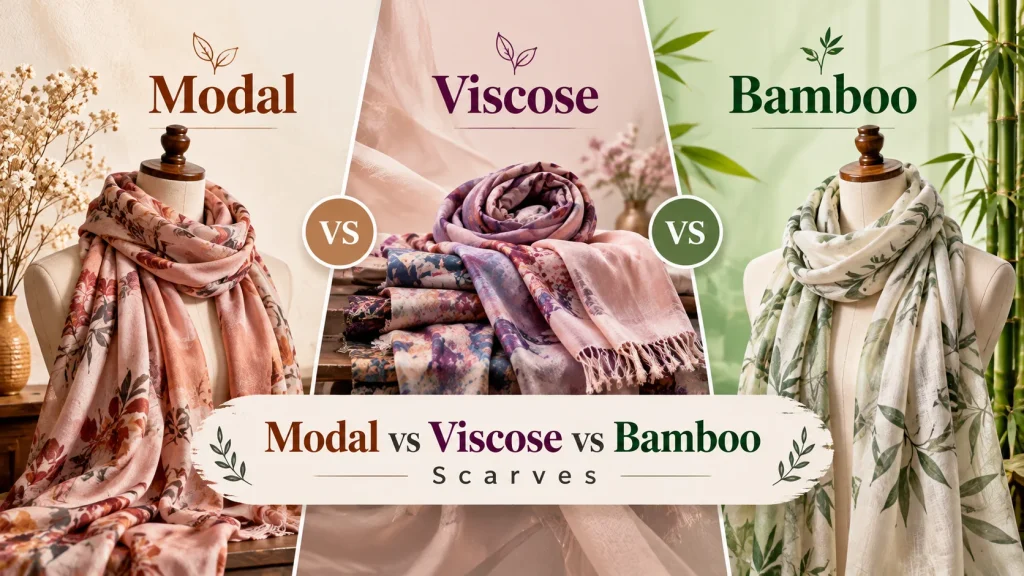
Viscose is the lowest-cost of the three and gives bright prints and fluid drape, but it is weak when wet. Modal is a refined viscose with higher wet strength, less shrinkage and a smoother hand, so it suits premium and everyday-wear scarves. Bamboo scarves are usually viscose made from bamboo pulp, chosen for their soft, cool feel, and must be labelled as viscose or rayon in most export markets.
Key takeaways
- All three are regenerated cellulose fibres made from plant pulp. None is a natural fibre like cotton or silk.
- Choose viscose for price-led printed ranges, modal for wash-and-wear and premium plains, and bamboo where the story helps sales and the label is correct.
- Labels in the US and EU must name the fibre as viscose or rayon, not just “bamboo”.
- Ask for fibre composition, GSM and a washed sample before you approve bulk.
What are modal, viscose and bamboo fabrics?
All three start as cellulose pulp, which is dissolved and pushed through fine nozzles to form filaments. That shared process explains their soft hand, good drape and strong colour uptake.
- Viscose, called rayon in the US, is the original process. Its pulp can come from many trees and plants.
- Modal is a high wet modulus viscose, usually made from beech wood pulp. The adjusted process gives a stronger, more stable fibre that holds its shape after washing.
- Bamboo fabric, in scarves, is almost always viscose made from bamboo pulp. Mechanically processed bamboo fibre exists but is rare and expensive.
Lyocell, sold under brands such as TENCEL, is a related fibre made with a different solvent. It is less common in scarves and usually priced above modal.
Modal vs viscose vs bamboo: side-by-side comparison
| Factor | Viscose | Modal | Bamboo viscose |
|---|---|---|---|
| Raw material | Wood or plant pulp, many sources | Mainly beech wood pulp | Bamboo pulp |
| Hand feel | Soft and smooth | Very soft, silky | Very soft, cool to touch |
| Strength when wet | Low | Higher than viscose | Similar to viscose |
| Shrinkage risk | Higher | Lower | Higher |
| Print and dye result | Bright and sharp | Bright, holds after washing | Bright |
| Relative cost | Lowest | Higher | Higher |
| Best for | Printed fashion scarves, gifting | Premium plains, hijabs, everyday wear | Eco-themed and summer ranges |
When should you stock modal scarves?
Modal is the safest choice when customers wear and wash a scarf often. It keeps its size and softness through repeated washing better than standard viscose, and colours stay brighter for longer. That makes it a strong fit for everyday scarves, modest-wear hijabs and solid colour programmes. Read our sourcing guide to hijab and modest-wear stoles.
Modal costs more than viscose, so it suits mid and premium price points. It also takes digital prints well, giving clean detail on a soft base. Browse our modal scarves range.
Modal also blends well. Modal-silk and modal-cashmere scarves add a premium hand at a lower cost than pure silk or cashmere, and modal-cotton gives a matte, everyday finish. Our scarf manufacturer guide explains the wider options.
When should you stock viscose scarves?
Viscose gives the most colour and drape for the money. It is the usual base for printed scarves, tasselled fashion scarves and seasonal ranges where the design matters more than long wear.
Its weakness is wet strength. Viscose loses a large share of its strength when wet and can shrink if washed warm, so care labels should say cold hand wash or dry clean. Our guide to viscose stoles covers weights and finishes, and the viscose scarves category shows current designs.
Are bamboo scarves worth stocking?
Bamboo scarves sell well where customers respond to a natural, eco-friendly story, and the fabric is genuinely soft and cool in warm weather. The risk lies in the claims. Turning bamboo into viscose uses the same chemical process as other viscose, so claims that the finished scarf is antibacterial or chemical-free should not be made without test evidence.
Treat bamboo as a premium viscose. Ask for the pulp source, a composition report and any environmental certificates the mill holds. Our bamboo scarves and sustainable scarves categories show what is available.
Which fabric is more sustainable?
None of the three is automatically the green option. The impact depends on where the pulp comes from and how the mill handles the chemicals used to dissolve it. Bamboo grows quickly, but it is processed the same way as other viscose, so the plant alone does not make the scarf sustainable.
For an eco-focused range, ask for pulp from FSC or PEFC certified forests, Oeko-Tex test results and, where budgets allow, branded fibres such as TENCEL Modal or LENZING ECOVERO viscose, which come with traceability documents. Then describe the scarf only by what you can prove.
How must these fibres be labelled for export?
Fibre labels must use the legal generic name in most markets.
| Fibre | United States label | European Union label |
|---|---|---|
| Viscose | Rayon or viscose | Viscose |
| Modal | Modal or rayon | Modal |
| Bamboo viscose | Rayon or viscose made from bamboo | Viscose (“bamboo” is not a recognised fibre name) |
The US Federal Trade Commission has acted against sellers who described rayon products simply as bamboo. EU fibre names are set by Regulation (EU) No 1007/2011. These rules sit alongside the wider care label requirements for textile export.
What should buyers check before a bulk order?
Check these seven points before you approve production.
- Fibre composition. Get percentages in writing and a test report for modal and bamboo claims, since blends with polyester or standard viscose are common.
- GSM and yarn count. Fix the fabric weight in your specification. Our GSM and fabric weight guide explains how.
- Washed sample. Hand wash one sample and measure it before and after. If shrinkage is beyond your tolerance, ask for pre-shrunk fabric.
- Colour fastness. Check rubbing and washing fastness on dark and printed colours.
- Hems and finish. Inspect rolled hems, tassels and edges, which fray first on light fabrics.
- Chemical compliance. For Europe and the US, ask for Oeko-Tex Standard 100 or equivalent test results. See our Oeko-Tex guide.
- Approved sample. Keep a signed-off sample for each colourway. Here is how to request samples from a shawl manufacturer.
Which fabric fits which buyer?
- Fashion retail and online stores: printed viscose for range and price, plus a few modal plains.
- Modest-wear stores: modal as the core, because it drapes softly and survives frequent washing.
- Eco and lifestyle boutiques: bamboo viscose with clear, correct labelling.
- Warm-climate markets: all three work. Our summer stoles guide covers the wider range.
- Corporate gifting: printed or plain modal with a woven label.
MOQ and lead time at Savita Shawls
| Term | Savita Shawls standard |
|---|---|
| MOQ | 100 pieces per design, lower on some stock styles |
| Stock styles with your label | 10 to 15 working days |
| Custom printed scarves | 20 to 25 working days after sample approval |
| Custom embroidered scarves | 30 to 40 working days after sample approval |
| Samples | Delivered internationally in 7 to 10 working days |
| Shipping | FOB, CIF or DDP with export documents |
Mixed orders are possible. You can split a total quantity across modal, viscose and bamboo designs as long as each design meets its minimum.
Source modal, viscose and bamboo scarves from Savita Shawls
Savita Shawls has manufactured scarves, stoles and shawls in Gurgaon since 1984 and exports to more than 40 countries. Send your fabric, print, size and quantity through our bulk quote form, or ask about private label manufacturing with your own labels and packaging.
Frequently asked questions
Is modal better than viscose for scarves?
For durability, yes. Modal is stronger when wet, shrinks less and stays soft after more washes. Viscose costs less and gives equally bright prints, so it suits fashion scarves that are washed rarely.
Are bamboo scarves really made of bamboo?
The pulp comes from bamboo, but most bamboo scarves are viscose made from that pulp. That is why they are labelled as rayon or viscose made from bamboo in the US and as viscose in the EU.
Is viscose the same as rayon?
Viscose is the most common type of rayon. In the US the fibre is usually labelled rayon, while in Europe and India it is called viscose.
Which scarf fabric is best for hot weather?
Modal, viscose and bamboo viscose all absorb moisture and feel cool, so all three suit summer ranges. Modal and bamboo usually feel softest against the skin.
Do modal scarves shrink?
Modal shrinks less than standard viscose, but some shrinkage is still possible. Wash a sample before bulk production and state cold hand wash on the care label.
Which is more sustainable, modal, viscose or bamboo?
It depends on the pulp source and the mill’s process rather than the fibre name. Look for certified pulp, Oeko-Tex results and traceable branded fibres, and make only the claims your supplier can document.
What is the minimum order for modal or viscose scarves?
Savita Shawls starts at 100 pieces per design for custom orders, with lower quantities on some stock styles.