
The main places to buy shawls wholesale in Delhi are the traditional trading markets of Old Delhi, including Chandni Chowk and its textile lanes, along with large wholesale hubs such as Sadar Bazaar and the readymade-garment trade around Gandhi Nagar. They suit small, mixed, ready-stock purchases. If you need a fixed design, your own label, consistent quality across hundreds of pieces, or export documentation, a factory-direct supplier in Delhi NCR is usually the better route.
This guide explains how each option works, what to expect, and how to decide, so you can buy shawls in the right place for your quantity and your business.
How the shawl wholesale market in Delhi works
Delhi has been a trading hub for textiles for centuries, and much of the shawl trade still runs through traders. A typical chain looks like this:
- Manufacturers and weavers produce shawls in the north, including Punjab, Haryana, Uttar Pradesh, Kashmir and the NCR.
- Wholesale traders in Delhi’s markets hold ready stock and sell by the piece or in small lots.
- Retailers and boutiques buy from those traders, usually at a higher cost per piece than a manufacturer would charge.
Market traders are valuable if you want to see and touch products, build a mixed range quickly, and buy without a minimum order. The trade-off is that you are generally buying what is in stock today, from an intermediary, and repeat orders may not match the original piece.
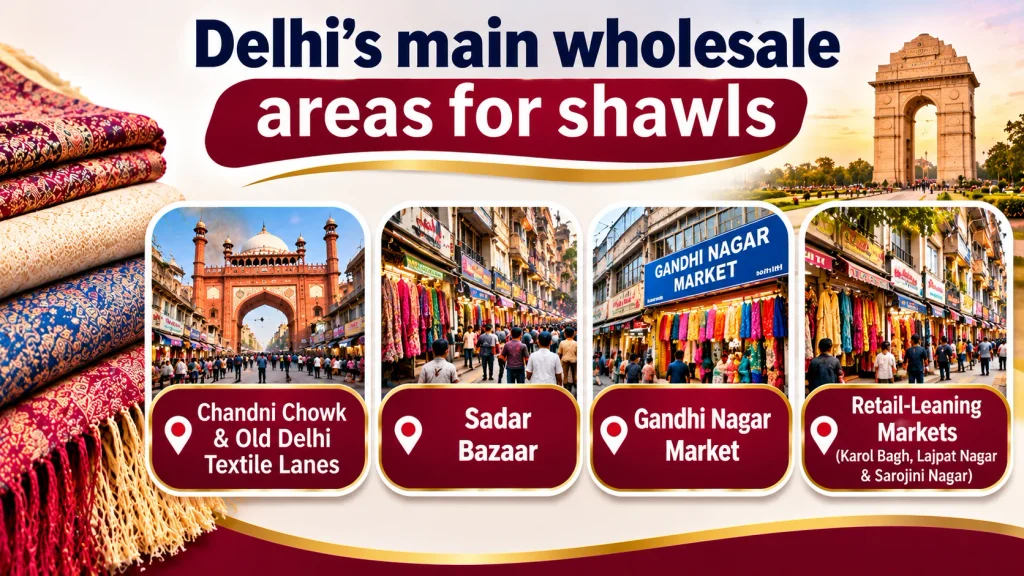
Delhi’s main wholesale areas for shawls
Specialisations shift over time, so treat this as a starting map and verify on the ground.
Chandni Chowk and the Old Delhi textile lanes. Historic wholesale district with long-established fabric and textile traders, including the Katra Neel area. This is where many buyers start looking for shawls, stoles and dupatta-type products in ready stock. Expect crowded lanes, cash-oriented trade, and wide variation in quality between shops.
Sadar Bazaar. One of Delhi’s largest wholesale markets for general goods and accessories. Useful for buyers putting together mixed assortments, including seasonal accessories.
Gandhi Nagar market. Known mainly as a large readymade garment market in East Delhi. It is a major source for garments, and some traders stock shawls, scarves and winter accessories, but it is not a specialist shawl market. Check what a stall actually stocks before you plan a trip.
Retail-leaning markets such as Karol Bagh, Lajpat Nagar and Sarojini Nagar are better for retail-level shopping than for volume wholesale pricing.
Weekly closing days and peak hours differ by market, so confirm them before you travel. Winter is the busiest time for shawls.
Buying in a Delhi market: pros and cons
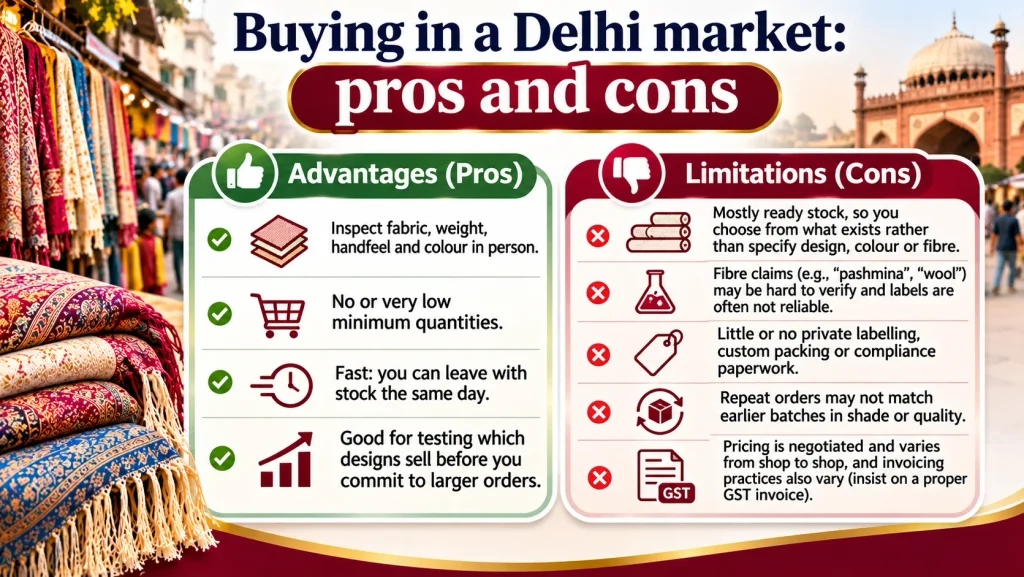
Advantages
- You can inspect fabric, weight, handfeel and colour in person.
- No or very low minimum quantities.
- Fast: you can leave with stock the same day.
- Good for testing which designs sell before you commit to larger orders.
Limitations
- Mostly ready stock, so you choose from what exists rather than specifying design, colour or fibre.
- Fibre claims such as “pashmina”, “wool” or “silk blend” may be hard to verify, and labels are often not reliable. Ask for fibre composition in writing, and consider a lab test for higher-value goods.
- Little or no private labelling, custom packing or compliance paperwork.
- Repeat orders may not match earlier batches in shade or quality.
- Pricing is negotiated and varies from shop to shop.
- Invoicing practices vary, so insist on a proper GST invoice if you need input tax credit.
When to go factory-direct
Move from the market to a manufacturer when any of these apply:
- You need volume. Once you are buying in hundreds of pieces per design, factory pricing usually beats trader pricing.
- You want your own design or label. Private label scarves, custom colours and your own packaging are factory services.
- You need consistency. A manufacturer can repeat a design with controlled shade and quality.
- You export. Documentation, packing, test reports and shipping terms matter. Suppliers may quote ex-factory, FOB or CIF.
- You need compliance proof. Retailers in the EU, UK and US increasingly ask about dyes, chemicals and social audits.
- You supply corporate gifting. Branded or co-ordinated orders need planned production, not whatever is in stock.
A practical middle path: use the markets to research trends and test small lots, then work with a manufacturer for your best sellers.
How to find reliable wholesale shawl suppliers in Delhi NCR
Delhi NCR includes manufacturers in and around Gurgaon, Noida and Faridabad, not just traders in the old markets. To shortlist a supplier:
- Confirm whether they manufacture or trade. Ask for a factory video call.
- Verify the entity. Check the IEC, GSTIN and company or LLP record. See our guide on how to verify a shawl supplier in India.
- Request fibre details in writing, including blend percentages and GSM.
- Order a paid sample before any bulk commitment.
- Ask about compliance if you sell in regulated markets: see azo-free dyes and REACH and GOTS, Sedex and BSCI.
- Agree terms in writing: MOQ, lead time, payment, Incoterms and quality tolerances.
Market vs factory-direct: a quick comparison
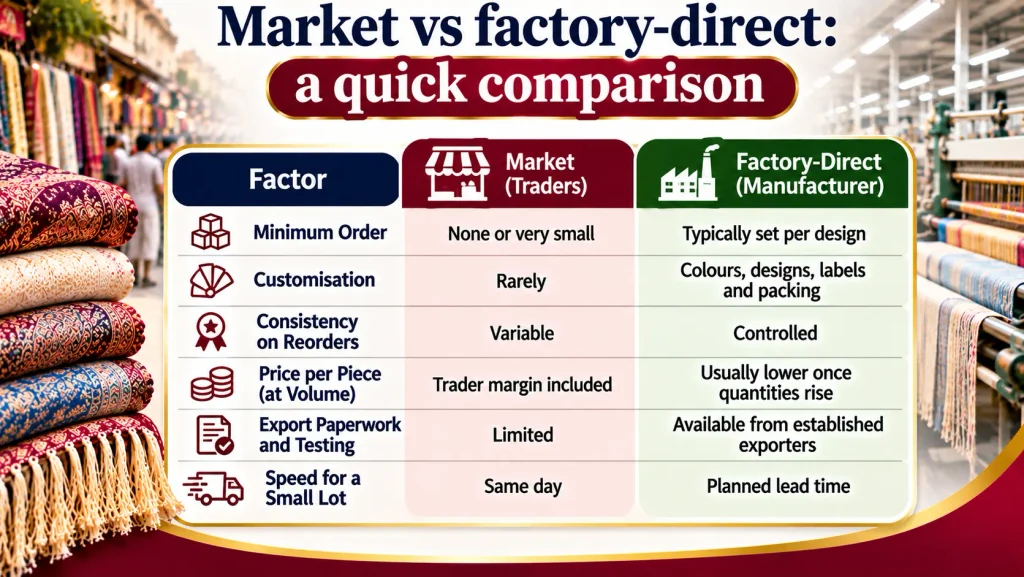
- Minimum order: market, none or very small; factory, typically set per design.
- Customisation: market, rarely; factory, colours, designs, labels and packing.
- Consistency on reorders: market, variable; factory, controlled.
- Price per piece at volume: market, trader margin included; factory, usually lower once quantities rise.
- Export paperwork and testing: market, limited; factory, available from established exporters.
- Speed for a small lot: market, same day; factory, planned lead time.
Savita Shawls: a Delhi NCR manufacturer and exporter
Savita Shawls (Savita Fashions LLP) is a Gurgaon-based manufacturer and exporter of shawls, stoles and scarves, established in 1984. We supply private label scarves, bulk orders and corporate gift shawls to retailers, brands and corporate buyers. On core ranges, our minimum order is 100 pieces per colour per design (some product lines differ, so check the product page), with a 15-day lead time and next-day sample dispatch on payment. Pricing is quoted ex-factory, FOB or CIF.
[CONFIRM: add the Gurgaon factory or office address, visiting hours and phone number, and say whether buyers can visit by appointment.]
If you are comparing Delhi markets against a factory, ask for a sample and a price at your target quantity, and compare them side by side.