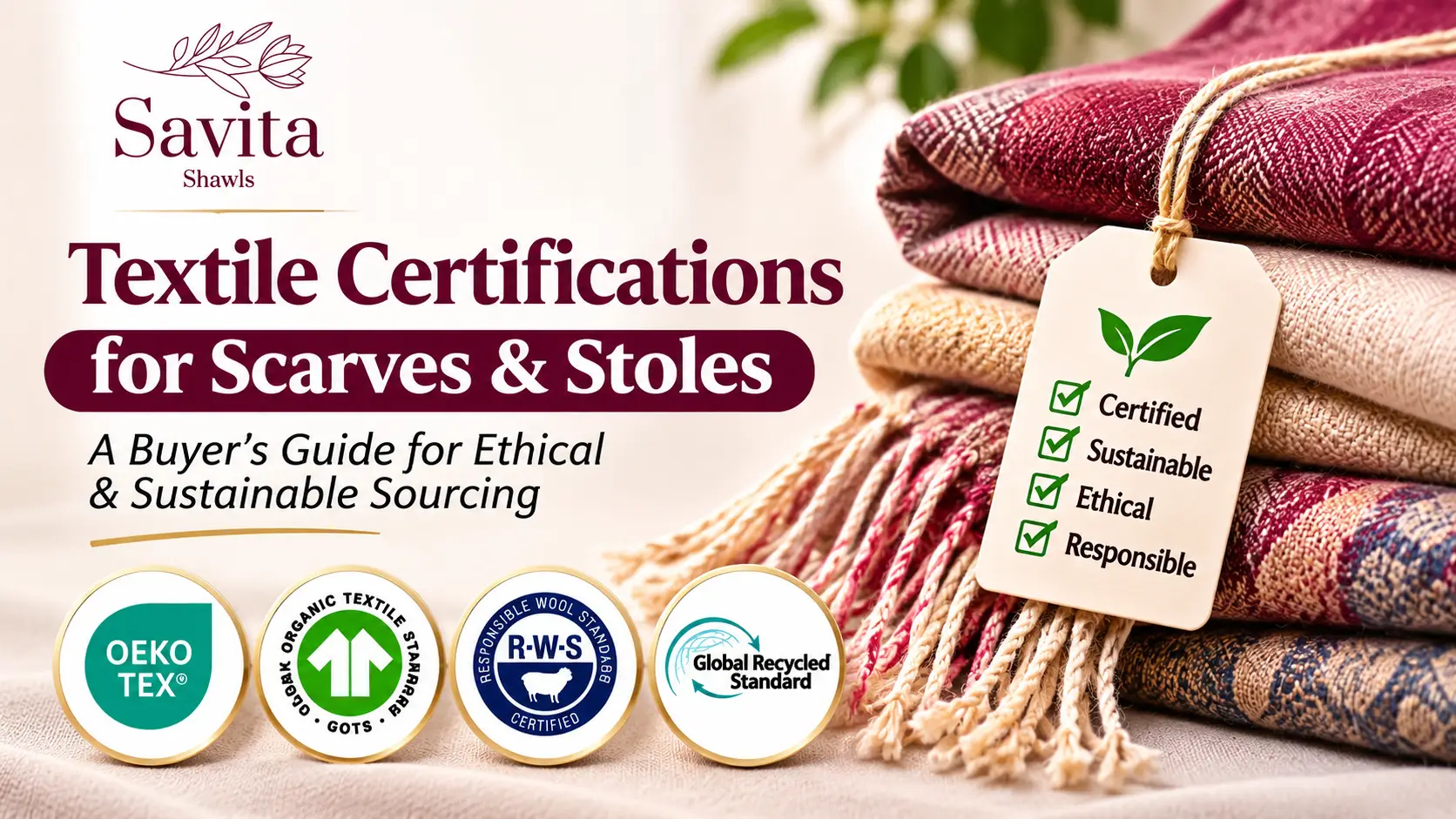
When you buy scarves in bulk, ask for different proof for different questions. GOTS proves what the fibre is and how it was processed. Sedex (SMETA audit) shows how a factory treats its workers. BSCI shows whether a supplier meets a code of conduct on labour and ethics. A good GOTS certified scarf manufacturer should show current certificates for each claim, not just a logo on a website.
Retail compliance teams in the EU, UK, US and Australia now ask for these documents during supplier onboarding. This guide explains what each certification covers, what it doesn’t, and how to verify it before you place an order.
What does each certification actually prove?
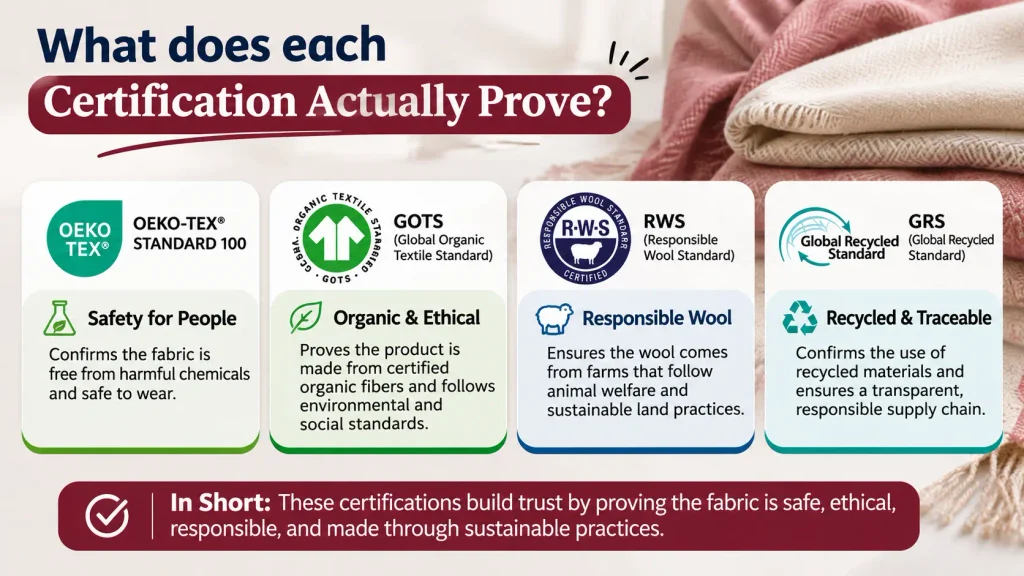
These three are often grouped together, but they answer three different questions.
- GOTS (Global Organic Textile Standard): covers the product and process. It checks organic fibre content, restricted chemicals, wastewater treatment, and social criteria across the processing chain.
- Sedex / SMETA: Sedex is a platform for sharing supplier data. The audit behind it is SMETA, which reviews labour standards, health and safety, environment, and business ethics at a specific site.
- BSCI (amfori BSCI): a social compliance system built on a code of conduct. Audits produce a rating, and buyers who are amfori members use it to monitor their suppliers.
Neither Sedex nor BSCI says anything about the fibre. A factory can pass a social audit and still not be able to sell you GOTS-certified goods, and the reverse is also true.
GOTS: what to ask a scarf manufacturer
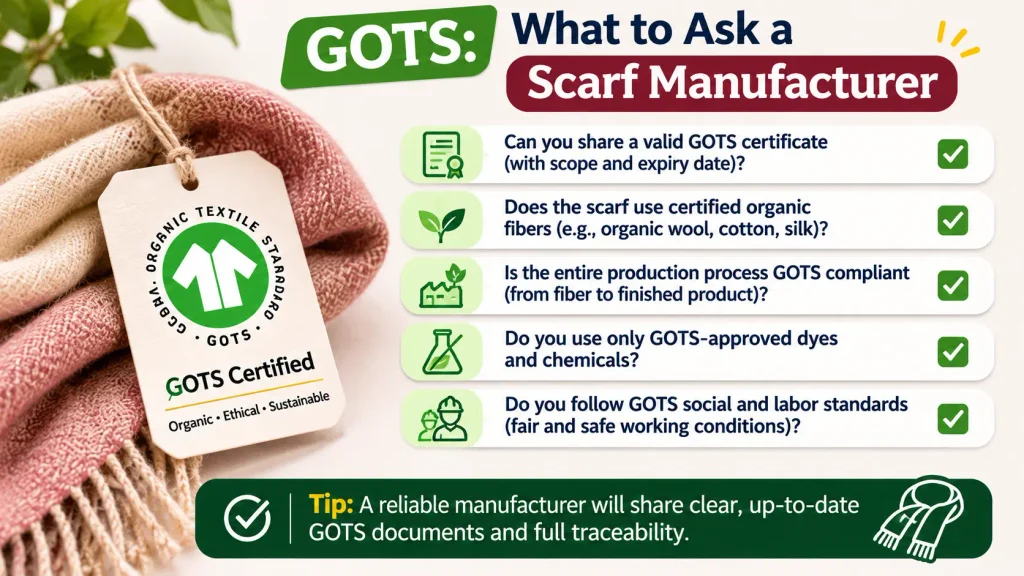
If you want organic cotton scarves wholesale, or organic wool or other certified fibres, GOTS is the label to check. Ask for these:
- A valid scope certificate that lists the exact facility and the product categories it covers.
- A transaction certificate (TC) for your shipment. In GOTS, certified status applies to a specific consignment, not to the factory in general.
- Label grade. “Organic” needs at least 95% certified organic fibre. “Made with organic” needs at least 70%. A scarf at 70% should not be sold as “organic”.
- The full chain. Spinning, weaving, dyeing and finishing steps carried out by subcontractors must also be certified. If dyeing is outsourced to an uncertified unit, the claim fails.
You can check any certificate in the public GOTS database, using the licence number on the document. Check the current GOTS version, because the criteria are revised periodically.
Sedex audit for textiles: what buyers should look for
Many buyers ask for a “Sedex audit” when they mean a SMETA report. What to request:
- The SMETA audit report (2-pillar or 4-pillar) and its date. Reports are usually valid for about a year.
- The factory’s Sedex ZC or ZS number so you can confirm the site on the platform.
- The corrective action plan for any non-conformities, and proof they were closed.
Ask which site was audited. A head office audit does not cover a separate production unit.
BSCI certified supplier India: what the rating means
amfori BSCI audits rate suppliers on a scale from A (very good) to E (insufficient). Ask for:
- The latest audit report and rating, plus the audit date.
- Whether the audit covers the unit that will make your order.
- Evidence of how the supplier handles subcontracting, since scarves often involve outsourced embroidery, dyeing or finishing.
A BSCI audit is a monitoring tool, and its rating changes over time. Treat it as a snapshot, not a permanent badge.
Which certification do you need? A buyer’s checklist
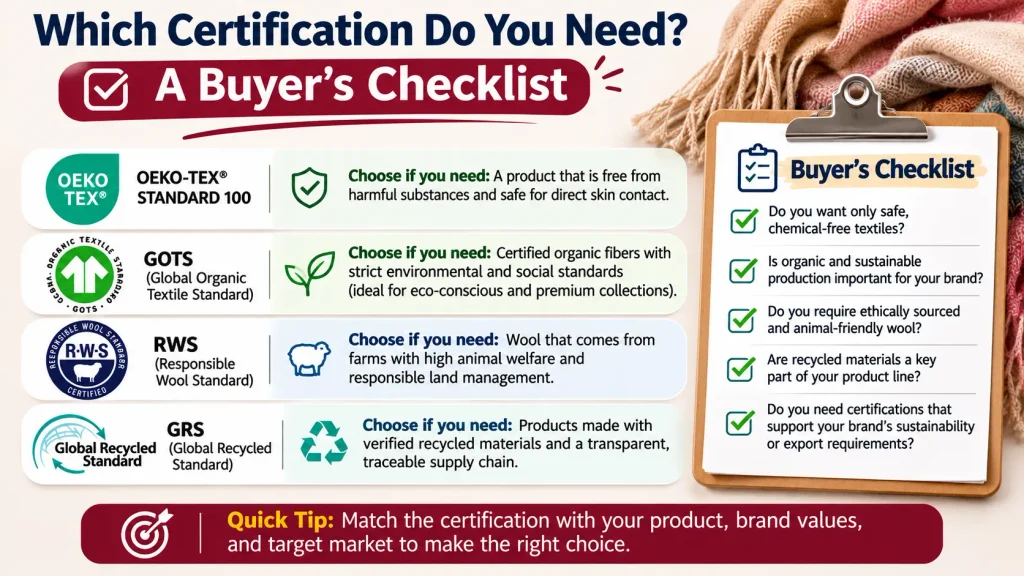
- Selling “organic” or eco-labelled scarves: GOTS is the one that supports the claim.
- Supplying a major retailer or brand with a code of conduct: expect them to ask for SMETA/Sedex, BSCI, or both.
- Corporate gifting or private label programmes: ask for the social audit first, then GOTS if the product is marketed as organic or sustainable. Explore our corporate gift shawls and private label fashion scarves for customised B2B sourcing options.
- EU market: supply chain due diligence rules are tightening, so audit documentation and traceability matter more each year.
Red flags when a supplier says “we are certified”
- A logo with no certificate number.
- A certificate that names a trading company, not the factory that will make your goods.
- An expired audit report.
- No transaction certificate offered for a GOTS order.
- “GOTS-compliant” or “organic-friendly” wording, which is not the same as GOTS certified.
Our compliance position at Savita Shawls
[CONFIRM: list only the certifications Savita Fashions LLP actually holds, with certificate numbers, audit dates and the covered site. Example structure: “Our Gurgaon unit holds [certificate] valid until [date]. Certificate copies are available on request during onboarding.”]
Savita Shawls has manufactured and exported shawls, stoles and scarves from India since 1984. We work with buyers on private label scarves, bulk orders and corporate gift shawls, with a minimum order of 100 pieces per colour per design on core ranges, a 15-day lead time and next-day sample dispatch on payment.
Explore our shawls and scarves manufacturing collection to discover more sourcing options.
If your compliance team needs specific documents before sampling, tell us at enquiry stage and we will confirm exactly what we can supply.
Frequently Asked Questions
What does GOTS certified mean for a scarf?
It means the scarf’s fibre and processing meet the Global Organic Textile Standard. This includes minimum organic fibre content, restricted chemical inputs, wastewater treatment and social criteria. Certification applies to the whole processing chain, and each shipment needs its own transaction certificate.
Is Sedex a certification?
No. Sedex is a platform where suppliers share ethical trade data. The audit behind it is usually a SMETA audit. A buyer should ask for the SMETA report and the site’s Sedex number, not just a “Sedex member” claim.
What is the difference between Sedex and BSCI?
Both look at social compliance, but they are different systems. SMETA/Sedex is an audit methodology shared through a platform, and amfori BSCI is a code-of-conduct programme with its own rating scale. Buyers often accept one or the other depending on their own supplier programme.
How do I verify a BSCI certified supplier in India?
Ask for the latest audit report, rating and audit date, and confirm the audited site is the one that will produce your order. Ask whether subcontractors are covered. Retail buyers who are amfori members can also check through their own account.
Do I need GOTS for organic cotton scarves wholesale?
If you plan to market the scarves as organic, GOTS is the most widely recognised certification and gives you the strongest proof. “Organic” requires at least 95% certified organic fibre, and “made with organic” requires at least 70%.
Can a factory be GOTS certified but not audited for social compliance?
GOTS includes social criteria, but many buyers still ask for a separate SMETA or BSCI audit because retailers’ supplier programmes require their own audit format. Ask the supplier which documents they can provide.
What documents should I request before a bulk scarf order?
Request the GOTS scope certificate and transaction certificate (if the order is organic), the latest SMETA or BSCI audit report with its date, confirmation of the audited site, and the factory’s corrective action status. Ask for these before you approve samples.