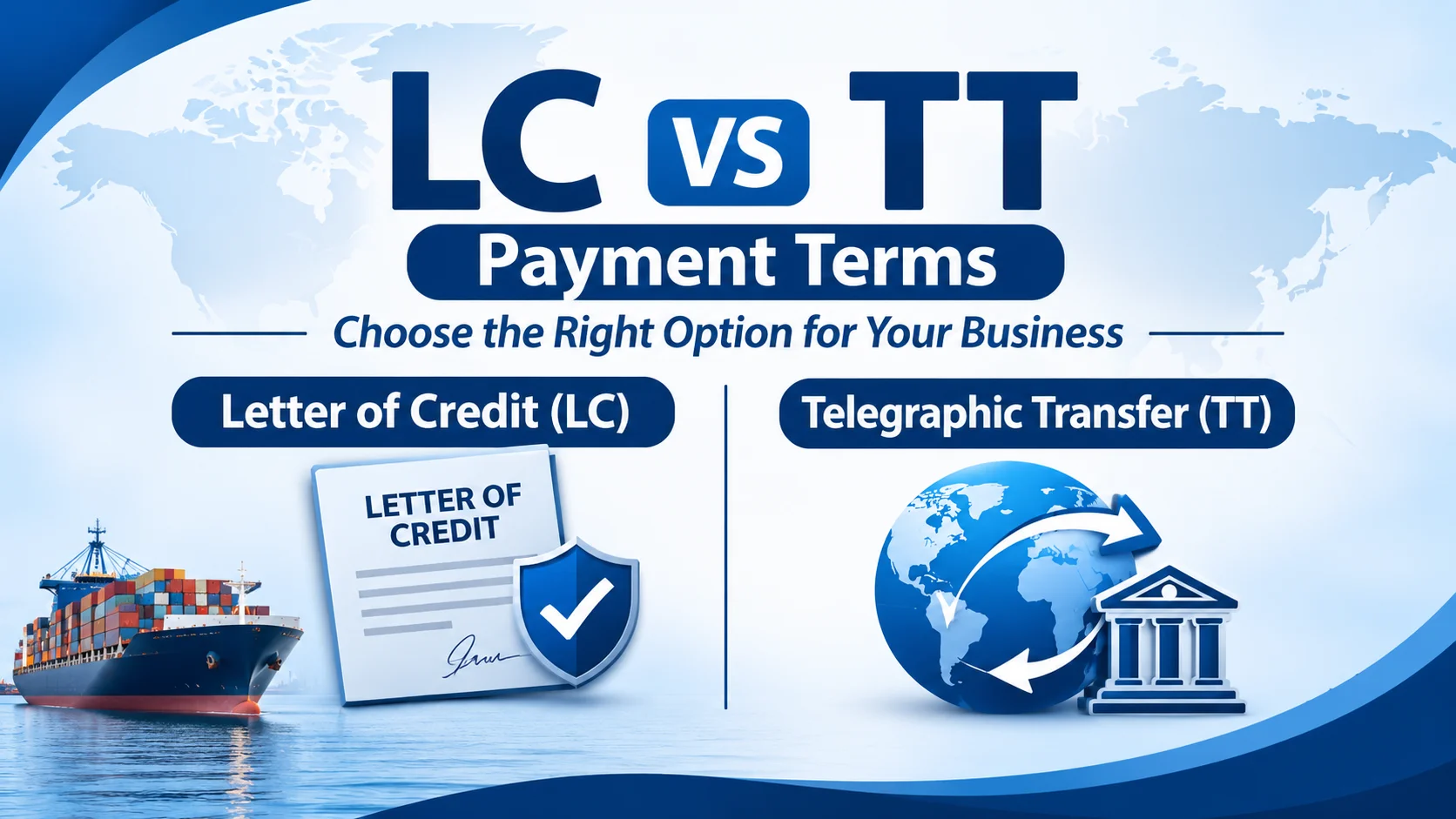
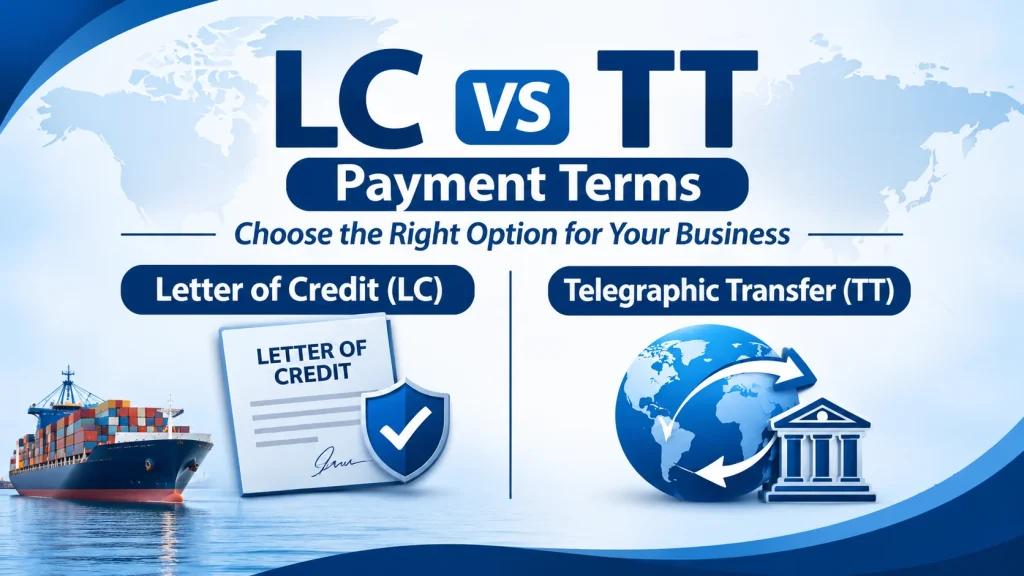
TT (telegraphic transfer) is a direct bank wire from you to the supplier, usually split into an advance and a balance. LC (letter of credit) is a bank’s promise to pay the supplier once the supplier presents the documents the credit asks for. Most small and mid-size shawl buyers use TT with an inspection before the balance is paid. LC suits larger or first-time orders where both sides want a bank in the middle, at the price of extra fees and strict paperwork.
Payment terms decide who carries the risk in an import order. If you pay everything upfront, you carry the risk that goods will not arrive as agreed. If the supplier ships before being paid, the supplier carries it. The LC vs TT payment choice is about sharing that risk fairly. This guide explains both methods in plain language, compares them side by side, shows what each costs, and helps you pick the right payment terms for import from India, whether you are buying a first trial order or a large seasonal shipment of shawls.
Key facts at a glance
- TT is a bank-to-bank wire transfer sent through the SWIFT network. It is the most common way to pay for shawl and scarf orders.
- LC (also called a documentary credit) is a bank guarantee of payment, issued at the buyer’s request, that is released only when the supplier presents compliant documents.
- Letters of credit follow the ICC rulebook UCP 600, which remains the current standard. The credit must say that it is subject to these rules.
- A typical TT structure for custom production is an advance to start work and a balance before or against shipping documents.
- LC fees vary by bank and risk, and issuance fees are often quoted between roughly 0.1% and 1% of the credit value, with minimum charges. Other fees come on top.
- On an LC, a small mismatch in documents can delay payment, so the paperwork needs care.
What is TT (telegraphic transfer) in a shawl order?
TT is a direct bank transfer from your account to the supplier’s account. It is also called a wire transfer. It reaches the supplier within a few working days, and you can send it in US dollars, euros, pounds or another agreed currency.
For a shawl order, TT is usually split:
| Stage | Typical payment | Purpose |
|---|---|---|
| Order confirmation | Advance payment (a share of the total) | Covers yarn, dyes and production start |
| Before shipment | Balance after inspection | Releases goods once quality is confirmed |
| Alternative balance | Balance against a copy of the shipping document | Used when inspection is done by the supplier |
The exact split is a matter of negotiation, and it depends on the order size, the supplier’s history with you and how much of the order is custom. Our guide on MOQ negotiation with shawl suppliers explains how order size affects the terms you can ask for.
Advantages of TT
- Fast and simple. One bank transfer, with no credit to open or amend.
- Low cost. Bank charges are usually a fixed fee on each transfer, far below LC fees.
- Flexible. You can change quantities or add pieces without amending a credit.
Risks of TT
- You rely on the supplier. After the advance is paid, you have no bank guarantee that goods will ship as agreed.
- Fraud risk. Fake bank details sent by email are a known problem. See the safety checklist below.
- Weak leverage after the balance. If you pay in full before inspection, you lose your main protection.
What is an LC (letter of credit) in textile trade?
A letter of credit is a written promise from your bank, the issuing bank, to pay the supplier a set amount, as long as the supplier presents the documents the credit lists, in exactly the form and by the date the credit states. The supplier’s bank checks the documents and passes them to your bank, which then pays.
The basic flow is:
- You and the supplier agree LC payment in the sales contract.
- You ask your bank to issue the LC in the supplier’s favour.
- The supplier’s bank advises the supplier that the credit has arrived.
- The supplier produces and ships the shawls.
- The supplier presents the required documents through the bank.
- The banks check the documents against the credit terms.
- If the documents comply, payment is made at sight or on the agreed date.
Common LC types for shawl orders
| LC type | What it means | When it is used |
|---|---|---|
| Sight LC | Payment is made soon after compliant documents are accepted. | Most common for first and mid-size orders. |
| Usance (term) LC | Payment is made after a set period, often 30, 60 or 90 days after documents are accepted. | When the buyer wants credit time. |
| Confirmed LC | A second bank, often in the supplier’s country, adds its own payment guarantee. | When the supplier doubts the buyer’s bank. |
| Unconfirmed LC | Only the buyer’s bank guarantees payment. | When the buyer’s bank is trusted by the supplier. |
Under UCP 600, credits are irrevocable, which means they cannot be changed or cancelled without the agreement of everyone involved.
Advantages of an LC
- Payment security for the supplier. The bank promise makes it easier to commit to a large or custom order.
- Document discipline for the buyer. You can require an inspection certificate, a packing list, a certificate of origin and other papers as conditions for payment.
- No upfront payment by the buyer. Money moves only when the supplier ships and presents compliant documents.
Risks and costs of an LC
- Fees. Issuance, confirmation, amendment, document handling and discrepancy charges can all apply. Issuance fees are often a small percentage of the credit value, with a minimum charge, and confirmation adds more.
- Strict compliance. A small mismatch, such as a spelling difference in the consignee name, can count as a discrepancy and delay payment.
- It checks documents, not goods. An LC proves that papers match. It does not prove that shawl quality is right, so you still need inspection. See our guide to AQL and pre-shipment inspection.
- Time and effort. Opening and amending a credit takes days, which matters when production schedules are tight.
LC vs TT: side-by-side comparison
| Factor | TT (wire transfer) | LC (letter of credit) |
|---|---|---|
| Speed to set up | Same day | Several days, sometimes longer with amendments |
| Bank charges | Low, fixed per transfer | Higher, several fee types |
| Security for the buyer | Depends on the supplier and your inspection | Payment tied to documents, but not to goods quality |
| Security for the supplier | Low until fully paid | High, backed by a bank |
| Flexibility | High | Low, since changes need an amendment |
| Paperwork | Light | Heavy, strict compliance |
| Best for | Small and mid-size orders, repeat buyers | Large orders, new relationships, higher-risk routes |
| Negotiating power | Strong if you keep the balance until after inspection | Strong if you list the documents you need |
Which payment terms suit which buyer?
First sample or trial order
Samples and small trial orders usually go by TT, often paid in full, because LC fees would be out of proportion. Our guide on how to request samples from a shawl manufacturer explains the sampling stage.
Small and mid-size bulk orders
TT with an advance and a balance is the usual choice. The balance should be tied to an event you can check: a passed inspection report, or copies of the shipping documents.
Large or high-value orders
An LC at sight can suit both sides, especially when you have not traded before. Many buyers also use a mix: an LC for most of the value plus a small TT advance for materials.
Repeat buyers with a good track record
After several clean orders, many suppliers agree to better terms, such as a smaller advance. Some buyers move to credit terms, which means they pay after delivery. That depends on trust, volume and your credit position.
How to protect yourself when paying by TT
TT works well, but protect your money with these steps:
- Verify bank details by phone. Never rely on an email alone. Call a number you already know, not one printed in the email asking for payment. Fake invoices and changed bank details are a common fraud.
- Pay only to a company account in the supplier’s registered name, matching the invoice and contract.
- Keep the balance until after inspection. Tie it to a passed report. Read about AQL and pre-shipment inspection.
- Approve colours and samples before you pay the advance. See our guide to lab dips and strike-offs.
- Put terms in writing. The purchase order or proforma invoice should state the amounts, dates, currency, bank details and what happens if production is late.
- Keep records. Save transfer receipts and written approvals in case of a dispute.
- Check the supplier first. Our guide on choosing the right shawl manufacturer lists what to verify.
How to avoid problems with an LC
Most LC problems come from document errors, not from bad faith. To keep payment moving:
- Agree the document list before the credit is opened. Typical documents include the commercial invoice, packing list, bill of lading or air waybill, certificate of origin, insurance document and an inspection certificate.
- Check the draft credit carefully and ask for amendments before production starts, not after shipment.
- Match names and descriptions exactly. Company names, addresses, goods descriptions and quantities must agree across all documents.
- Respect the dates. The credit has a latest shipment date and an expiry date. Under UCP 600, documents must normally be presented within 21 days after shipment, and always within the credit’s validity.
- Ask for a document checklist from the supplier’s bank or your own.
Origin certificates matter too, because they can reduce duty in your market. See our guides to importing shawls from India to the USA, importing shawls and scarves from India to the UK and sourcing shawls for Dubai and the UAE.
A worked example: $30,000 shawl order
| Detail | TT with advance and balance | Sight LC |
|---|---|---|
| Order value | $30,000 | $30,000 |
| Payment at order | 30% advance, $9,000 | Nothing paid, LC opened |
| Payment before shipment | 70% balance, $21,000, after inspection | Paid by the bank when documents comply |
| Bank charges | Fixed fee on each transfer | Issuance, advising, document and possible confirmation or amendment fees |
| Main risk for you | Supplier performance after the advance | Document discrepancies, higher fees |
| Time to set up | Immediate | Several days |
The numbers are illustrative. The percentages, fees and conditions are set by contract and by your bank, so ask for a written quote from your bank for the LC and compare it with the TT cost. For small orders, the fees often outweigh the benefit.
Payment terms and delivery terms work together
Your payment method and your delivery term should fit each other. For example, under FOB you pay freight separately, and under DDP the seller carries delivery and duty. Our guide to DDP shipping from India explains how delivery terms change the price and risk. Make sure the payment terms, the Incoterm and the inspection date all appear on the same purchase order.
Frequently asked questions
What is the difference between LC and TT?
TT is a direct bank transfer from the buyer to the supplier, usually in two parts. An LC is a bank’s promise to pay the supplier once compliant shipping documents are presented. TT is faster and cheaper, and LC gives both sides a bank guarantee.
Which is safer for the buyer, LC or TT?
An LC makes sure you pay only against the documents you list, but it does not check the goods. TT can be just as safe if you keep the balance until after a passed inspection and verify the supplier’s bank details. Neither replaces quality inspection.
What are typical payment terms for import from India?
For custom shawl orders, a common structure is an advance to start production and a balance before shipment or against shipping documents. Larger orders may use an LC at sight. Exact terms depend on the supplier, the order size and your history together.
How much does a letter of credit cost?
Costs vary by bank, country and risk. Issuance fees are often a small percentage of the credit value, with a minimum charge, and confirmation, amendment and discrepancy fees can add to this. Ask your bank for a written fee schedule before you commit.
Is advance payment safe when ordering shawls from India?
It can be, if you verify the supplier, pay only to a company account in its registered name, approve samples first and keep the balance until after inspection. Avoid paying the full amount upfront on a new relationship.
What is a discrepancy in a letter of credit?
A discrepancy is a mismatch between the presented documents and the credit terms, such as a wrong date, name or quantity. A discrepancy can delay or stop payment until it is fixed or accepted by the buyer.
Can I mix LC and TT in one order?
Yes. Many buyers pay a small TT advance to cover materials and use an LC for the rest of the order value. Put this clearly in the sales contract.
Choose payment terms that work for your shawl order
If you are planning a bulk order, tell us your quantity, destination and preferred payment method, and we will confirm the terms we can offer for your order. You can browse our wholesale shawls supplier range, read more about us as a shawl manufacturer in India, or ask about private label shawl manufacturing and custom shawl orders. When you are ready, request a quote or use the contact page.