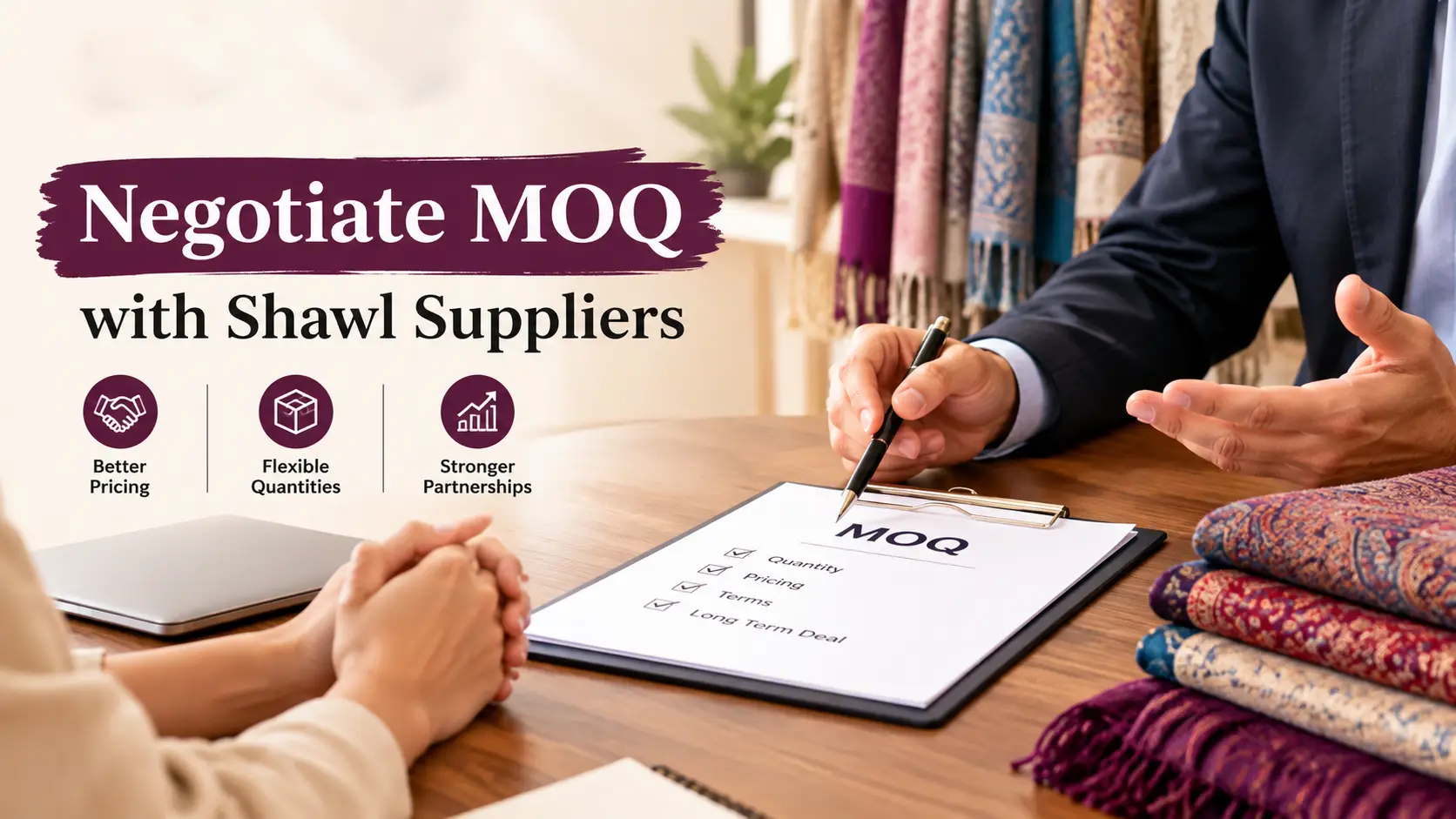
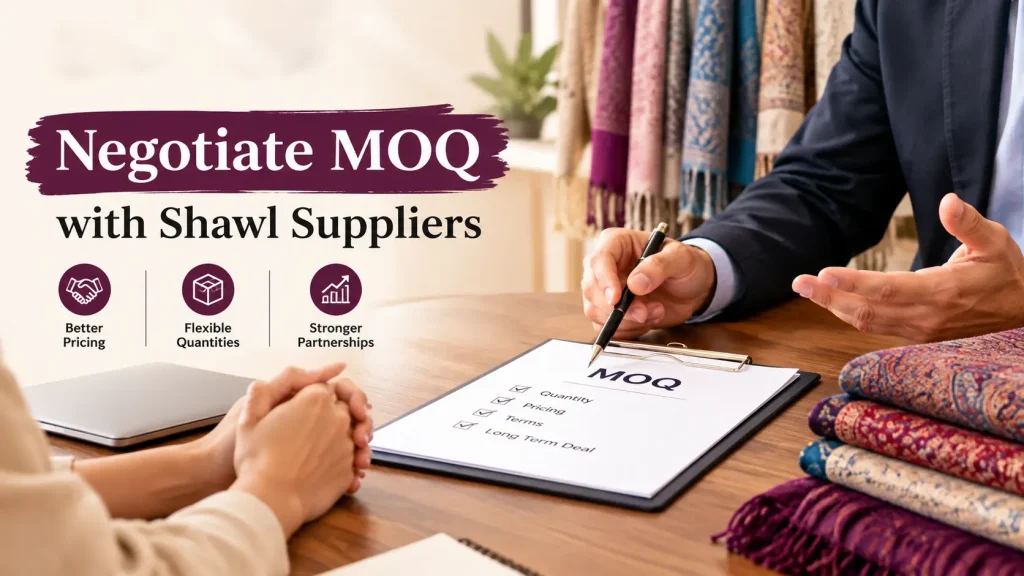
MOQ (minimum order quantity) with shawl suppliers is negotiable in most cases, particularly when a buyer offers flexibility on colour or design variety, commits to a repeat-order relationship, or accepts a slightly longer production lead time. The key to negotiating without hurting your margins is understanding what actually drives a supplier’s MOQ (fabric dyeing lots, loom setup costs, or embroidery batch minimums) rather than treating it as a fixed, non-negotiable number.
Buyers who understand the cost structure behind an MOQ consistently negotiate better terms than those who simply ask for a lower number without offering anything in return.
What Actually Determines a Shawl Supplier’s MOQ
MOQs aren’t arbitrary. They’re usually driven by one or more of these factors:
- Dye lot minimums: Dyeing a small batch of yarn or fabric isn’t cost-efficient below a certain quantity, since setup and colour-matching costs are largely fixed regardless of batch size
- Loom or machine setup time: Changing a loom’s configuration for a new weave pattern takes time that only becomes cost-effective when spread across a larger run
- Embroidery or hand-work batch size: Hand embroidery workshops often organize work in batches tied to artisan availability, making very small custom orders harder to schedule efficiently
- Raw material purchasing thresholds: Suppliers often buy yarn or fibre in bulk from their own vendors, and passing on per-unit savings depends on reaching a minimum production volume
- Packaging and finishing setup: Custom packaging, labels, or branded tags usually have their own minimum print or production runs, separate from the shawl MOQ itself
Understanding which of these is driving a specific supplier’s MOQ tells you exactly what to offer in a negotiation.
Negotiation Levers That Actually Work
1. Consolidate Colours or Designs
If a supplier’s MOQ is tied to dye lot minimums, ask whether the MOQ applies per colour or across your total order. Many suppliers will accept a lower per-colour minimum if you consolidate your order into fewer colourways rather than requesting ten different shades in small quantities.
2. Offer a Repeat-Order Commitment
Suppliers are often willing to lower MOQ on a first order if a buyer can credibly commit to repeat purchasing, since the relationship’s long-term volume offsets the inefficiency of a smaller initial batch. This works best when backed by a written purchase forecast, even an informal one, rather than a verbal promise.
3. Accept a Longer Lead Time
Rush production at low volume is inefficient for a supplier because it disrupts their production schedule. Offering flexibility on delivery timeline, allowing your order to be slotted into existing production runs, can unlock lower MOQs than a buyer demanding both low volume and fast turnaround.
4. Simplify Customization Requests
Custom packaging, branded labels, or unique embroidery patterns often carry separate MOQs from the base shawl product. If your MOQ concern is specifically about customization minimums, ask whether standard packaging with a simpler branded insert (rather than fully custom printed boxes) can reduce that portion of the minimum.
5. Mix Product Categories Within One Order
Some suppliers calculate MOQ per fabric type or weaving technique rather than per finished product. If you need smaller volumes across multiple categories (Pashmina, wool, viscose), ask whether combining them into a single purchase order changes how MOQ is calculated, since it may be assessed on total order value rather than per-category volume. This is especially relevant if you’re building a private label Pashmina line alongside more accessible fabric options.
6. Start with a Trial Order at a Small Premium
Some suppliers will accept below-MOQ orders at a per-unit price premium, treating it as a paid sample run rather than a loss-making short batch. This can be a reasonable trade-off for buyers testing a new market or product line before committing to full MOQ volume.
What Not to Do When Negotiating MOQ
- Don’t ask for a lower MOQ and a lower per-unit price simultaneously without offering anything in exchange, since this typically signals a buyer who hasn’t understood the supplier’s cost structure
- Don’t misrepresent your order volume potential to secure favourable terms; suppliers remember buyers who don’t follow through, and it damages future negotiating leverage
- Don’t skip the sample stage to save time, even when negotiating a smaller trial order, since quality issues in an unapproved batch are far more costly than the time saved
Structuring a Tiered Order to Manage MOQ Across Multiple SKUs
If you need product variety but individual suppliers won’t budge on per-SKU minimums, consider structuring your sourcing as a tiered strategy:
| Tier | Approach | Best For |
|---|---|---|
| Core SKUs | Full MOQ, negotiated pricing | High-confidence, repeat-selling products |
| Trial SKUs | Small batch at premium pricing | Testing new colours, patterns, or markets |
| Custom/private label | Combined order with core SKUs to meet MOQ | Building a differentiated private label shawl or OEM line |
This approach lets you manage cash flow and inventory risk without abandoning product diversity altogether.
How MOQ Interacts with Quality and Certification Requirements
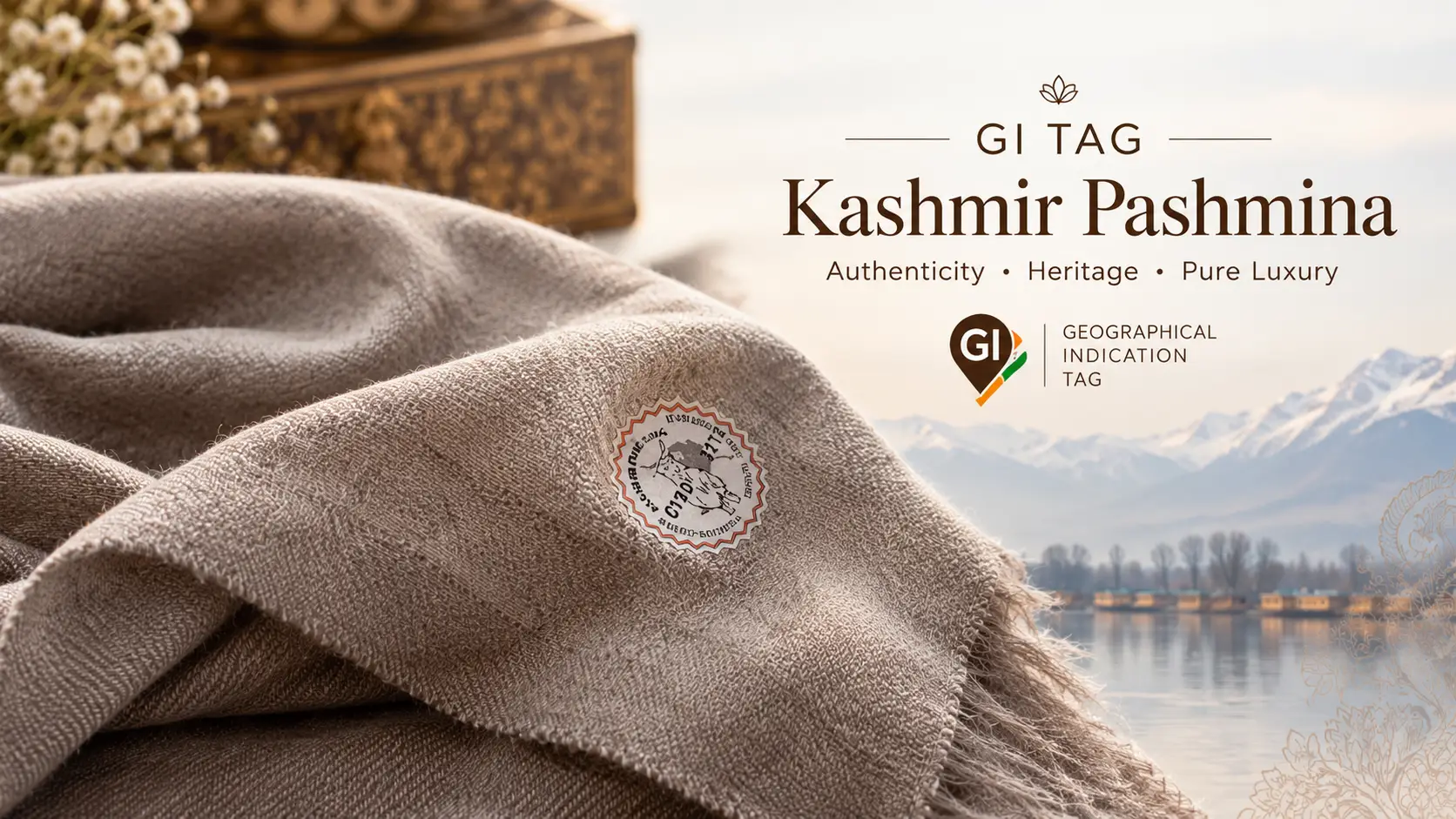
Buyers focused on GI-certified Pashmina or ISO-audited production should be aware that certified sourcing sometimes carries slightly higher MOQs, since certified fibre batches and audited production runs are managed more rigidly than general-purpose stock. This is a reasonable trade-off in most cases, since the documentation and consistency benefits (covered in our guides to the GI tag for Kashmir Pashmina and ISO certified shawl factories) typically outweigh the cost of a marginally higher minimum order.
When to Walk Away from an MOQ Negotiation
Not every MOQ is worth negotiating down. If a supplier’s minimum reflects a genuinely efficient production batch size for your required specification, pushing for a smaller order may only result in a rushed, poorly managed run that damages the relationship and the product quality. In these cases, it’s often better to either:
- Accept the MOQ and manage inventory risk through better demand forecasting, or
- Source that specific SKU from a different supplier better suited to smaller batch production, while keeping your primary supplier for higher-volume core products
Questions to Ask Before Your Next MOQ Negotiation
- Is the MOQ calculated per colour, per design, or across the total order value?
- What specifically drives this MOQ: dyeing, weaving setup, embroidery batching, or raw material purchasing?
- Would a repeat-order commitment or longer lead time change the minimum?
- Is there a trial-order option at a per-unit premium instead of the full MOQ?
- Does combining multiple product categories into one purchase order affect how MOQ is assessed?
How Savita Shawls Structures MOQ for Wholesale and Private Label Buyers
Savita Shawls works with buyers across a range of order sizes, from established wholesale accounts to newer private label brands testing the market. We structure MOQ discussions around your specific product mix, whether that’s custom shawls, white label production, or core catalogue stock. Review our wholesale shawl and stole buyer’s guide for general order planning, or explore the Pashmina shawls manufacturer category to see current stock and volume tiers.
Frequently Asked Questions
Is MOQ always negotiable with shawl manufacturers?
Not always, but it’s frequently more flexible than initially quoted, especially when a buyer can offer something in return, such as colour consolidation, a repeat-order commitment, or flexibility on lead time.
What is a typical MOQ for wholesale shawl orders?
MOQs vary significantly by fabric type, customization level, and manufacturer, ranging from a few dozen units for simpler stole designs to several hundred units for heavily customized or hand-embroidered products. Confirm current MOQs directly with your supplier for the specific SKU you need.
Can I combine different shawl types in one order to meet an MOQ?
Sometimes. Some suppliers calculate MOQ per fabric type or technique, while others assess it against total order value. Ask directly how your specific supplier structures MOQ before assuming combined orders will help.
Does a lower MOQ mean lower quality?
Not necessarily, but very small custom batches can be harder for a supplier to manage with the same quality consistency as a standard production run. This is why trial orders, even at a small premium, are often a better approach than pushing for an unusually low custom MOQ.
Should I prioritize price or MOQ flexibility when negotiating?
It depends on your business stage. Newer brands testing product-market fit often benefit more from MOQ flexibility, even at a slightly higher per-unit cost, while established buyers with predictable demand typically benefit more from negotiating better pricing at full MOQ volume.
How does MOQ affect private label and custom branding orders?
Private label and custom branding often carry separate MOQs for packaging, labelling, and sometimes fabric customization, in addition to the base product MOQ. Clarify each of these separately during negotiation rather than assuming one number covers the full order.
Working through MOQ options for your next order? Get a wholesale quote from Savita Shawls and discuss volume tiers suited to your specific product mix.