AQL inspection for garments is a statistical sampling method (defined in ISO 2859-1) that tells you how many pieces to pull from a finished bulk lot and how many defects you can accept before rejecting the whole lot. For shawls, most buyers set AQL 2.5 for major defects, AQL 4.0 for minor defects, and zero tolerance for critical defects, then run the check when 80 to 100 percent of the order is packed.
If you are placing a bulk order for shawls, stoles or scarves with a supplier in India, the single most useful quality tool you have is a clear AQL written into the purchase order. It turns “good quality” from a feeling into a number both sides can check. This guide explains AQL inspection for garments in plain language, what the AQL 2.5 meaning is for a shawl order, how to build a pre shipment inspection checklist, and how textile quality inspection in India usually works in practice.
Key facts at a glance
- AQL stands for Acceptable Quality Limit (also written Acceptance Quality Limit).
- The sampling tables come from ISO 2859-1, which is the same system as ANSI/ASQ Z1.4.
- Three defect classes are normally used: critical, major and minor.
- Common setting for apparel and accessories: critical 0, major 2.5, minor 4.0, at General Inspection Level II.
- Best timing for the final check: when at least 80 percent of the order is finished and packed, before the goods leave the factory.
What AQL inspection for garments actually is
Nobody checks every single piece in a 5,000 piece shawl order. It would take days and still miss things. Instead, an inspector draws a random sample from the finished lot, checks each piece in the sample against an agreed standard, and counts the defects. If the count stays at or below the accept number, the lot passes. If it goes over, the lot fails.
That is AQL inspection for garments in one paragraph. The “AQL” part is simply the defect level you and your supplier agree is acceptable. The same method is used for shirts, jackets and accessories, and it works just as well for shawls, stoles, scarves and mufflers.
Three choices make up any AQL plan:
- Inspection level, which controls how large the sample is. General Level II is the standard default.
- AQL value per defect class, such as 2.5 for major and 4.0 for minor.
- Lot size, meaning the number of finished pieces being inspected together.
AQL 2.5 meaning, without the jargon
The AQL 2.5 meaning that matters on the shop floor is this: for a given defect class, the lot is acceptable if the defect rate stays around 2.5 percent or lower. It is a limit on the quality level, not a promise that exactly 2.5 percent of your shawls will be faulty.
Two points that buyers often miss:
- AQL is not a target. A good manufacturer aims far below it. If a supplier runs at AQL 2.5 every time, your returns will hurt.
- A pass does not mean the lot is perfect. It means the sample was within limits. A lot can contain a few faulty pieces and still pass, which is why the defect definitions in your order matter as much as the number.
A lower AQL number is stricter. AQL 1.5 allows fewer defects than AQL 2.5, and AQL 4.0 allows more. Premium and luxury buyers often tighten to 1.5 for major defects. Mass retail often sits at 2.5 or 4.0.
Critical, major and minor defects in shawls
Before any inspection, both sides need to agree what counts as a defect and how serious it is. Here is a practical split for woven shawls, stoles and scarves:
| Defect class | What it means | Shawl and scarf examples | Typical AQL |
|---|---|---|---|
| Critical | Unsafe, illegal or makes the product unusable. One piece fails the lot. | Wrong fibre content on the label, banned dye or chemical failure on a lab test, missing mandatory care or origin label for the destination market, strong chemical smell | 0 (not accepted) |
| Major | Likely to make the customer return the product or reduce its sale value. | Holes, snags or broken threads in the body, visible stains, clear shade difference against the approved sample, wrong size beyond tolerance, wrong colour or design, uneven or missing fringe sections | 2.5 |
| Minor | Small flaw that most customers would not notice or reject over. | Loose thread ends, slight hem waviness, small packing creases, a barely visible mark under close inspection | 4.0 |
A note on handwoven and handloom shawls. Natural slubs, tiny weaving variations and slight width differences are part of handcrafted cloth. They are not defects, but your inspector will treat them as defects unless the order says otherwise. If you are buying handwoven pieces, write the allowed variation into the specification. Our guide to handwoven vs machine made pashmina explains what natural variation looks like and where a real fault begins.
Sample size and accept/reject numbers
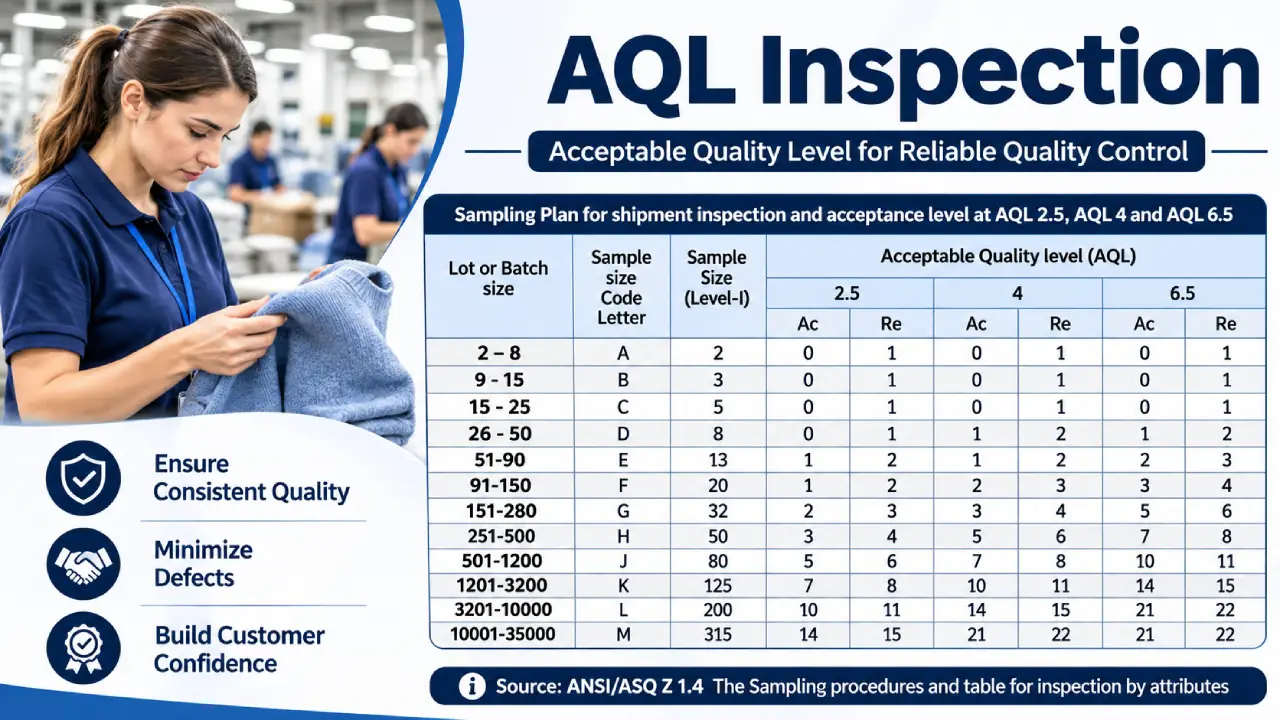
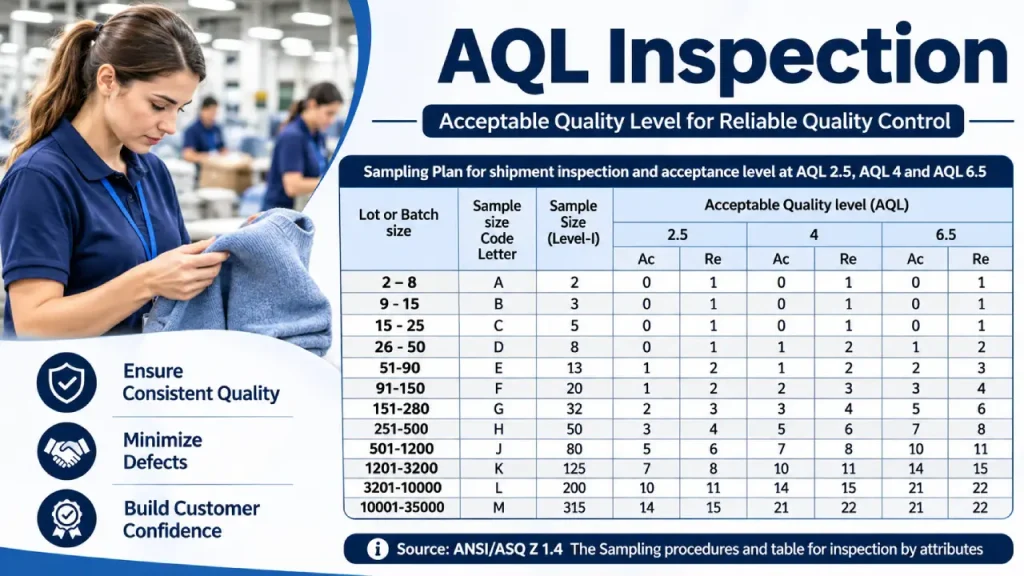
Under ISO 2859-1 at General Inspection Level II, single sampling, normal inspection, the sample size depends on the lot size. The table below covers the lot sizes most shawl buyers deal with. Always confirm against the current ISO 2859-1 table or let your inspection agency apply it, because this is a summary and not a replacement for the standard.
| Lot size (finished pieces) | Sample size | Major defects, AQL 2.5 (accept / reject) | Minor defects, AQL 4.0 (accept / reject) |
|---|---|---|---|
| 501 to 1,200 | 80 | 5 / 6 | 7 / 8 |
| 1,201 to 3,200 | 125 | 7 / 8 | 10 / 11 |
| 3,201 to 10,000 | 200 | 10 / 11 | 14 / 15 |
“Accept 7” means that if the inspector finds 7 or fewer major defects in the sample, the lot passes on major defects. At 8 or more, it fails. Critical defects stay at zero in every case.
Which inspection level should you pick?
- Level I: smaller sample, lower cost, less certainty. Suitable for repeat orders with a supplier you already trust.
- Level II: the standard choice for most first and regular orders.
- Level III: larger sample, higher certainty. Worth it for high value pieces, new suppliers or retailers with strict return policies.
A worked example on a 3,000 piece shawl order
Say you order 3,000 printed wool-blend shawls. You set General Level II, AQL 2.5 for major defects and AQL 4.0 for minor defects.
- A lot of 3,000 falls in the 1,201 to 3,200 band, so the sample size is 125 pieces.
- The inspector pulls 125 shawls at random from across all cartons, not just the top ones.
- The inspector finds 6 major defects (two small holes, three stains, one wrong size) and 9 minor defects (loose threads and creases).
- Major limit is 7, so 6 passes. Minor limit is 10, so 9 passes. No critical defects were found.
- The lot passes, and you can release the balance payment.
If the inspector had found 8 major defects, the lot would fail even though everything else looked fine. That is the value of setting numbers upfront: nobody argues about whether 8 is “a lot” or “not many.”
Pre shipment inspection checklist for shawls
A pre shipment inspection checklist keeps the inspector focused on what you care about. Use this list as a starting point and trim it to your product.
| Check | What to look for |
|---|---|
| Quantity and assortment | Total pieces and carton count match the purchase order. Colour and design ratio per carton is correct. |
| Colour against approved standard | Bulk shade matches the approved lab dip, strike-off or signed sample under standard lighting. Check shade variation between cartons. |
| Size and weight | Length and width within the agreed tolerance. Fabric weight in line with the specification (see our note on GSM fabric weight in shawls). |
| Fabric and weave | No holes, snags, missing picks, broken ends, thick or thin places, stains or oil marks. |
| Fringe, tassels and edges | Even length, secure twisting or knotting, no missing sections, clean rolled or hemmed edges. |
| Print, embroidery or jacquard detail | Placement, registration and colour fastness appearance match the sample. No missing stitches or loose embroidery threads. |
| Labels and branding | Fibre content, care instructions, country of origin and brand labels are correct and attached as specified. See our guide to care label requirements for textile exports. |
| Smell and feel | No chemical, damp or musty odour. Hand feel matches the approved sample. |
| Packing and cartons | Polybag or wrap as specified, correct carton strength, shipping marks, barcodes and carton weight. Our notes on shawl packaging for export cover what holds up in transit. |
| Lab test reports | Fibre content, colour fastness and chemical compliance reports are available where your market requires them. These are separate from AQL sampling. |
Fibre content and chemical compliance are verified in a laboratory, not by eye. If you are buying fabrics with specific safety certifications, read our page on OEKO-TEX certified shawl suppliers so you know which reports to ask for before the inspection date.
How textile quality inspection in India works
Textile quality inspection in India is usually done at three points, and a smart buyer uses more than one.
1. Inline checks during production
The factory’s own quality team checks fabric after weaving, after dyeing or printing, and after finishing. This is where most problems are caught cheaply. To understand where those checkpoints sit, see our overview of the shawl manufacturing process in India.
2. Initial or during-production inspection (optional)
When 20 to 30 percent of the goods are done, a buyer or agent checks early output against the sample. If something is wrong, it can be fixed before the whole lot is made. This is a smart step on a first order.
3. Final random inspection before shipment
This is the AQL inspection itself. It is carried out when at least 80 percent of the order is finished and packed. Buyers either send their own representative or nominate a third-party inspection company, and many of the large international agencies have offices across Indian textile hubs such as Delhi NCR, Ludhiana, Panipat, Jaipur and Kolkata. You pay the agency directly, and the inspector reports back to you, not to the factory.
For a closer look at how a manufacturer builds quality into its own process, read how Savita Shawls ensures quality. For the order stage before inspection, the guide on how to request samples from a shawl manufacturer shows how to lock in the approved standard your inspector will compare against.
Writing AQL into your purchase order
An AQL that lives only in an email is hard to enforce. Put these points in the purchase order or the signed quality agreement:
- The standard used: ISO 2859-1, single sampling, normal inspection, General Level II.
- AQL values: critical 0, major 2.5, minor 4.0 (or your chosen numbers).
- The approved reference: lab dip, strike-off, pre-production sample or sealed counter sample, with a reference number.
- Written defect definitions, with photos where possible, and the accepted natural variation for handwoven goods.
- Size and weight tolerances.
- Inspection timing: when at least 80 percent of goods are packed, with the factory giving you notice of at least a few working days.
- Who inspects and who pays: your agent, a named third-party agency, or the factory’s own team with report sharing.
- What happens on failure: rework, re-inspection and who bears the cost.
- Payment link: balance payment released only after a passed report.
If you are still negotiating quantities, our guide on MOQ negotiation with shawl suppliers helps you keep quality terms intact while discussing minimum order size. If you plan to sell under your own brand, the quality terms also apply to private label shawl manufacturing and custom OEM shawl orders.
What to do if the lot fails
- Get the report and photos. Ask for the defect list, quantities and images before any discussion.
- Agree the cause. Is it a one-off, such as a stained carton, or a process issue, such as a dyeing problem across the lot?
- Choose the fix. Usually this means 100 percent sorting and removal of defective pieces, rework where possible, and replacement of rejected pieces.
- Re-inspect. A fresh random sample is drawn after the fix. Do not accept a re-check limited to the pieces already sorted.
- Hold payment and shipping until the re-inspection passes.
A supplier who welcomes this process is usually a supplier who expects to pass. Our article on how to choose the right shawl manufacturer covers other signs to look for before placing the first order.
Frequently asked questions
What does AQL stand for in garment inspection?
AQL stands for Acceptable Quality Limit, also called Acceptance Quality Limit. It is the maximum defect rate that a buyer and supplier agree is acceptable for a lot of finished goods.
What is the AQL 2.5 meaning for a shawl order?
AQL 2.5 means the lot is acceptable if the rate of major defects stays at about 2.5 percent or lower. In a sample of 125 shawls, you accept up to 7 major defects and reject the lot at 8 or more.
Which AQL should I use for shawls and scarves?
Most buyers use critical 0, major 2.5 and minor 4.0 at General Inspection Level II. Luxury and premium retailers often tighten major defects to AQL 1.5 or 1.0.
When should the pre shipment inspection be done?
Do it when at least 80 percent of the order is finished and packed, and before the goods leave the factory. Doing it earlier misses defects in unfinished goods, and doing it after dispatch leaves you no room to fix anything.
Who pays for the inspection?
The buyer normally pays for an independent third-party inspection, since the report is for the buyer’s benefit. Some factories include their own internal inspection report in the order price. Agree this in writing before production starts.
Does AQL cover fibre content and dye safety?
No. AQL checks visible and measurable product quality by sampling. Fibre content, colour fastness and chemical compliance are verified through laboratory tests, and a failed critical test should fail the lot regardless of the AQL result.
Can I use AQL inspection for small orders?
Yes, though for very small lots (under about 100 pieces) a 100 percent check is often more practical. Many buyers also run a simple pre-shipment photo check for trial orders.
Plan your next bulk shawl order with clear quality terms
If you source shawls, stoles or scarves in volume, share your target AQL, inspection method and destination market with us. We will quote against your specification, and you can browse our full range as a wholesale shawls supplier in India or read more about us as one of the shawl manufacturers in India. Ready to talk numbers? Request a quote or reach us through the contact page.
Importing into a specific market? See our pages for exporting shawls to the USA, shawl manufacturers for London and the UK and shawl manufacturers for Dubai.