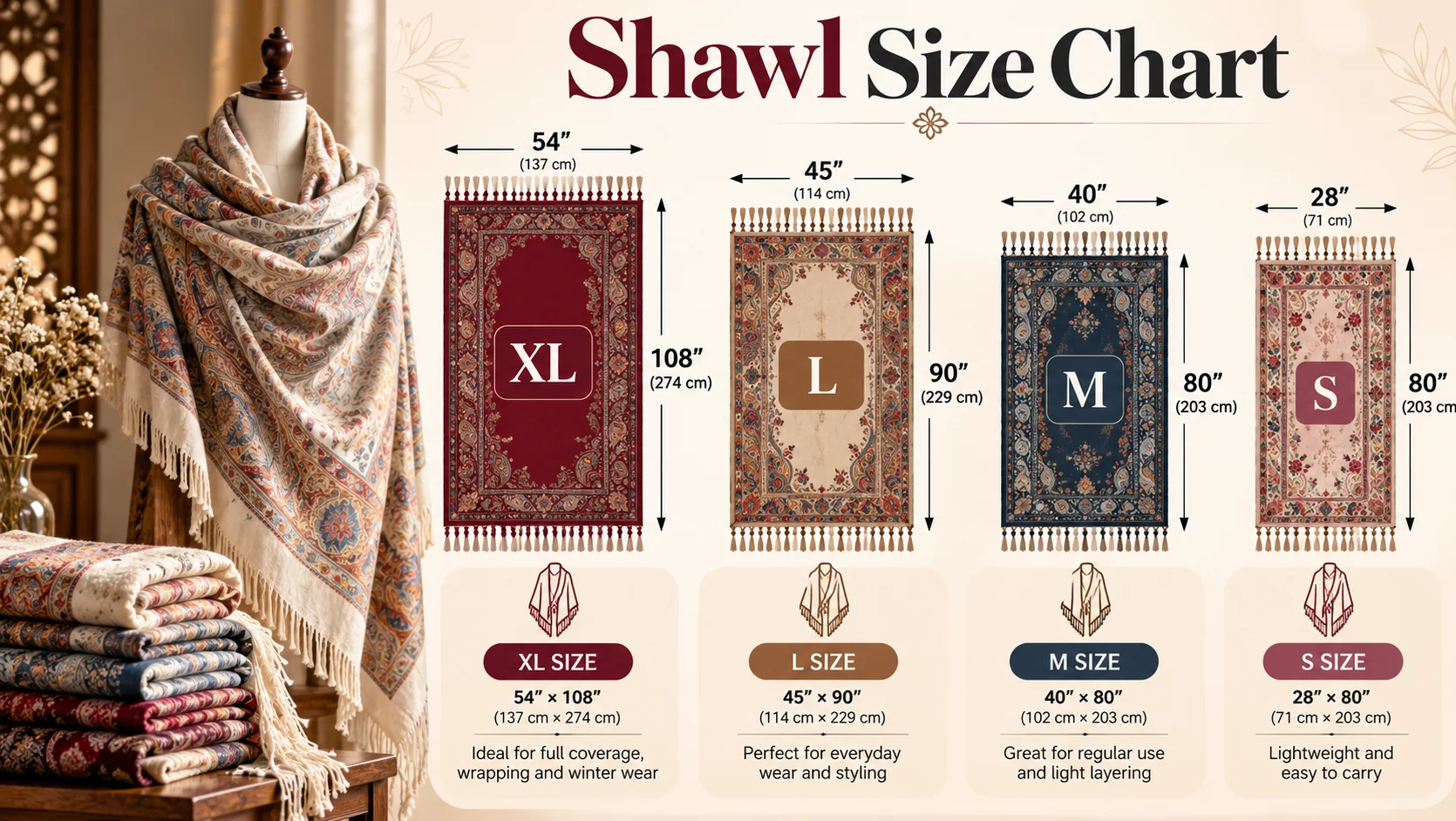
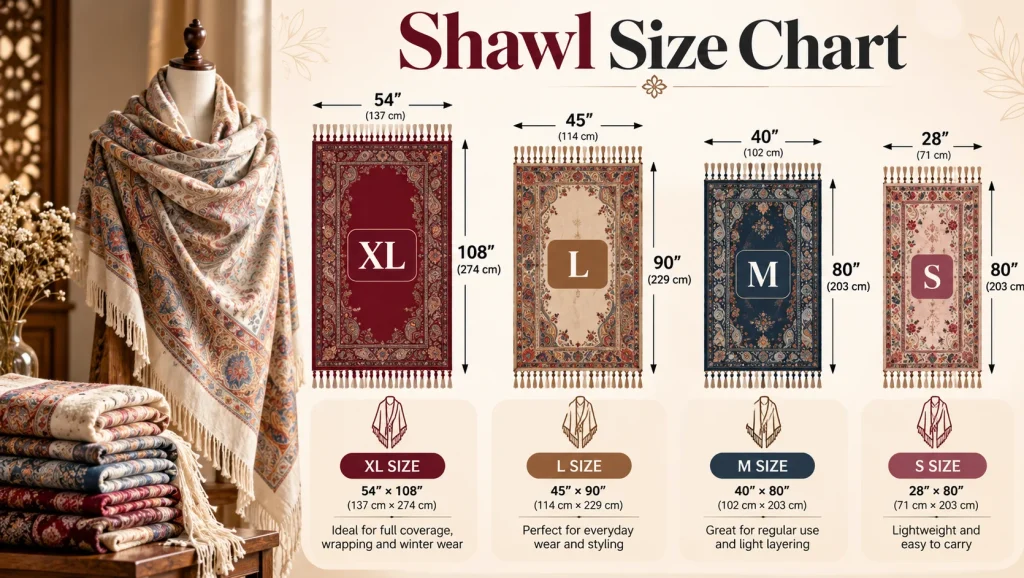
The most common wholesale sizes are 100 x 200 cm (39 x 79 inches) for a women’s shawl, 70 x 200 cm (28 x 79 inches) for a stole, 125 x 250 cm (49 x 98 inches) for a men’s shawl and 90 x 90 cm (35 x 35 inches) for a large square scarf. These are trade conventions rather than fixed standards, so every order should state the exact size, whether fringe is included, and the tolerance you will accept.
Key takeaways
- Shawls are wide enough to wrap the shoulders, stoles are narrower, and scarves are narrower still.
- Always say whether a size includes or excludes fringe. Fringe can add 5 to 10 cm at each end.
- Agree a size tolerance, such as plus or minus 2 cm, before production.
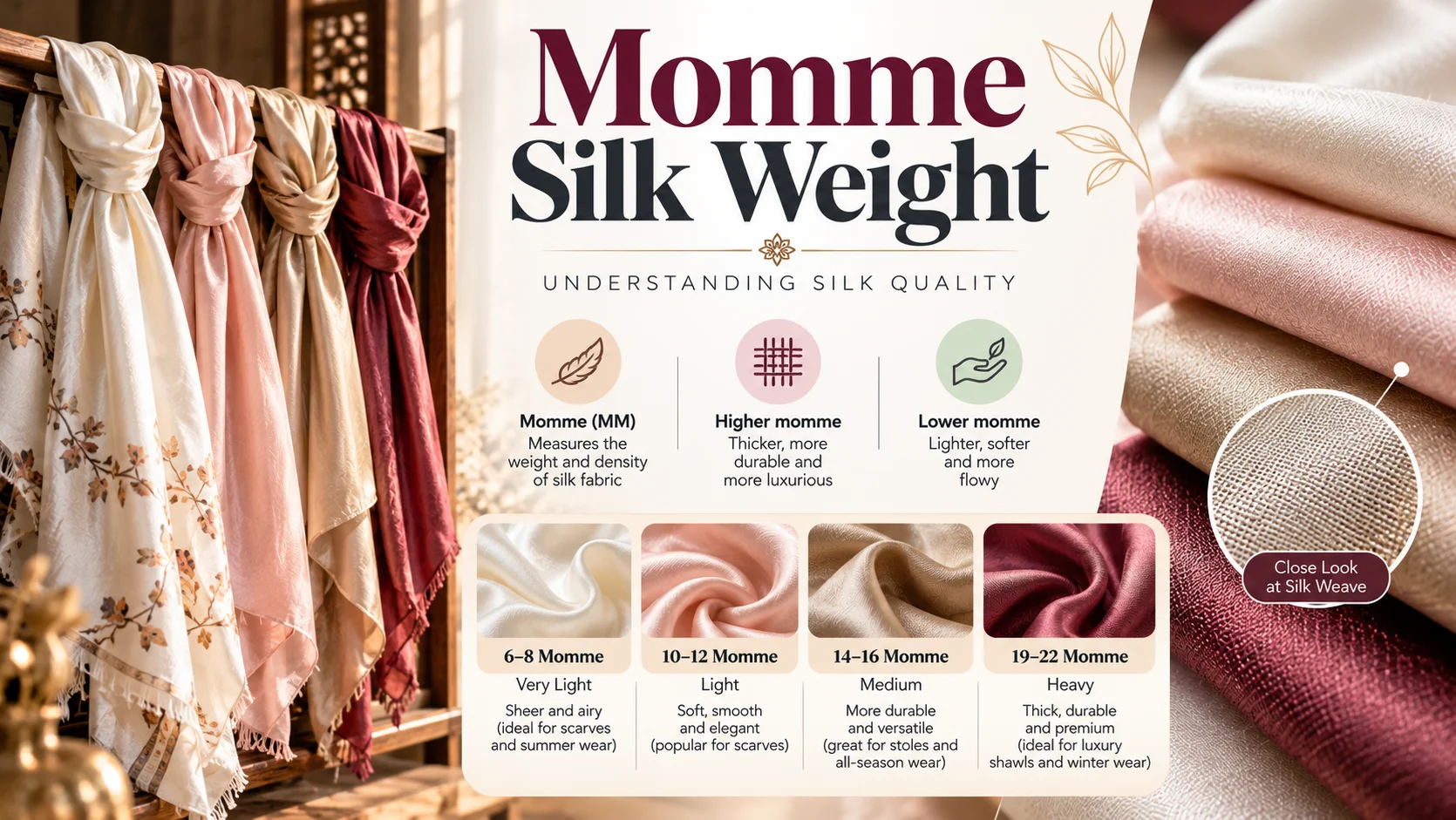
- Size and GSM together decide weight, which affects both the feel of the product and your shipping cost.
Master size chart: shawls, stoles and scarves
| Product | Common size (cm) | Common size (inches) | Typical use |
|---|---|---|---|
| Women’s shawl | 100 x 200 | 39 x 79 | Everyday and occasion wear |
| Large women’s shawl | 110 x 220 | 43 x 87 | Winter, wraps and cover-ups |
| Men’s shawl | 125 x 250 | 49 x 98 | Winter warmth, traditional wear |
| Stole | 70 x 200 | 28 x 79 | Most popular year-round format |
| Wide stole | 75 x 200 | 30 x 79 | Fuller drape, evening wear |
| Slim stole | 50 x 180 | 20 x 71 | Light fashion layer |
| Oblong scarf | 45 x 180 to 65 x 180 | 18 x 71 to 26 x 71 | Fashion and printed scarves |
| Muffler | 30 x 180 | 12 x 71 | Men’s winter neckwear |
| Knitted muffler | 25 x 160 | 10 x 63 | Casual winter neckwear |
Inch figures are rounded to the nearest inch. Our guide to the difference between a shawl, stole and scarf explains how each format is worn.
Square scarf sizes
| Format | Size (cm) | Size (inches) | How it is worn |
|---|---|---|---|
| Neckerchief | 50 x 50 | 20 x 20 | Tied at the neck or on a bag |
| Bandana | 55 x 55 | 22 x 22 | Neck, head or wrist |
| Medium square | 70 x 70 | 28 x 28 | Knotted at the neck or as a headscarf |
| Large square | 90 x 90 | 35 x 35 | Classic silk square, folded or knotted |
| Extra-large square | 110 x 110 | 43 x 43 | Headscarf, hijab or shoulder wrap |
| Blanket scarf | 140 x 140 | 55 x 55 | Folded into a triangle as a winter wrap |
Square silk scarves usually sit at 70 x 70 cm or 90 x 90 cm. Browse our silk scarves to see these formats.
Regional and speciality sizes
Some markets use formats of their own.
- Dupatta: a long Indian scarf worn with salwar suits and lehengas, commonly around 90 x 225 cm (35 x 89 inches) or longer. Read about the bridal pashmina dupatta.
- Rectangular hijab: often around 70 x 180 cm (28 x 71 inches), long enough to wrap and pin. See our guide to hijab and modest-wear stoles.
- Square hijab: around 110 x 110 cm (43 x 43 inches), folded into a triangle.
- Pareo or sarong: around 100 x 180 cm (39 x 71 inches) for beach and resort wear.
Indian and Middle Eastern buyers often prefer larger shawls, while European and North American buyers favour 70 x 180 cm to 70 x 200 cm stoles and narrower scarves.
Which size sells best for each product?
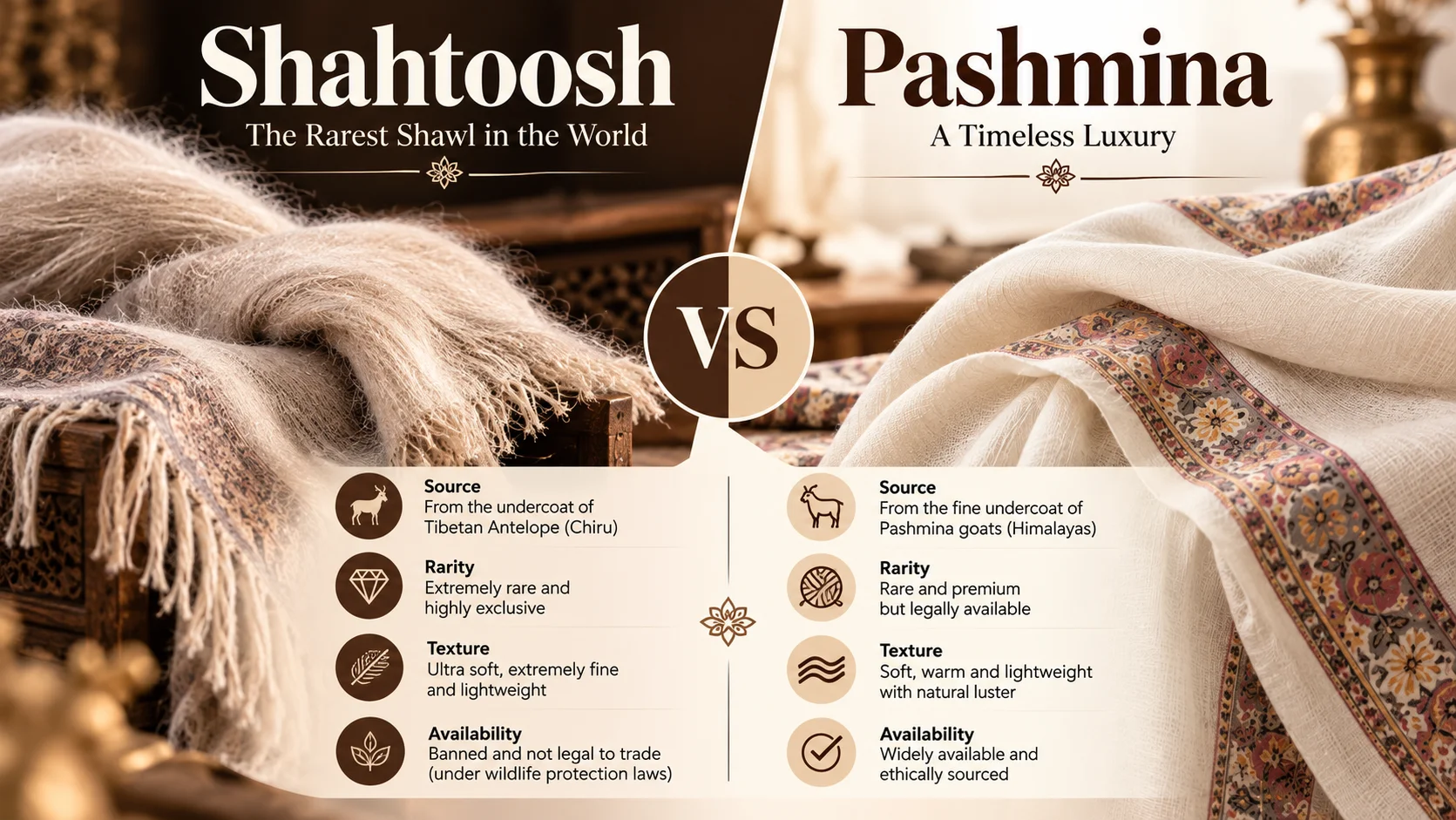
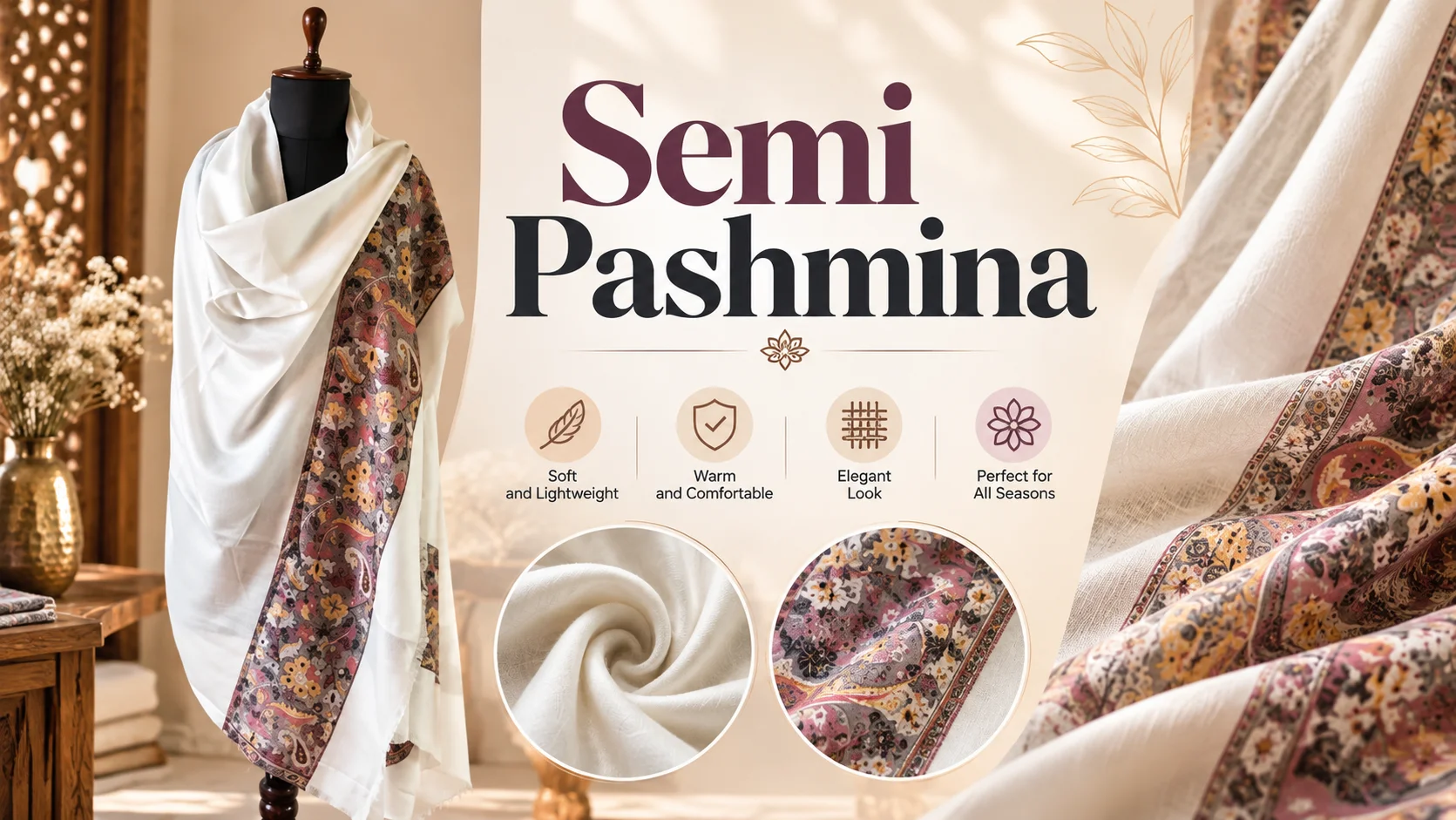
- Pashmina and wool shawls: 100 x 200 cm for women and 125 x 250 cm for men. See our pashmina shawls and men’s pashmina shawls.
- Fashion and printed stoles: 70 x 200 cm, the most versatile format. Browse our stoles.
- Winter scarves: 30 x 180 cm mufflers and 70 x 200 cm oblongs. See our winter scarves.
- Designer shawls for occasions: 100 x 200 cm or larger for full coverage. See our ladies designer shawls.
Why do sizes vary between suppliers?
The same “stole” can arrive in slightly different sizes from two suppliers, for a few reasons:
- Loom width. Each loom weaves up to a set width, and some handlooms limit the widths available.
- Finishing. Washing, brushing and pressing can shrink or relax the fabric after weaving.
- Units. A supplier working in inches may make a 28 x 80 inch stole, which is about 71 x 203 cm rather than an exact 70 x 200 cm.
- Regional habits. Makers who serve different markets settle on different standard sizes.
This is why a written size specification matters more than the product name.
How should you measure a shawl or scarf?
- Lay it flat on a table without stretching it.
- Measure the width across the middle, edge to edge.
- Measure the length of the woven or printed body only, from the base of the fringe at one end to the base at the other.
- Measure the fringe separately at each end.
- Record both figures, for example “70 x 200 cm plus 8 cm fringe each end”.
Measure several pieces from a bulk lot, not just one, to check consistency.
Fringe, tolerance and shrinkage
Three details cause most size disputes:
- Fringe: a 70 x 200 cm stole with 10 cm fringe at each end is 220 cm long overall. Always state whether the size includes fringe. Our fringed and tassel scarves show common fringe lengths.
- Tolerance: handwoven and finished textiles vary slightly. A tolerance of plus or minus 2 to 3 cm on length and 1 to 2 cm on width is common. Put your tolerance in the purchase order.
- Shrinkage: wool, viscose and cotton can shrink during washing or finishing. Ask whether the stated size is before or after finishing, and measure a washed sample.
How does size affect weight and shipping cost?
Weight equals length times width times GSM. For example:
| Product | Size | GSM | Approximate weight |
|---|---|---|---|
| Women’s wool shawl | 100 x 200 cm | 250 | About 500 g |
| Stole | 70 x 200 cm | 180 | About 250 g |
| Men’s shawl | 125 x 250 cm | 300 | About 940 g |
| Silk square | 90 x 90 cm | 60 | About 50 g |
Figures exclude fringe and packaging. Larger sizes use more yarn, cost more to make and weigh more in a carton, which matters for air freight. Our guides to GSM and fabric weight, FOB vs CIF and export shawl packaging help you plan costs.
What should go on your size specification?
- Finished size in centimetres, with inches if your market uses them.
- Fringe length, and whether the size includes it.
- Tolerance on length and width.
- GSM or weight per piece.
- Size on the care or hang tag, if required by your market. See our guide to care label requirements.
Then confirm everything on a physical sample. Here is how to request samples from a shawl manufacturer.
MOQ and custom sizes at Savita Shawls
| Term | Savita Shawls standard |
|---|---|
| MOQ | 100 pieces per design, lower on some stock styles |
| Custom sizes | Available on custom orders |
| Stock styles with your label | 10 to 15 working days |
| Custom woven designs | 45 to 60 working days after sample approval |
| Samples | Delivered internationally in 7 to 10 working days |
Order shawls, stoles and scarves in your size
Savita Shawls has manufactured shawls, stoles and scarves in Gurgaon since 1984 and exports to more than 40 countries. Read about working with a custom shawl manufacturer, ask about private label manufacturing, or request a bulk quote with your size, fibre and quantity.
Frequently asked questions
What is the standard size of a shawl?
A standard women’s shawl is about 100 x 200 cm (39 x 79 inches). Men’s shawls are larger, usually around 125 x 250 cm (49 x 98 inches).
What is the standard size of a stole?
The most common stole size is 70 x 200 cm (28 x 79 inches). Slimmer stoles of 50 x 180 cm and wider stoles of 75 x 200 cm are also popular.
What size is a large square scarf?
A large square scarf is usually 90 x 90 cm (35 x 35 inches). Medium squares are 70 x 70 cm and neckerchiefs are about 50 x 50 cm.
Does the size of a scarf include the fringe?
It depends on the supplier, which is why you should always ask. Many quote the body size and list fringe separately, for example 70 x 200 cm plus 8 cm fringe at each end.
How do I convert scarf sizes from cm to inches?
Divide centimetres by 2.54. For example, 70 x 200 cm is about 28 x 79 inches, and 90 x 90 cm is about 35 x 35 inches.
What size tolerance is acceptable for shawls?
A tolerance of plus or minus 2 to 3 cm on length and 1 to 2 cm on width is common for woven shawls and stoles. Agree it in writing before production.
Can I order shawls in a custom size?
Yes. Savita Shawls makes custom sizes on custom orders, starting at 100 pieces per design.