A buyer orders 500 stoles, receives 500 stoles, and complains that they are too narrow. The supplier sent exactly what was ordered. The buyer wanted shawls. This happens constantly in the wholesale trade because the difference between a shawl, stole and scarf is a matter of dimension rather than a matter of opinion, and almost nobody agrees on where the boundaries sit. This guide gives you working definitions, a sizing table, and the language to put on a purchase order so the goods that arrive are the goods you pictured.
Shawl vs stole vs scarf: the short answer
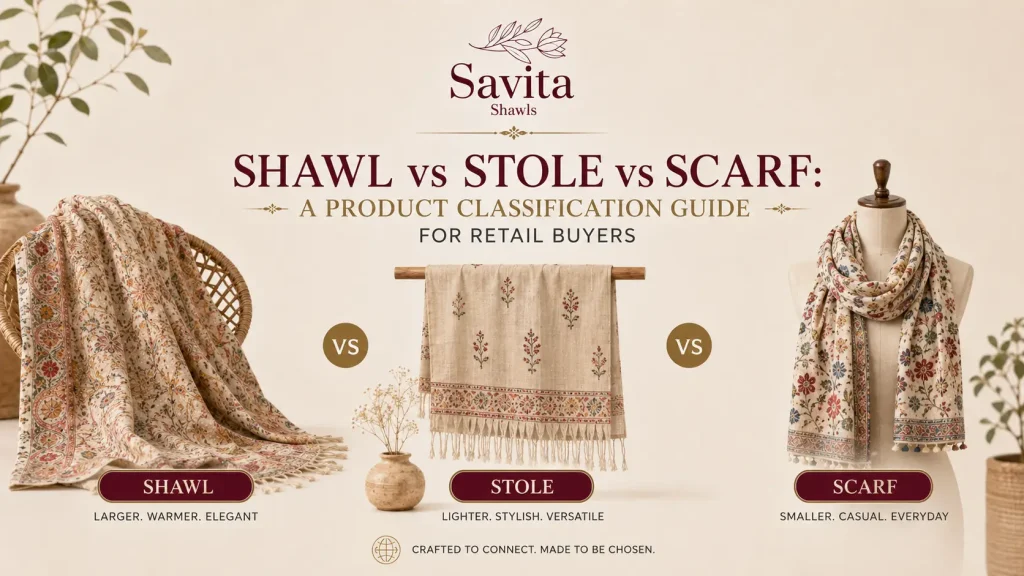
A shawl is the widest and heaviest of the three, worn as an outer layer over the shoulders and typically 70 to 100 centimetres wide. A stole is narrower and lighter, roughly 50 to 70 centimetres wide, worn draped rather than wrapped. A scarf is narrower again, usually under 50 centimetres wide, worn around the neck.
Width is the deciding variable. Length varies less between the three, generally sitting between 180 and 220 centimetres. If you remember one thing, remember that you are buying a width.
What makes a shawl a shawl
A shawl is an outer garment. It covers the shoulders and upper back, provides warmth, and in most markets carries some formality or occasion association. Standard wholesale dimensions run 70 by 200 centimetres, with wide formats at 90 by 200 or 100 by 200 centimetres.
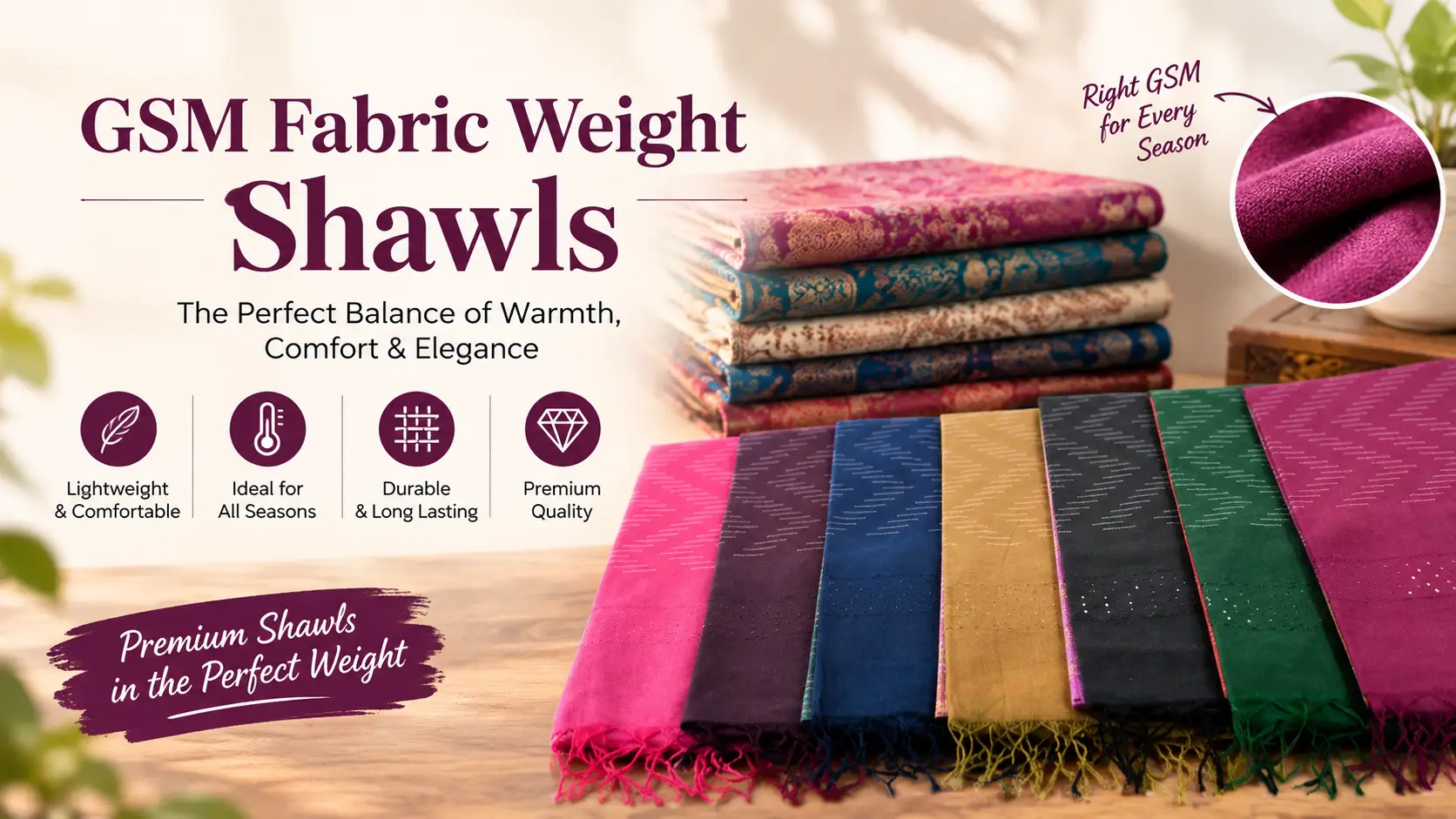
Weight follows function. Because a shawl is worn for warmth rather than decoration, GSM runs higher, commonly 180 to 320 depending on fibre. A pashmina shawl at 200 GSM feels substantial in the hand in a way a 100 GSM stole does not.
Shawls carry the traditional Indian craft techniques. Kani weaving, sozni embroidery and jamawar patterning are shawl techniques, applied to a large enough surface to display the work. This is also why shawls command the highest retail prices in the category.
What makes a stole a stole
A stole sits between a shawl and a scarf, both in width and in purpose. It is worn draped over one or both shoulders rather than wrapped for warmth, which is why it can be lighter and narrower. Standard dimensions run 55 by 180 centimetres, with 70 by 200 also sold as a stole in many Indian catalogues.
That overlap at 70 by 200 is the source of most confusion in the trade. The same physical piece is listed as a stole by one supplier and a shawl by another. Neither is lying. The categories genuinely overlap, which is exactly why you should specify centimetres rather than category names on a purchase order.
Stoles carry the widest fabric range of the three. Viscose, modal, cotton and linen suit lighter stoles for warm weather, while fine wool, silk and cashmere serve autumn and evening ranges. Buyers sourcing across the full range will find the guide to stole manufacturing in India covers fabric selection in detail.
What makes a scarf a scarf
A scarf is a neck accessory. It is narrow, generally under 50 centimetres wide, and is tied, knotted or looped rather than draped. Common wholesale sizes are 30 by 150 centimetres for a long scarf and 90 by 90 centimetres for a square scarf.
The square scarf is a separate product with its own market, strongly associated with silk and with printed design. It is bought by different retail buyers than rectangular scarves and sold at different price points, so treat it as its own line rather than a size variant.
Scarves are the highest volume and lowest unit price of the three, which makes them the usual entry point for promotional and corporate programmes where quantity matters more than perceived luxury.
Shawl, stole and scarf sizing reference
| Product | Typical Width | Typical Length | Typical GSM | Worn As |
|---|---|---|---|---|
| Shawl (standard) | 70 cm | 200 cm | 180 to 320 | Shoulder wrap, outer layer |
| Shawl (wide) | 90 to 100 cm | 200 to 220 cm | 200 to 320 | Full wrap, occasion wear |
| Stole | 55 to 70 cm | 180 to 200 cm | 90 to 250 | Draped over shoulders |
| Scarf (long) | 30 to 50 cm | 150 to 180 cm | 80 to 200 | Neck, tied or looped |
| Scarf (square) | 90 cm | 90 cm | 60 to 120 | Neck, head or bag accessory |
| Wrap | 90 to 110 cm | 200 cm | 150 to 250 | Loose outer layer |
Treat these as trade norms rather than standards. There is no governing body enforcing them, and any supplier can label any dimension however they like.
Terminology that blurs the shawl, stole and scarf difference
Pashmina is a fibre, not a product category. A pashmina can be a shawl, a stole or a scarf, and the word says nothing about size. Buyers regularly order “a pashmina” and receive a size they did not expect. Specify both the fibre and the dimensions, and read the detail on pashmina stole specifications if that is your target product.
Wrap and shawl are used interchangeably by most suppliers. If a distinction exists, a wrap is looser and less structured. Do not rely on the difference.
Dupatta is a South Asian garment worn as part of a three piece outfit. It is stole width but longer, commonly 220 to 250 centimetres, and sold into a different retail context entirely. Do not substitute one for the other in a listing.
Muffler generally means a heavier knitted neck piece rather than a woven one, which puts it in a different production process altogether.
Palla, chunni and odhani appear in Indian supplier catalogues and describe regional garment forms rather than precise dimensions. Ask for centimetres.
Why the difference between a shawl, stole and scarf matters commercially
Three reasons, and all three cost money when they go wrong.
Returns. A customer who ordered a shawl and received a stole returns it, and you pay the shipping both ways plus the restocking labour. Mismatched product listings are one of the largest avoidable return drivers in accessories retail.
Customs classification. Shawls, stoles and scarves can attract different HSN codes and therefore different duty rates depending on fibre and construction. Declaring the wrong category creates either an overpayment or an inspection.
Price positioning. A shawl sells at a higher retail price than a stole of the same fibre because it uses more fabric and carries more perceived value. Listing a stole as a shawl gets you a return. Listing a shawl as a stole leaves margin on the table.
How to specify a shawl, stole or scarf on a purchase order
Never write the category name alone. Write the specification, in this order:
- Product category as your shorthand, for example stole
- Exact dimensions in centimetres, stating whether fringe is included or excluded
- Fibre composition with percentages, for example 70 percent wool 30 percent silk
- GSM
- Finish, meaning fringe type or hem
- Colour reference, ideally a Pantone code
A line reading “stole, 70 x 200 cm excluding 8 cm fringe, 100 percent viscose, 110 GSM, twisted fringe, Pantone 19-4052” cannot be misinterpreted. A line reading “500 stoles, navy” can be interpreted six ways, and will be.
Cotton buyers should note that cotton stole weights and sizes vary more between suppliers than most fibres, which makes written GSM specification particularly worthwhile in that category.
How Savita Shawls categorises the range
Savita Fashions LLP, trading as Savita Shawls, has manufactured shawls, stoles and scarves from Gurgaon, Haryana since 1984 and supplies buyers in more than 20 countries. GST registration is 06AFPFS3876N1Z0 and IEC is AFPFS3876N.
The catalogue separates shawls at 70 by 200 centimetres and above from stoles at 55 by 180 and scarves at 30 by 150 and 90 by 90 square. All dimensions are confirmed in writing on the purchase order before production, and custom sizing is available on OEM orders without additional tooling charges.
MOQ is 100 pieces per stock design and 200 pieces per custom or OEM design, with corporate gifting from 50 pieces with branding. Samples ship within 5 to 7 business days and the cost is credited against the bulk order, which is the cheapest way to confirm that a size specification means what you think it means.
The stole product range and the pashmina shawl range are listed separately for this reason. Buyers building a first bulk order should read the guide to wholesale stole supply, and importers should review export documentation and shipping terms before confirming an order.
Frequently asked questions
What is the difference between a shawl, stole and scarf?
Width is the deciding factor. A shawl is 70 to 100 centimetres wide and worn as an outer layer for warmth. A stole is 55 to 70 centimetres wide and draped over the shoulders. A scarf is under 50 centimetres wide and worn around the neck. Length is similar across all three, typically 180 to 220 centimetres.
Is a pashmina a shawl or a stole?
Neither. Pashmina is a fibre combed from the Changthangi goat, not a product category. A pashmina can be made as a shawl, a stole or a scarf, and the word alone says nothing about dimensions. When ordering, specify both the fibre and the exact size in centimetres to avoid receiving a product in the wrong format.
What size is a standard stole?
The most common wholesale stole size is 55 by 180 centimetres, though 70 by 200 centimetres is also widely sold as a stole in Indian catalogues. That overlap with shawl sizing causes frequent disputes. Always specify dimensions in centimetres on the purchase order and state whether the measurement includes or excludes the fringe.
What is the difference between a stole and a dupatta?
A stole is a fashion accessory draped over the shoulders, typically 55 by 180 centimetres. A dupatta is a South Asian garment worn as part of a coordinated three piece outfit, similar in width but longer at 220 to 250 centimetres. They sell into different retail contexts and should not be substituted for one another in a product listing.
Do shawls, stoles and scarves have different HSN codes?
They can. Customs classification depends on fibre composition and construction as well as product type, and the applicable HSN code determines the duty rate you pay on import. Misclassification either costs you more than necessary or triggers a customs inspection. Confirm the code with your exporter before dispatch and check it matches across all shipping documents.
Which sells at a higher retail price?
A shawl generally commands a higher retail price than a stole of the same fibre, because it uses more fabric and carries greater perceived value. Scarves sit lowest per piece and highest in volume. Listing a stole as a shawl leads to returns. Listing a shawl as a stole gives away margin unnecessarily.
What should I write on a purchase order to avoid sizing disputes?
Specify six things: product category, exact dimensions in centimetres stating whether fringe is included, fibre composition with percentages, GSM, finish type, and a Pantone colour reference. A line reading “stole, 70 x 200 cm excluding 8 cm fringe, 100 percent viscose, 110 GSM” cannot be misread. A line reading “500 stoles, navy” can be interpreted several ways.
Is a wrap different from a shawl?
In practice, barely. Most suppliers use the terms interchangeably. Where a distinction is drawn, a wrap is looser and less structured than a shawl and sometimes slightly wider at 90 to 110 centimetres. Do not rely on the difference in a purchase order. Specify the width you want in centimetres instead of relying on category naming.
Ready to order
Send your specification with product type, dimensions, fibre and quantity, and Savita Shawls will confirm pricing, lead time and sample availability. Samples dispatch within 5 to 7 business days with the cost credited against your bulk order, so confirming that a size specification matches your expectation costs very little. Start with a bulk pricing enquiry, email sales@savitashawls.com or call +91 7696677766.