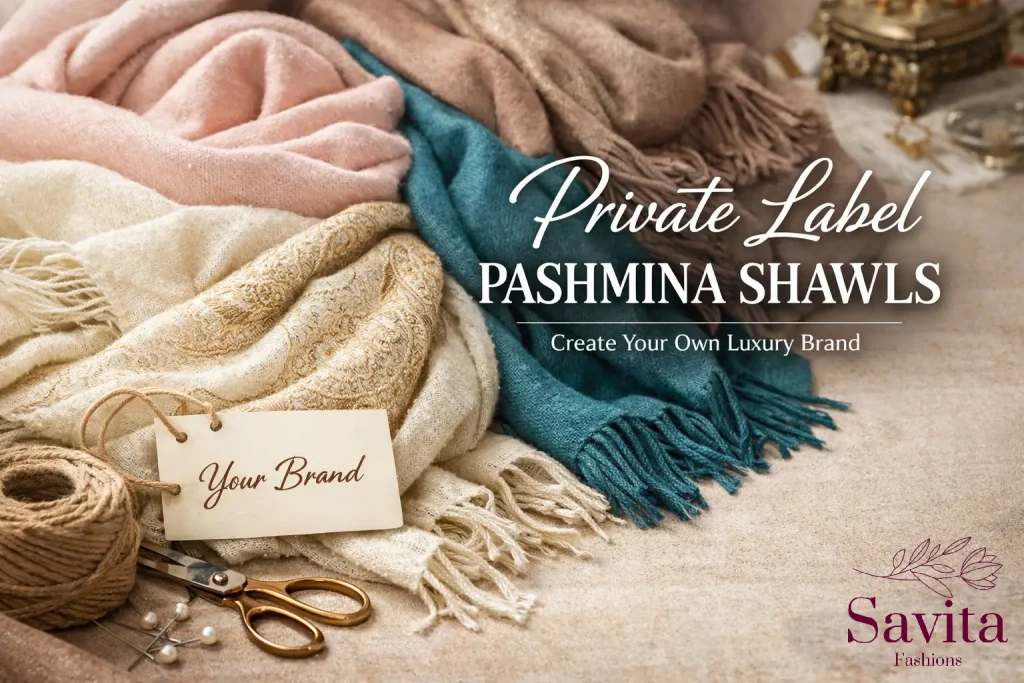
Around the globe, the fashion industry is facing a conceptual transformation. For the most part, brands are content selling basic items. However, they wish to attach an image of self, enclosed in a cocoon of originality and encrusted in precious memories. One of the items that best provides these qualities is the private label pashmina shawls.
Fashion brands, retails outlets, wholesalers, importers all will find private label pashmina shawls to be among the most high yield product categories in the luxury accessories business. This is not a commodity. These shawls are a part of an old tradition, originating from the valley of Kashmir where for generations, cashmere fibers, the softest in the world, have been hand woven, hand-spun and worn.
Why this alternative sounds appealing today is due to the fact that the ‘private label’ concept is getting more and more favourable. In other words, you don’t have to be a part of a giant luxury business anymore to be able to produce, brand and market elegant pashmina scarves as one’s own label. So, no matter if your scope is a fashion e-commerce company, a small retail outlet, subscription services, or even wholesale businesses, private label pashmina shawls will enable you to have quality products in a cluttered and low-end space.
This light of understanding touches on every aspect of the question: what is the concept of private labeling can one anticipate to what are the features one can include in their products, what are the MOQs, how can one minimize the risk of oversized packaging, what kind of manufacture can a brand choose and how can a business grow in the long run. Should you wish to roll-up your sleeves and grow brands that are well-received and elicit multiple purchases, then read on for this is one of those articles you need.
Pashmina is a very exquisite and elite end product in the spectrum of textiles that there is today because all three components; aged handicrafts, superfine animal hair and branding, converge. There are high-paying consumers in Europe, North America, Middle East, Japan and Australia when it comes to paying for genuine pashmina product. In this context, it is a viable business for the B2B suppliers or buyers as as long as there is a possibility of establishing the right manufacturing partnership arrangements in India.
The cashmere industry is worth approximately US$3.5 billion, while the bulk of world’s pashmina processing and export takes place in India and is growing. More than 80 countries are the destination for Indian pashmina exports annually, which is why India is the most commercialized source of pashmina in the world.
In order for importers, wholesalers, boutique owners and private label brands alike to flourish in this segment, finding and procuring a good pashmina shawl manufacturer in India is possibly their best business decision. This guide provides you with all the necessary information in order to make such a decision in a clear and decisive manner, with all the facts and the chances fully understood.
Why Private Label Pashmina Shawls Are Growing in Demand?
Over the past five years, the growth in demand for private label pashmina shawls has increased drastically for various reasons that are both consumer trends and business opportunities.
The first factor is that the consumer’s anticipation and willingness to spend on fashion accessories of high quality origin has reached its peak. In particular, people from the North America, Western Europe, and Gulf region today prefer to buy more of goods which are perceived as premium, handmade, and authentic. Pashmina meets this craving. It’s lightness, encouraging storytelling and its firmness against winter chills makes it the perfect fiber for those who appreciate the more expensive fibers.
Secondly, the emergence of direct-to-consumer (DTC) brands has resulted in the dramatic growth of private labeling in virtually all product categories. Aspirant entrepreneurs, as well as small brands, do not require retail shelf space or substantial investment to go into the market with their product lines. No longer do entrepreneurs have to purchase huge inventories of economically priced private label pashmina shawls. They can purchase the goods in some workable quantity and distribute them through their own company’s website or a platform system and grow a client base without compromising margin.
Thirdly, the demand for bulk pashmina shawl purchases goes up in relevance to the increased popularity of corporate gifting. Corporations involved in various businesses including multinational corporations, luxury hotels, wedding coordinators and event planners are ordering customized shawls and promo items for giveaways, employee gifts and occasion souvenirs in large quantities and it does not present any problem of demand. The B2B several service brands which are in the business of gifting white label shawls, modified shawls and other items make much cash from this market alone.
The impact of the ever-increasing influx of international fashion trade shows, the popularity of e-commerce platforms, and the reach of social media marketing has amplified the process through which niche, high-end products can be availed in the international markets by small companies. This is where private label pashmina shawls come in as such brands are unbeatable.
The Kashmir valley is known worldwide for its historic association with pashmina production in its purest form. The raw material for a pashmina is bred from the fine hairy underbelly of Changthangi goat, a Ladakhi and Tibetan plateau breed, which grows between 12-16 microns in diameter, thus exceedingly finer and, of course, softer than regular cashmere which portends up to 19 microns in thickness. And it is the Indians or those who learned from Indians as Indians have already used this fibre to its maximum potential spanning centuries that it is not information that shall be transferred to any low-cost textiles produced elsewhere.
Aside from most of the Kashmir area, some manufacturing areas of India like Ludhiana, Amritsar and Delhi NCR, open up international buyers to a wider variety of pashmina blends, jacquard wraps, printed shawls, and embroidery designs at different cost levels. All these geographical locations turn India into a hugely and diversely inclusive, a one- stop destination for every buyer sourcing different kinds of shawls.
Another fundamental aspect that gives India competitive advantages arises from the textile exports. DGFT policy, trade claims with those major importers and efficient transport structures as well as experienced people in preparing export documentation just to name a few, enable foreign buyers to break their reservations. Also, the sourcing process is easier when the pashmina shawl manufacturer in India has long been in business and has served many foreign customers before.
What Are Private Label Pashmina Shawls and How They Work
Before you plunge into the business of private labeling, you must understand the concept and its workings. To put it in another way, private label pashmina shawls are crafted by a third party, normally companies from India, Nepal, or even in the Kashmir region, are labeled, packed, and distributed under the buyer’s name or brand.
This is how the process typically works. While looking for a pashmina manufacturer with private labeling capabilities, a customer requests such services from a specific manufacturer. The customer will specify the details of the product, including its content, colour, size and other designs. The shawls are produced by the manufacturer in the fashion that you desire. The branding is applied – labels are put, hang tags are attached, logos embroidered, and even custom packaging – and it’s your own brand’s product in the market.
The primary factor that differentiates private label products from simply selling is the ownership of the brand. In the case of private label pashmina shawls, the products, the message and brand position are all under one’s name. Every consumer would want to feel quality and satisfaction in using the product but would not necessarily remember the original producer of the product. For this reason, a long-term equity, loyalty and the ability to price form a brand.
In addition, private labeling allows for the design of a distinctive product narrative. Pashmina shawls may be painted as eco-friendly, using the craft of small-scale artisans, premier gift products for loved ones, or even wholesome essentials. This is a quintessential feature of the private label philosophy eagerly seeking it.
Benefits of Private Label Pashmina Shawls for Brands and Retailers
Creating business cases for private label pashmina shawls is attractive in many business dimensions. The rationale for working within such a system makes brands and retailers at any stage of development irresistible prospects.
The primary contributor is the better profit margins. Rebranded products allow much more strategic pricing. With private label shawls, there are no longer intermediaries to the supply chain and the manufacturer pricing can be more easily obtained. A handcrafted product can be sold for many times more than the cost price minus any manufacturing expenses, especially when the branding is powerful and the shawl is stated to be luxurious.
When the market has too many players, branding and differentiation becomes even more critical. Shawls branded as shawls are found everywhere, Why Not. Would a private label pashmina shawl with the unique logo, matching color scheme, composition and package design, where each element has a purposeful brand idea, be as memorable on any shelf or page. Those differentiators are what makes it possible to charge higher prices and protect their customers.
Being able to oversee the whole product development process, you also get to choose the fiber combinations, sizes, types of weave and colors. No more being limited by what the reseller is selling. This privilege of being able to package the product around your brand image that you have communicates is, in fact, worth a lot especially for those brands which are fashion oriented and have to be consistent and coherent in every season.
A robust private label is one that naturally leads to customer retention and repeat purchases. Rather than frequent the market, wooed by a pashmina designed shawl, the consumer returns to your ‘crown’. This creates the connection between the brand and the customer that can ensure a steady stream of income.
The structure of the private label model contains provision for increase in production as orders increase. Minimum order quantities are low, first marketed to test the waters, refined products and companies and then expanded. A rather limited exposure attached to a very high profit business potential, these, private label pashmina shawls, are the the best for growing companies.
Private Label Pashmina Shawls vs White Label Shawls
The terms “private label” and “white label” are often used interchangeably, but there is a meaningful distinction that every brand and retailer should understand.
Standardized products such as white label shawls are produced by manufacturers in large volumes and no customization is done. One white label shawl can be acquired and branded by multiple brands making them theirs. The product as in the weave, the sizes and the composition of the material is constant for all all the buyers. The differentiation comes in only in the label or the tag that is attached. This model favors those companies that want a very fast market entry without putting funds into developing new products.
With private label pashmina shawls, a greater level of customization is involved. The product is custom made for your business – from designing the fibers right down to the coloring and finishing. A white label shawl can be availed and branded within a of few days however, developing a private label pashmina may take weeks of product search, sampling and quality checking before any production commences.
Companies with a well-defined brand and clear-cut need for differentiation prefer the private label route. It ensures that the competition doesn’t just buy the same product, but instead concepts are in sum totally different. For already operational wholesalers interested in volume, or new entrants with a constrained timeline, create white label shawls can be quicker and more efficient than ever before.
In fact, lots of the most prominent brands consciously incorporate both of these strategies in their growth plans – A impatient Go to Market culminates with white label shawls, followed soon after with completely private label pashmina shawls.
How Custom Logo Shawls Help Build a Strong Brand Identity
When it comes to luxurious tools of accessories, worth of a brand comes first. There is no more efficient way to create an identity of fashion brand or service gifts delivery organization than through custom logo shawls.
Putting your logo on a simple pashmina can in fact enhance the image of the company and take it to another level. Whether it is constructed into the fabric, embroidered into one corner, or printed in an elegant manner into the silk lining, the simple functional piece of shawl turns into a final customer. As every occasion on which the recipient will wear it will increase the chances of spreading your brand. In every personal, gifting, or business interaction, a custom logo shawl stands for quality, consideration, and elevation of the brand as well.
Holiday related gifting is pleasing and noteworthy due to customization, consideration and creation. Pashmina shawl bearing company colours and logos are one of such presents. Pashminas either enhanced or developed within the organization help create a culture about the organization.
Shawls made of Pashminas with the brand are created by the recipients themselves such as private label pashmina shawls and those enhanced by the organization. They also help in customer retention and make the customers more attached to the brands, which makes the organization more profitable in the long run.
Fashion houses can create an enhanced perception of their goods by designing bespoke scarves featuring a brand logo, which does not burden companies of this kind with unforeseen expenses.
By adding a label or a logo, especially if it is woven or embroidered, does not make production much more expensive; however, it allows raising the cost that buyers are prepared to pay for the same item. The effect is more evident when applied to high-end packages combined with the positive brand image.
Such businesses as corporations and corporate events planners, find cost effective gift alternatives, such as custom logo shawls which have very high perceived value as gifts. Rather than the conventional corporate gifts which are mostly pens or coffee mugs, pashminas are useful and appreciated as gifts. This makes it an efficient tool to increase brand awareness and to maintain client relationships.
Our private label pashmina shawls are made in India and the required minimum order is 50 pieces.
The secret to leveraging the branding tool of custom logo shawls to the maximum degree is uniformity – making sure the position of the logo, its color, and the design is consistent with your overall branding. Employing a supplier who has good embroidery, jacquard machinery and screen printers helps to bring your brand to the level it requires.
Nonetheless, all of this aside, producing private label pashmina shawls is not an easy process.
Understanding Shawl Branding Services for Business Growth
Shawl branding services are wide-ranging and include much more than simply sticking, which is a label. Knowing what a contracted branding, in this case, comprises will enable you to identify the appropriate company and provide more returns for your investment in attaching the private label.
In particular, the creation of printed categories and elaboration of hang tags is one of the constituents of complex shawl branding. In addition, the design and development of custom packages, embroidery, patterns’ designing with jacquard, what is more about colors, even brand positioning advice are provided as part of full scale string branding. Top pashmina makers employ professionals whose primary responsibility is to assign every single area of branding to clients most creatively untouched.
On the most basic level there are woven labels. A good woven label gives an impression of quality and permanence far greater than the lasting printed label which might erode or the weak peelable sticker. For luxury brands of pashminas these standards should be of no question regarding the woven labels in the colors of your brand with your logo and directions for care as acceptable premium apparel would have to consist of private label pashmina shawls.
For the first time in point of purchase, the brand is judged by the hang tags provided. Through these hang tags, consumers understand who you are, what the product is, what it is made of, and how it should be cared for. These decorative hang tags, which are very attractive, act as deal breakers for the client and are very useful especially in premium or niche retail stores.
Presentation of a product is very important in drawing a client’s response towards it since packaging includes its ideal features like a branded box for packing reusable presents or a carton for dirty as the design that it has on the tissue papers or the bows. Packaging can also explain a lot about the company selling through the internet or even gifts, and is most likely the first thing the customer comes into contact with. One of the most important and profitable activities anyone can engage in a branding for making the private label pashmina shawls is introducing the high-end packaging.
Key Features to Look for in Private Label Pashmina Shawls
All the pashmina goods are not the same and also the business implies the same quality or level of service with every supplier. There are a number of aspects of the product to consider in private label pashmina shawls, i. e. producer’s or supplier’s label, before going to deal with them.
First of all, an issue which should matter the most is the fibre origin. Pure pashmina is obtained from inner coats of “changthangi” goats which are endemic to high altitude lands of Ladakh and Tibet. It has to be between 12 microns and 16 microns in diameter unlike standard high-quality cashmere. Avoid the ‘pashmina’ suppliers that sell the product at such low prices that seem unsustainable, for they will likely have spurious silk made of synthetic materials or lower pashmina fiber. Seek certificates and teaching laboratory analysis verification of the fiber being used.
The quality of weave of shawls affects its drape and texture and also its lifespan. Hand-woven pashminas need higher expertise and take more time compared to machine-woven pashminas which is reflected in the quality of the product. When it comes to positioning for elite brands. Fashionable wear hand-woven pashminas are the way to go. Though this can also be achieved using high quality machine made pashminas at reasonable costs for fashion retail.
For private label pashmina shawls, uniformity is very important.
In color, size and finishing all issues produced must be similar to the entire order approved sample and should be exactly the same for every single piece and item of merchandise supplied. Reliable tenders utilize quality assurance procedures to inspect the goods prior to shipping and offer a pre-shipment inspection report to prove the contents of a lot.
One way in which one supplier can stand out from other competitor suppliers is this customization flexibility – the ability of the one supplier to handle your particular design directives. Suppliers who can make non-standard color ranges, weave patterns, embroider; decorate; and provide different sizes without strange minimum orders are cloyingly advisable.
It’s quite critical when buyers come from overseas to s*Mathhare the matter of export compliance. One would expect that their manufacturer knows all the intricacies that come with international business with regard to documentation, compliance with customs regulations, warehousing or distribution and transportation of their products lest their private label pashmina shawls get stuck somewhere in transit.
Materials, Craftsmanship, and Quality Standards in Pashmina Shawls
Pashmina shawls are typically evaluated on two things-bangalore wool and weaving. These two factors regulate the operation of procurement to your product advantage.
Real Pashmina is that which is composed of 100% type A wool. Sheer originality, lightness and warmth – bumper long warmth can be achieved using any other fibre or span felt, but not combinations of all the three. Pure Pashmina shawls acquire the highest place in this range of products and necessarily are available at an excessive price.
This concept of blending pashmina and silk in mostly 70%-30% ratio realizes a high gloss, little bit more rigid structure and increases the durability while keeping most softness features of pure pashmina including all the other benefits as mentioned earlier. Such a blend of pashminas is very common in fashion being a retailing product, because such pashminas look very attractive in pictures, these pashminas amenably carry any embellishments like embroidery and moreover every retail store offering them sells them at a more affordable rate in comparison to other pashminas.
Finally, when you consider those factory made, mass produced… private label pashmina shawls, they are not even worth mentioning.
Cashmere, well known for its warmth and softness, is combined with pashmina or natural wool to create a very cost-effective product. Such wraps are cheaper as they provide warmth and volume, private label pashmina shawls, or corporate purposes, targeting where prices are important.
On craftsmanship, it’s great to go for these manufacturers whose craftsmen are well trained in skilled Kashmiri weaving techniques. Kani, sizing, and hand block printing are great examples of what is the most traditional craft forms associated with pashmina. These methods offer substantial enhancement of the craft and business of the finished product.
It becomes important to even consider adding quality certifications such as the Geographical Indication for Pakistani Pashminas, OEKO-TEX for their chemical use and ISO for their processes. The product messaging of brands that have such certifications further bolsters the confidence of the consumers and allows for higher price points.
MOQ and Pricing in Private Label Pashmina Shawls
Brands and retailers frequently posing questions on private label pashmina shawls usually ask: ‘What is the minimum order and what is the price?’
The response provided above ranges widely depending on the extent of customization, fiber content and the manufacturer you are dealing with. Nevertheless, knowing the general framework will allow you to plan your investment carefully.
For store brand shawls with very little branding (a logo and a swing tag), the MOQ is 50–100 per design. Such low levels are the reason why store brand is often the first option for market entry of newly created brands.
For all other private label pashmina shawls applications — with colour development of yarn to match a certain Pantone number, patterns woven on a base fabric, embroidery and presentation — the MOQs are usually 100 – 500 pieces, per SKU. For some of the manufacturers, the MOqs can be relaxed more for the clients who have dealt with them for a while or for brands that will be purchasing few SKU’s at the same time.
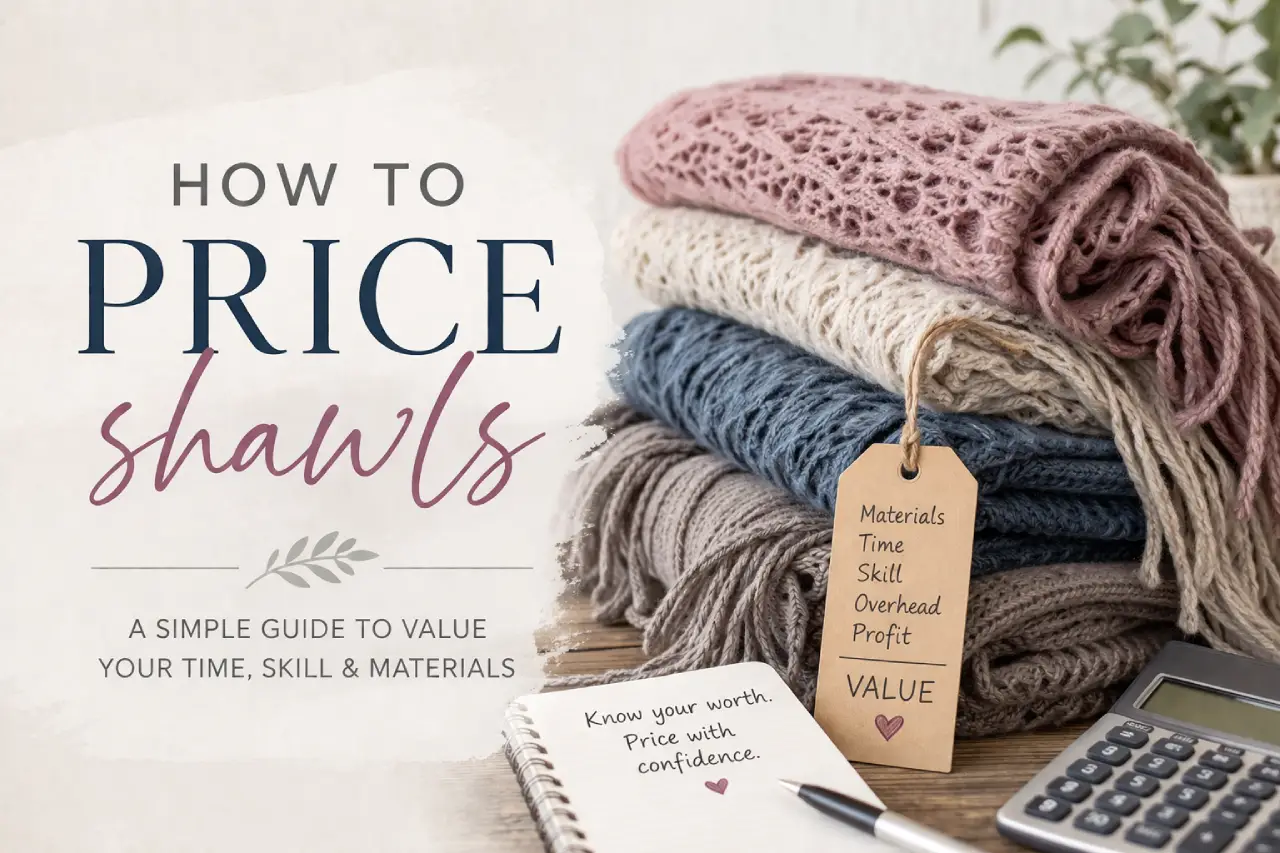
The cost of producing private label pashmina shawls, on the whole, varies depending on the fiber, type of weave, level of customization, quantity, and need for branding. There are study design ref: 33 aspects which do make the growing order and a component cost decreasing up to a certain limit – this increases gross profit margin as shown in figure 2 with MEPSI conversations. Thus, the advantage of the supplier is the possibility to conclude a monetary arrangement with the supplier agreeing on how the parties will increase cost efficiency.
It is also important to know about samples costs. Normally, such samples are offered by experienced suppliers only. However, such samples cannot be used in production, hence one must take into account the cost for making them. The process of sample making can take anywhere between two to four weeks. On the other hand, the process of actually producing garments can take between four and eight weeks depending upon any complexities of the order and the size of it.
Care must be taken to get each fabric cost, customization cost, branding cost, packaging cost and shipment cost broken up clearly in a quote that is formatted right. This helps in scrutinizing the cost structure and finalizing a price that is optimal for the brand’s business.
Customization Options in Private Label Pashmina Shawls
A very rich set of options can be found when it comes to customization for private label pashmina shawls, and this is what makes it possible for the imaginative organizations to develop themselves a unique range of products. Presented below is an in-depth description of the design possibilities you may include.
The first thing to alter in most cases is the color of the items. It is common to find experienced manufacturers matching colors according to Pantone PMS, and you will be able to color coordinate your range of shawls with that of your brand, or the latest trend colors and patterns. One can custom order a shawl dyed in a single color or even several colors, designs such as tie and dye, ombre and many color blends are available.
Designing and customization of paint pattern and weave is one of the factors driving the success of branded products. Built in designs have the characteristic of the fabric woven in jacquard weaving technique which makes it possible to stitch any artistic pattern such as geometric, floral and other designs. It is one of the high valued customization which improves the final product’s perceived value and quality.
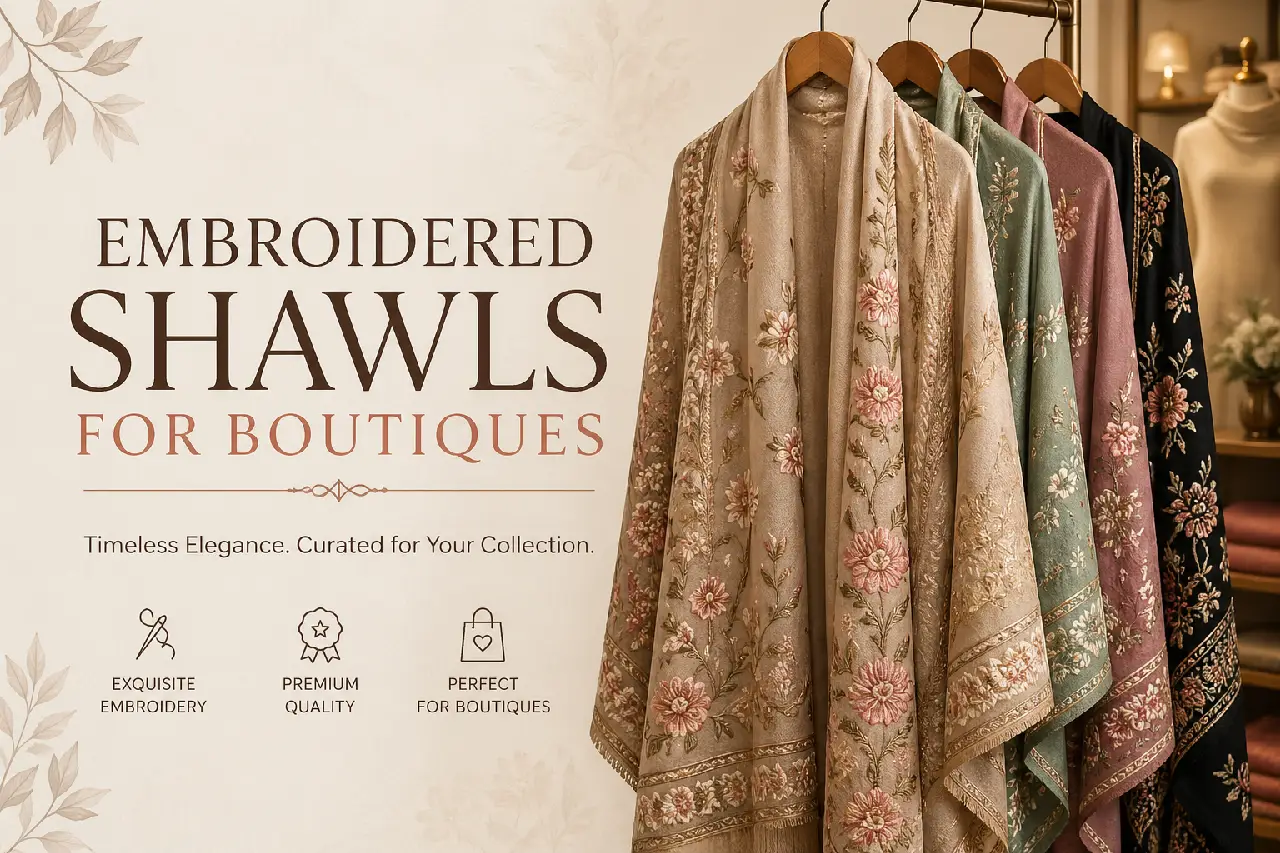
Private label pashmina shawls are traditional plain apparels that add class and style to the service when embellished with embroidered work and other aspects. Chain stitch embroidery, aari work, mirror work and sequin embellishment are common for brands that serve the high-end and wedding range of customers. Despite the fact that the working techniques discussed are time-consuming, they produce outstanding outlooks.
Specifically, the customization of sizes and dimension enables you to design the shawls, scarves, stoles or wraps in the specific sizes that complements your product line. In most cases, the length and width of a shawl come in 70 cm by 200 cm, however custom made lengths can be created easily.
Distinct features like twisted fringe, hand-knotted fringes as well as chain stitch borders are tension wise exposing the products to be more charming.
The finishing portion usually is made up of fringing, embellishment or the combination of both. Labeling and branding elements that are applicable are of many types design main woven labels, care labels, foot wear labeling, hang tags, swing tickets and size labels all can be customized and vary from how the product is. Design weaving and printing is not limited to hang tags which can be printed and interwoven.
However, there are many talented designers that do private label pashmina shawls and other products.
Packaging and Branding Strategies for Premium Positioning
For lines of private label pashmina shawls, packaging is far from being the last thing to think about — it is part of the brand building policy. Premium accessories depend greatly on the moment of unboxing, generating positive feedback, status sharing and intention to buy the products again.
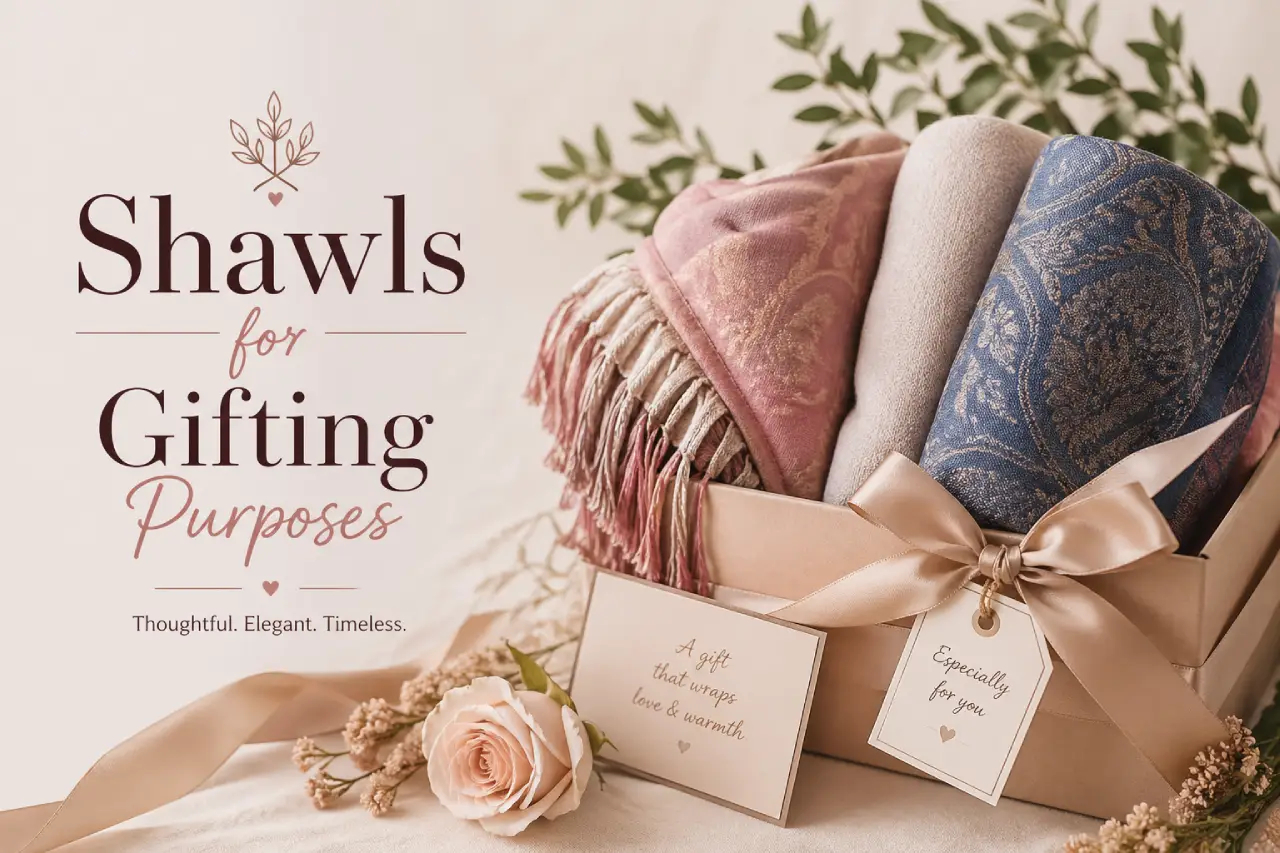
The deluxe packing plan for private label pashmina shawls often consists of several levels. As an exterior package works a firm gift box with your brand coloration, pressed emblem, and closure on magnet — first approach is to show that the product is worth its price. Within the embouchure, scrolled into the bands or placed in a case, is the shawl. It is either wrapped with a sticker indicative of the brand or fastened with a ribbon. The last part of the package is a card with the brand or care instructions or even both.
Carrier bags help, but often eCommerce also has to account for in what condition the finished goods will be shipped. There’s no use of a well crafted box design if the box arrives in poor condition. Provide manufacturers with your design to make sure that the product will stay in good shape and remain attractive to the buyers.
Packaging which is suitable for transport and shipment of goods, and suitable for presentation without additional causes and without the use of additional selling displays (certainly in case of counters and hanging tags) for wholesale and retail customers increases sales. Of course, manufacturers of these products are extremely fond of that box with the insert, because evidently, it is time consuming to ‘dress up’ the product for display.
Better still are the corporate clients around corporate gifting who expect brand differences, i.e. a client’s logo appearing on packaging ribbons, post cards, and boxes among other things. Incorporating these customization features into packaging for corporate clients who require gifts with your company’s logo on shiromani shawls will get you right on the table of those top-tier accounts and transform your business into the only other premium mementos partner.
It’s it is a wise idea to spend on enhanced packaging because it always pays off; the customers will have a higher opinion about the product, the customer satisfaction ratings will be as high as possible, and people will be talking about the packaging and sharing the unboxings with their circle of friends and family. Its commercial relevance should also not be overestimated.
How to Choose the Right Manufacturer for Private Label Pashmina Shawls
In the private label pashmina shawls business, the relationship with a manufacturer is very crucial. The correct choice of manufacturer can improve the brand’s position in the market; the incorrect one may lead to losses and reputation damage. There are many criteria that will assist in making the right decision in choosing the respective customer.
Have at least a few manufacturing companies researched in advance which they use for production. In case, the private label pashmina shawls manufacturer is legitimate, they should be able to provide evidence as to where the producing unit is situated, the coils they use for the fiber, the number of any export licenses, as well as quality certificates if any. It would be prudent to request a production manager samples of their products, details regarding the maximum quantity of production that may be realized, and names of customers that they are currently serving.
Determine the extent of customization by determining your need and understanding what color, design, branding, packaging is required and how well the supplier addresses these matters. A manufacturer experienced in private label pashmina shawls will have certain internal guidelines for the custom orders and will further notify the customer of the limits of such customization if any.
Always ask for samples before placing a specific production order. This is an imperative. Scrutinize the sample in terms of fiber content, weave construction, colors (shades), and it’s branding. If the sample is no good in any of those, such factors have to be resolved first.
Assess the quality of communication during the sampling stage. Timeliness, clarity, and appropriateness of communication methods are in most cases an indication of how efficiently the parties will handle production deadlines and issues.
Assess how soon production is finalized then plan in the volume of stock that has to be brought in. Larger more experienced producers tend to stick to their lead times however when making the first book of a particular supplier anticipatory actions in anticipation of delays need to be put in place.
Carefully manage and structure any financial commitments. As a standard rule, in most cases, deposits placed range from 30 per cent up to 50 per cent of the total order before the manufacturing activities kick in and completion on or before shipment. Be acquainted with how the finances shall be conducted, the currency of exchange and the method of the remittance conditioned with the contract.
If this is not possible, the factory should be visited by someone s party hired by the buyer and an audit of the factory should be performed. This can only be proper when these standards on production, work and assurance of quality are ensured by these large entities, holding focus on first development efforts.
While all of them will provide you with a variety of their goods for purchase, there are others who will be able to work out design private label pashmina shawls for you so you could start your own pashmina shawl business.
Common Mistakes to Avoid in Private Label Shawl Business
Entering the private label pashmina shawls, as a business, pays well, yet there are some cons to it as well. Rounding up lessons learnt about what demands the newcomers concern the most will prevent a lot of time wasting, loss of money, and mental God rest disturbance.
Most new participants faultily overstep the first and perhaps the most valuable stage – examining and authorization of the principal example. Do not allow any sewing process to take place unless and until the sample is examined and approved. A picture, even a series of them, would not be able to show the real value of a pashmina shawl in terms of its color accuracy, detail, and texture. It is wise to ask, nay, demand, samples, before any financial investment is made in the order.
Even established brands are sometimes blindsided by overly optimistic timelines. Most pashmina shawls, especially those that are hand-woven or feature embroidery, cannot be considered quick turn items. Allocating inventory in view of such schedules will lead to out of stock scenarios, missed opportunities, turn seasons, and loss of customers. Always include a minimum 2~3 week delay in preparation of your order.
One of the key issues is that brands are compromising on fiber genuineness which is a huge risk both commercially and reputationally. For instance, if you set out to sell the product as a real pashmina shawl whose fiber content turns out to include synthetic or poor-quality fibers, you bear the menace of a number of consumers’ complaints, returns and lowering of your brand. For that reason, ensure you include fiber test reports and confirm them.
Inadequate investment in packaging is an error that diminishes the usefulness of the most exquisite shawl. package explains the quality of the brand even before one even have to touch the product. Assessing prices and opting for cheaper packaging rather indicates a misconception of expensive accessories.
There is a danger in producing too much on the first production order when the market has not been ascertained. Begin with proper volumes, confirm availability of the market, and gradually increase production in intervals, in accordance with the market needs once market is created.
Chinese factories offer a wide range of services, including private label pashmina shawls in addition to designing and weaving.
If you don’t try and gain exclusive rights to your designs, this is another mistake that lowers your brand creative attributes. For example, when you pay someone to design a particular print or color scheme, a clause should be included in the manufacturer contract that bars them from reproducing the said design for a competing brand.
How to Scale Your Business with Private Label Pashmina Shawls
When you have developed the ranges of your first private label pashmina shawls collections and you have proved that there is market for the same, the next move is to scale systematically. Business rationale in this niche is growing by increasing your range of products, expanding the depth of the distribution channels and strengthening the role of the brand within the expensive accessories segment.
Plan it as ski slopes which simply have more turns or easier slopes. Introduce two or three main models at the beginning with the best selling designs in the most commercial colors. When the customer base increases, other color tones and designs like stoles, travelling wraps, gents pashmina scarves as well as pashmina blankets are introduced. To enhance average purchases and cater for more consumers, the product line is expanded in such a way.
Enhancing your DTC operations as well as your wholesale volume and channel systems allows you to establish stronger relationships with your customers. A neater description of high-value wholesale clients will inform of businesses such as individual stores, exclusive hotels or spa retreats or even companies that handle gifts for employees. One can resolutely place private label pashmina shawls with clients by way of a well-rounded wholesale presentation including the history of the company, its reputation for top-of -the-line goods and how much one can possibly profit.
Diversifying efforts towards content creation and search engine optimization raises the potential for consumers to initiate contact with the business. Detailed longform articles about products, laundering and care tips instructions, how-to wear guides, brand features and the like – all such take resources for return on investment in organic traffic growth as well as client trust enhancement in the long run.
Utilize with maximum effectiveness seasonal and gift windows. In the fall and winter seasons, pashmina shawls always sell well. Likewise, end of year gifts is also particularly popular around the following holidays – Christmas, Diwali, Valentines, Mothers, and corporate year-end gift giving season as well. Prepare stock and spend on marketing during these periods. Take into account, of course, the time required for production.
Develop programs keeping in mind customer loyalty, offering various benefits with repeat transactions. Customers who use private label pashmina shawls and enjoy the product will most certainly order again gifts, products in different colors, and related products. Offering email newsletters, loyalty bonuses, and very often personalized offers allows increasing the value gained from customers over a longer period of time.
Global Market Trends for Private Label Pashmina Shawls
The private label pashmina shawls in the global high-end scarf market are still in high demand & generating healthy revenue. It is very important to identify brand essentials & awareness to tap the market to the fullest.
The market for fashion accessories keeps rising globally, especially in major economies such as North America, Europe, and the Gulf Cooperation Council (GCC) countries. In these economies, consumers are willing to compromise on the number of items, but not on quality — this is the case for pashmina’s high-end range.
Another high growth area is in corporate gifts. With the growing emphasis on customer relations and employee engagement, the branded gifts that are of good quality have advanced as an investment. The custom logo scarves as well as the bespoke pashminas have proved very appealing in this market segment as they have a wide reach and even more desirably they are expensive and worth the money.
Sustainable businesses affect not only the supply side of retail markets, but also consumer demand. As a biodegradable fiber with a strong handicraft history, pashmina is preferred even more by consumers whose interest is directed towards sustainable and ethical sources of fashion. Particularly, these are the brands that embrace and enhance the narrative of sustainability of private label pashmina shawls which include clear chains of production, particular scope of ethics to avert exploitation, and development of artistic skills of certain societies ever craft pashmina.
The emergence of e-commerce has been one of the most fundamental facilitators of private label pashmina. Today’s platforms such as Shopify, Amazon, Etsy, and corporate DTC online websites have done a great deal in easing market access even for small brands that can reach the entire world and make significant sales.
Innovativeness is another human want that is likely to rise soon, and the private label pashmina shawls line is in a good position to satisfy against. Monogramming is Budgeted Trimmings as available service tends to of late and gifts very few consumers especially in this respect appreciate ordering colors of their choice or personalized packaging.
Conclusion: Building a Successful Brand with Private Label Pashmina Shawls
Private label pashmina shawls are currently one of the most interesting products in the premium segment of fashion accessories. The fact that the product is unparalleled in quality, with deep branding capabilities and attractive economics with high margins in addition to the growing demand worldwide creates a business concept that is hard to copy for other products and goods.
The companies which perform well in this area have one thing in common; they do not just focus on increasing volumes, but give their efforts for example to production development, creating a simple but important brand, engaging manufactures with experience in providing shawl branding services, entering new markets by focusing on the numbers.
It does not matter if you are a fashion brand which wants to incorporate a range of high end accessories, or a retailer in search of high yielding private label goods. A wholesaler creating a catalogue of white label scarves for a particular distribution channel or a businessman working on creating a brand for the first time. Such people should engage themselves with available opportunities in private label pashmina shawls.
The market is on the rise. Customers remain interested in the idea of high-level, high-quality, and artisan-produced decorative pieces. There has never been an easier time when creating a successful private brand that includes the components of attainable factories and large powerful e-commerce systems.
If only, there is no question whether such an opportunity is available or not. The only question that remains is if your brand is ready to seize it.
Are you equipped to introduce or extend your range of private label pashmina shawls? Reach out to us now and let us know how we can help implement your ideas. Probably, you would like to have an item of this collection so at least one piece is requested. Whether it is the traditional designs or the enhanced version — be it the research, the printing, the production of different labels or beautiful packages or custom printing on the shawls — we aim to achieve this with you.
Related Products
Showing 73–81 of 807 results
-
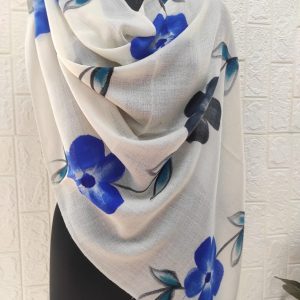
Off-White Hand-Painted Blue Floral Pashmina Shawls for Women
Read more -

Emerald Green Hand-Painted Multicolor Floral Pashmina Shawls for Women
Read more -
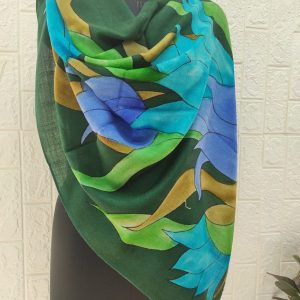
Emerald Green Hand-Painted Floral Pashmina Shawls for Women
Read more -
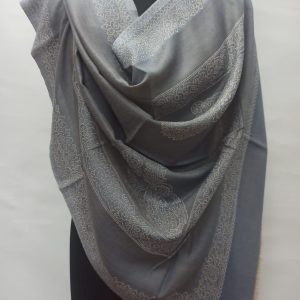
Grey Wool Golden Jaal Kani Pashmina Shawls for Women
Read more -
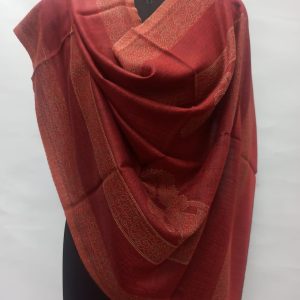
Maroon Wool Golden Jaal Kani Pashmina Shawls for Women
Read more -
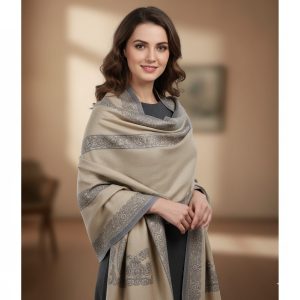
Beige Wool Blue Border Jaal Kani Pashmina Shawls for Women
Read more -
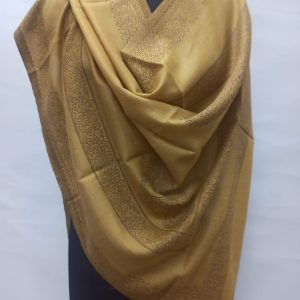
Mustard Wool Golden Jaal Kani Pashmina Shawls for Women
Read more -
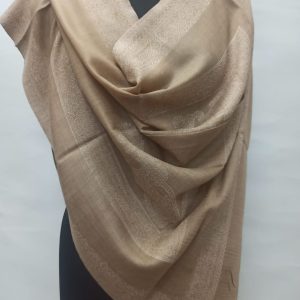
Wool Golden Jaal Kani Pashmina Shawls for Women
Read more -

Grey Wool Jaal Kani Pashmina Shawls for Women
Read more