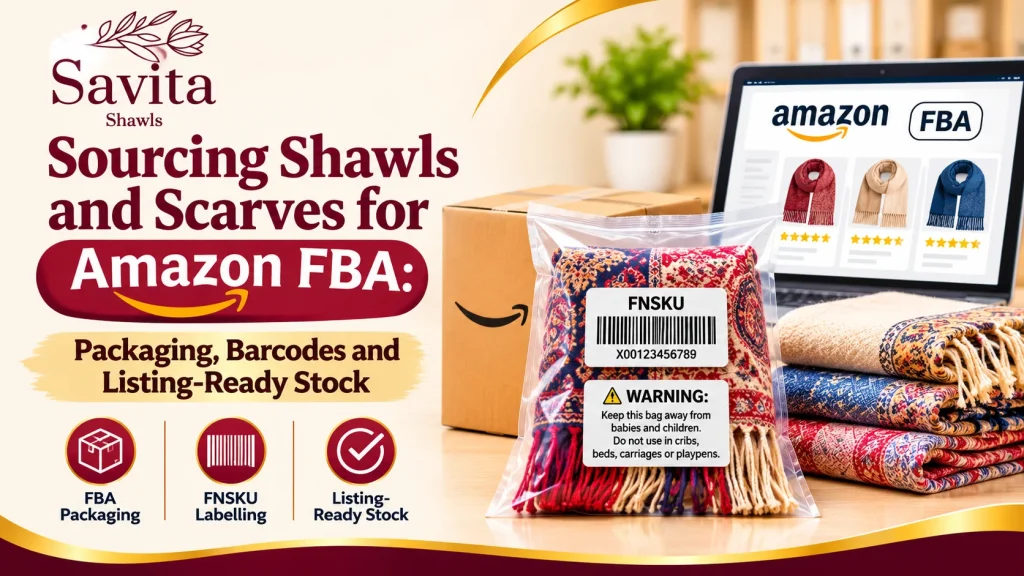
Scarves look like an easy product for Amazon. They are light, they do not break, and one size usually fits everyone. But FBA sellers who source from a factory for the first time often find out the hard way that the product itself is only half the job. A shipment can be held at the fulfilment centre because the poly bags have no suffocation warning, the barcodes do not scan, or one colour carries another colour’s label.
This guide is written for scarves for Amazon sellers who want to buy direct from a manufacturer. It covers what to source, how FBA packaging and FNSKU labelling work for textiles, what changed in 2026, and how to brief your factory so stock arrives ready to list and ready to receive.
Quick Answer
To source scarves for Amazon sellers successfully, buy from a manufacturer that can give you consistent sizes and colours, accurate fibre content and clean export documents. Each scarf must be folded into its own transparent, sealed poly bag. Bags with an opening of 5 inches or more need a suffocation warning, and every unit needs a scannable barcode, usually an FNSKU label, with a separate FNSKU for each colour or size. Since January 2026, Amazon no longer preps or labels FBA inventory in the US, so this work has to be done before the stock ships.
Why Scarves Work Well for Amazon FBA
There are good reasons scarves for Amazon sellers have become a popular private label category.
- Low weight and small fold. Scarves ship cheaply and take little storage space.
- No size returns. One-size products avoid the fit problems that drive apparel returns.
- Easy colour variations. One design in six colours can become a single parent listing with child variations.
- Gift demand. Scarves and stoles sell through the winter season and gifting periods.
- Room for a brand. A private label scarf with good photos and honest fibre content can stand out from generic listings.
What to Source: Choosing the Right Scarves for Amazon Sellers
Not every scarf suits FBA. When you shortlist scarves for Amazon sellers, look for products that photograph well, fold flat and do not crush or crease badly in a bag.
- Modal and viscose scarves: soft, light and good value. See our modal scarves range.
- Printed scarves: strong visual appeal in thumbnails. Browse printed scarves.
- Wool and fine wool stoles: winter best sellers at a higher price point. See fine wool stoles.
- Fashion scarves in solid colours: easy to run as a colour variation family. See fashion scarves.
Be careful with fibre names. Amazon customers leave reviews when a “pashmina” turns out to be acrylic. Describe the fibre exactly as it is. Our guide to pashmina vs cashmere vs wool vs acrylic shawls explains the differences, and how to identify real pashmina shows what buyers check.
FBA Packaging Rules for Scarves
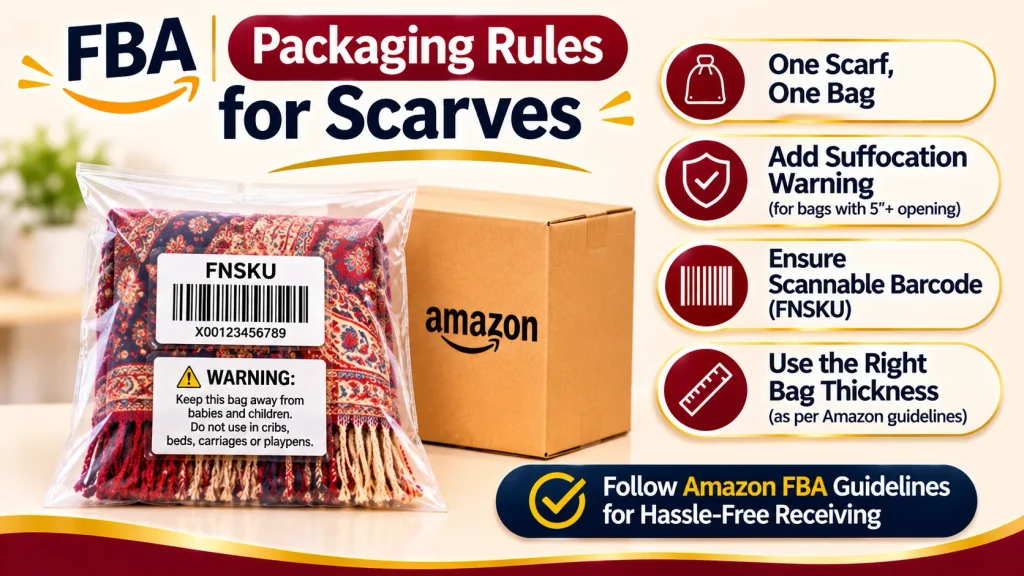
Amazon treats scarves as apparel and textiles. Packaging rules for scarves for Amazon sellers come down to a short list. Always check the current Seller Central packaging page before each new shipment, because details are updated.
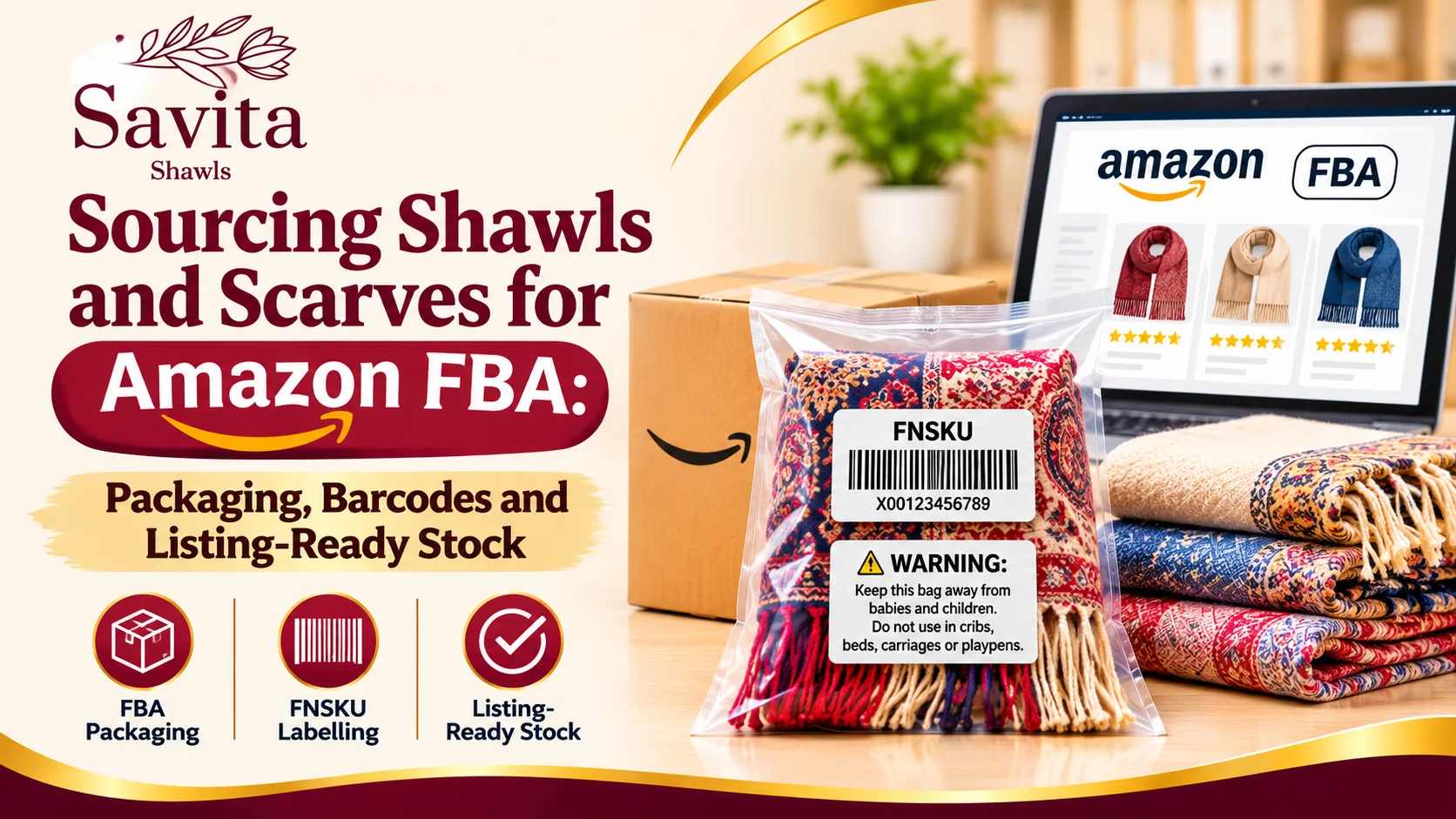
- One scarf, one bag. Fold each unit and place it in its own transparent poly bag.
- Seal the bag completely. Self-adhesive bags work, otherwise tape the opening.
- Add a suffocation warning. Bags with an opening of 5 inches or more, measured flat, must show a suffocation warning printed on the bag or applied as a label. The minimum font size depends on the bag’s size.
- Make the barcode scannable. The barcode must scan through the bag, or the label must be stuck on the outside.
- Use the right bag thickness. Amazon sets a minimum thickness for poly bags. Confirm the current figure on Seller Central and share it with your factory.
What Changed in 2026
From January 1, 2026, Amazon stopped offering FBA prep and labelling services in the US. That means Amazon will no longer bag, bubble wrap or barcode your units for a fee. If your scarves arrive unbagged or unlabelled, they can be delayed or rejected. For scarves for Amazon sellers, the practical result is simple: the factory or a prep centre must do this work before the cartons leave.
FNSKU Labelling for Textiles
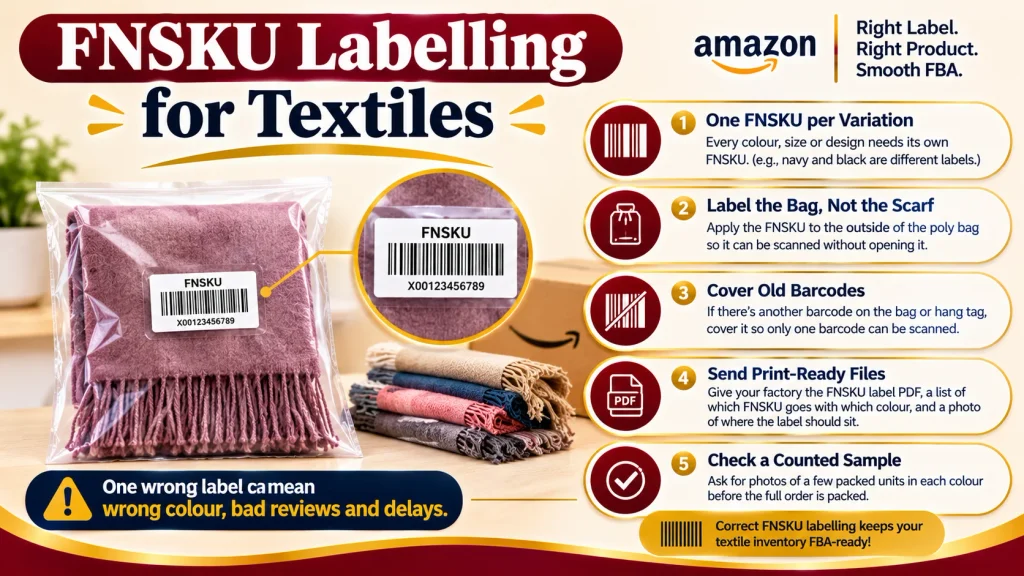
An FNSKU is the Amazon barcode that links a physical unit to your seller account. It usually starts with X00. Here is how to handle it for a scarf range:
- One FNSKU per variation. Every colour, size or design needs its own FNSKU. A navy scarf and a black scarf in the same design are two different labels.
- Label the bag, not the scarf. Apply the FNSKU to the outside of the poly bag so it can be scanned without opening it. Do not stick labels directly on fabric.
- Cover old barcodes. If a bag or hang tag has another barcode, cover it so only one barcode can be scanned.
- Send print-ready files. Give your factory the label PDF from Seller Central, a list of which FNSKU goes with which colour, and a photo showing where the label should sit.
- Check a counted sample. Ask for photos of a few packed units in each colour before the full order is packed.
Mislabelled colours are the most common problem we see with scarves for Amazon sellers. If ten black scarves carry the navy label, customers receive the wrong colour and leave reviews that hurt the whole listing.
Product Labels and Compliance
Compliance is easy to overlook when sourcing scarves for Amazon sellers. Beyond the Amazon barcode, each scarf needs the right product labelling for the country you sell in. In the US, for example, textile products need fibre content and country of origin labelling. Read our guide to care label requirements for textile export, and if you sell in Europe, consider an Oeko-Tex certified supplier.
If you plan to build a brand, Amazon Brand Registry requires a registered or pending trademark. Your factory can add your woven label and branded packaging through private label shawls and scarves.
How to Brief Your Factory for Listing-Ready Stock
A clear packing brief is the single biggest time saver for scarves for Amazon sellers. Send your manufacturer this list when you confirm the order:
| Item | What to send |
|---|---|
| Product specs | Size, fibre content, GSM, colour references, finishing |
| Fold | Folded size that fits your bag, with a photo |
| Poly bag | Bag size, thickness, suffocation warning text and font size |
| FNSKU labels | Label PDF per variation and a colour-to-label list |
| Product labels | Care, fibre content, origin and brand label artwork |
| Carton packing | Units per carton, one variation per carton if possible, carton labels |
| Documents | Commercial invoice, packing list, HSN and Incoterms |
For export packing, see our notes on export-ready shawl packaging. Check the right HSN codes for shawls and stoles and agree terms using our guide to FOB vs CIF.
Sampling, MOQ and First Orders
Start every new product with a paid sample. Photograph it, check how it folds into the bag, and test whether the barcode scans through the plastic. Our sample request guide shows what to inspect.
When you first test scarves for Amazon sellers on your account, keep the first FBA order modest across a few colours, then reorder the colours that sell. Our tips on negotiating MOQ with shawl suppliers help you keep early orders small. If you are still deciding between FBA and a no-stock model, compare it with our guide to shawl dropshipping suppliers in India.
Working With Savita Shawls
Savita Fashions LLP is a shawl, stole and scarf manufacturer based in Gurgaon, founded in 1984, and an IEC-licensed exporter supplying buyers in more than 40 countries. All our production is machine-made, which keeps size, weight and shade consistent across reorders, something Amazon listings depend on.
- Ready stock: dispatched the next day after payment.
- Made-to-order: 15 working days of production after order confirmation.
- Payment: 100% advance on your first five orders, then 50% advance and 50% before dispatch. Wire transfer or Wise, invoiced in USD or EUR.
Share your FNSKU labels and packing brief when you confirm your order, and we will confirm what can be done at the factory before production starts. For the full ordering process, read our wholesale shawl and stole buyer guide.
Get Your FBA Order Ready
If you are sourcing scarves for Amazon sellers or building your own scarf brand on Amazon, send us your product idea, target colours and quantities. Request a wholesale quote, contact our team, or message us on WhatsApp.
Frequently Asked Questions
Do scarves need to be poly bagged for Amazon FBA?
Yes. Amazon treats scarves as textiles, so each unit should be folded into its own transparent, sealed poly bag with a scannable barcode. Bags with an opening of 5 inches or more need a suffocation warning.
Does Amazon still label and prep FBA inventory?
Not in the US. Amazon ended its FBA prep and labelling services on January 1, 2026, so sellers must bag and label units before shipping, either at the factory or through a prep centre.
Do I need a different FNSKU for each scarf colour?
Yes. Each colour, size or design is a separate variation and needs its own FNSKU label.
Can my manufacturer apply FNSKU labels?
Many can, if you send print-ready label files, a colour-to-label list and a photo of label placement. Confirm this before the order is packed and ask for photos of finished units.
What are the best scarves for Amazon sellers to start with?
Solid colour modal, viscose or printed scarves are a good start because they are light, fold well and work as colour variations. Wool stoles suit sellers targeting winter demand at a higher price.