Dropshipping is sold as inventory free retail and delivered as margin free retail more often than anyone admits. The model genuinely works for testing demand and for sellers who cannot fund stock, and it genuinely struggles on shipping times, returns and quality control when the goods ship from India to a customer in Europe or North America. A shawl dropshipping supplier India arrangement is worth understanding honestly before building a business on it. This guide covers how the model actually operates, what the economics look like, and when moving to bulk buying makes more sense.
How a shawl dropshipping supplier India arrangement works
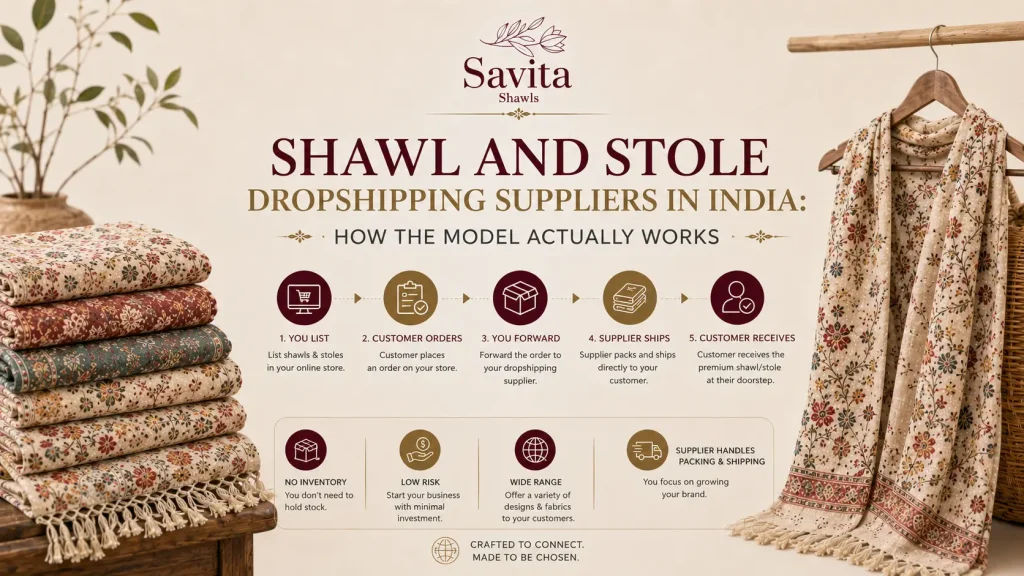
You list products on your own store. A customer orders. You forward the order and payment to the supplier, who packs and ships the piece directly to your customer, usually in your branding. You never hold stock.
The supplier handles warehousing, packing and dispatch. You handle marketing, customer service and returns. That split is the whole model.
Three variations exist in practice. Pure dropshipping ships each order individually from India. Hybrid arrangements hold a small buffer of your fastest lines in a local warehouse while dropshipping the long tail. Print on demand produces the piece after the order arrives, which extends timelines considerably.
Not every manufacturer offers dropshipping, and many established exporters do not, because the operational model is entirely different from bulk production. Ask directly rather than assuming.
The economics, honestly
Dropshipping unit prices sit well above bulk wholesale prices, because the supplier is picking, packing and shipping one piece rather than a carton of two hundred.
Individual international shipping is the largest cost difference. Shipping one stole from India to a customer in Germany costs a multiple of the per piece cost of shipping five hundred in a single consignment. That cost either eats your margin or raises your retail price above competitors holding local stock.
Payment processing, marketplace fees and advertising then come out of what remains. Sellers who model dropshipping margins on the product cost alone consistently find the actual figure much thinner.
Compare against bulk. A retailer buying 100 pieces at wholesale carries stock risk and gets a considerably lower unit cost, faster local delivery and control over packing. The bulk economics are set out in the guide to wholesale stole supply.
The honest summary: dropshipping is a demand testing tool and a starting position, not a destination. Sellers who find a product that moves generally improve their business by moving to bulk on that line while dropshipping the rest.
Shipping times and what customers expect
This is where the model strains hardest. International delivery from India runs 7 to 21 days depending on service and destination, against the two day expectation set by large domestic marketplaces.
Air express is fast but expensive per piece. Standard international post is affordable and slow, often without reliable tracking.
State delivery times prominently on your product pages rather than in a policy nobody reads. Sellers who set the expectation upfront see dramatically fewer disputes than those who let the customer discover it after ordering.
Customs is the variable nobody controls. A parcel held at destination customs adds days and occasionally triggers a duty demand your customer did not expect, which produces a complaint even when everything else went right. The documentation side is covered in the guide to stole export from India.
Quality control without holding stock
The structural weakness of dropshipping is that you never see the product before your customer does.
Order samples of every line you list, and keep them. You need to know what you are selling and you need a reference when a customer disputes what arrived. The sampling process is covered in the guide to requesting samples from a manufacturer.
Order test shipments to your own address periodically, using your own storefront as a customer would. This is the only way to see what actually arrives, including packing quality and delivery time.
Agree fibre composition and dimensions in writing for every listed product, because your listings carry your legal liability regardless of who shipped the goods.
Specify packing. A premium stole arriving in a plain courier bag undermines a brand you are paying to build.
Returns, refunds and where liability sits
Returning a single item to India is usually uneconomic. The shipping cost frequently exceeds the item value, which means most dropshipped returns end as refunds without goods coming back.
Model that into your pricing from the start. A return rate of eight to twelve percent on accessories is normal, and if every return is a full refund with no recovered stock, that is a direct cost per order.
Agree with your supplier in writing who bears the cost of a wrong or defective item shipped. A supplier who accepts liability for their own errors is worth paying slightly more for.
Consumer law in your market applies to you as the seller regardless of where goods ship from. Distance selling rules in the EU and UK give customers cancellation rights that your supplier arrangement does not override.
When to move from dropshipping to bulk
Four signals suggest the switch is worth making.
A single line sells consistently for three months. At that point stock risk on that line is low and the margin improvement is immediate.
Shipping complaints exceed product complaints. That means the model rather than the product is your constraint.
Your marketing cost per order stops falling. Bulk margin buys you room to compete on price or ad spend that dropshipping margin does not.
You want branding. Woven labels, custom hangtags and branded packaging need a minimum order, and the options are set out in the guide to custom stole development.
A sensible progression is dropshipping to find what sells, then bulk buying at a modest minimum on proven lines, keeping the long tail dropshipped.
What Savita Shawls offers
Savita Fashions LLP, trading as Savita Shawls, has manufactured stoles, shawls and scarves from Gurgaon, Haryana since 1984 and supplies wholesale buyers in more than 20 countries. GST registration is 06AFPFS3876N1Z0 and IEC is AFPFS3876N, verifiable on the GST portal and the DGFT portal. The company is registered with FIEO and AEPC.
The business is structured for bulk manufacturing rather than individual order fulfilment. Minimum order quantity is 100 pieces per stock design and 200 pieces per custom or OEM design, with corporate gifting from 50 pieces with branding. Sellers currently working with a shawl dropshipping supplier India arrangement and looking to move proven lines to bulk will find that 100 pieces on a single design is a modest commitment against the margin improvement it delivers.
Samples dispatch within 5 to 7 business days with the cost credited against the bulk order, which lets a seller evaluate quality before committing. Private label covers woven inner labels, care labels in your destination language, hangtags and individual poly bag packaging suitable for direct ecommerce fulfilment from your own stock. Production runs 10 to 15 working days for stock styles with your label. Shipping is available on FOB, CIF or DDP terms, with DDP suiting smaller ecommerce operations without a freight forwarder.
Frequently asked questions
How does a shawl dropshipping supplier India arrangement work?
You list products on your store, a customer orders, you forward the order and payment to the supplier, and the supplier packs and ships directly to your customer, usually in your branding. You hold no stock. The supplier handles warehousing and dispatch while you handle marketing, customer service and returns.
What margin can I expect from dropshipping shawls?
Considerably less than bulk buying, because dropshipping unit prices sit above wholesale and individual international shipping costs a multiple of the per piece cost in a bulk consignment. After payment processing, marketplace fees and advertising, sellers modelling margin on product cost alone usually find the real figure much thinner than expected.
How long does dropshipping delivery from India take?
International delivery runs 7 to 21 days depending on service and destination, against the two day expectation large domestic marketplaces have created. Air express is faster and considerably more expensive per piece. State delivery times prominently on product pages, since sellers who set expectations upfront see far fewer disputes.
How do I control quality if I never see the product?
Order samples of every line you list and keep them as a reference for disputes. Order periodic test shipments to your own address through your own storefront to see exactly what a customer receives, including packing and delivery time. Agree fibre composition and dimensions in writing, since your listings carry your legal liability.
Who handles returns in dropshipping?
Practically, you do. Returning a single item to India is usually uneconomic because shipping cost often exceeds item value, so most dropshipped returns end as refunds without goods coming back. Model a return rate of eight to twelve percent into your pricing, and agree in writing who bears the cost of supplier errors.
When should I switch from dropshipping to bulk buying?
When a line sells consistently for three months, when shipping complaints outnumber product complaints, when your marketing cost per order stops falling, or when you want branded labels and packaging. A sensible progression is dropshipping to find what sells, then bulk on proven lines while keeping the long tail dropshipped.
Do all Indian shawl manufacturers offer dropshipping?
No. Many established exporters are structured for bulk production and do not offer individual order fulfilment, because the operational model is entirely different. Ask directly rather than assuming. Savita Shawls operates as a bulk manufacturer with minimums of 100 pieces per stock design and 200 pieces for custom work.
Can I get my own branding on dropshipped shawls?
Some dropshipping arrangements include basic branding such as an inserted card or a branded polybag. Woven inner labels, custom hangtags and full private label packaging require a minimum order quantity, since labels and tags are produced in batches. This is one of the common reasons sellers move proven lines from dropshipping to bulk purchasing.
Ready to order
If you are running a dropshipping operation and a line has proven itself, moving that product to bulk is usually the single largest margin improvement available. Savita Shawls supplies from 100 pieces per stock design with private label branding and 10 to 15 working day production. Samples ship within 5 to 7 business days with the cost credited against your order. Start with a wholesale pricing enquiry, email sales@savitashawls.com or call +91 7696677766.