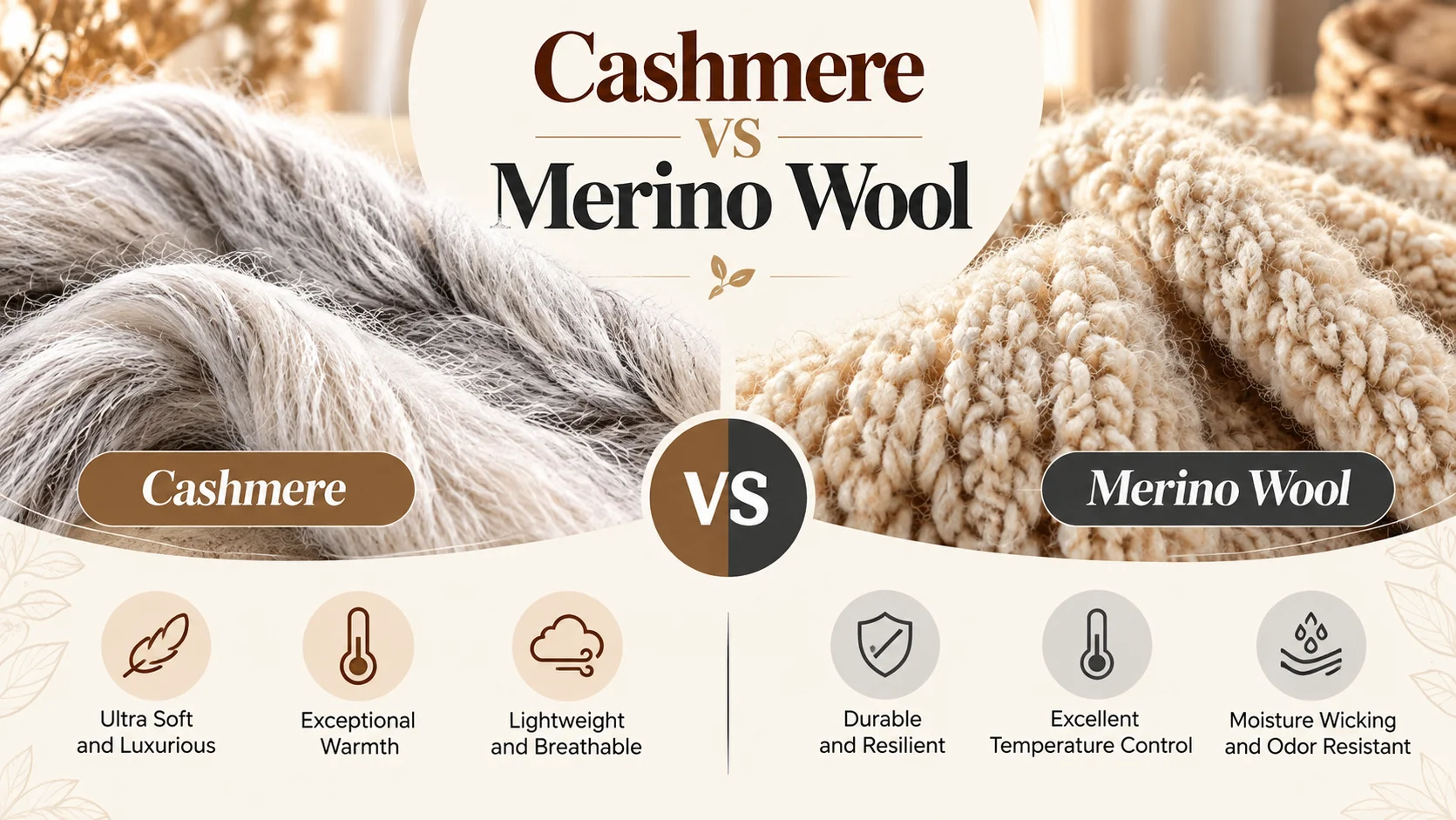
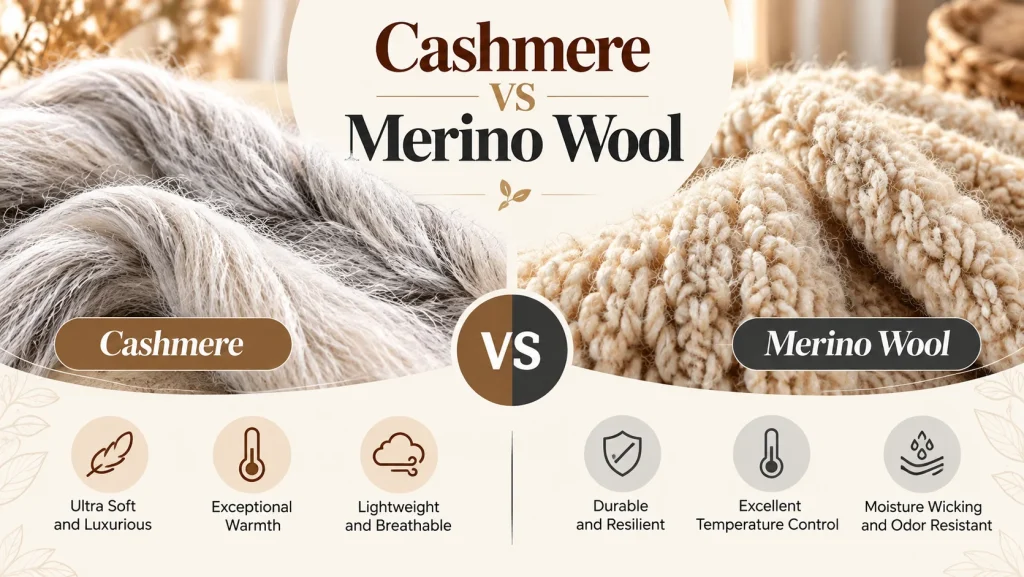
Cashmere is softer, lighter and warmer for its weight, and it carries a clear luxury image. Merino wool is tougher, easier to care for and costs far less, while still feeling soft against the skin. For scarf buyers, cashmere earns a higher margin per piece but ties up more money in stock, while merino moves faster at a lower price. Many ranges use both, often with a cashmere-merino blend in between.
Key takeaways
- Cashmere is usually finer and lighter. Fine merino comes close in softness at a fraction of the cost.
- Merino is more elastic and resilient, so it holds its shape and handles everyday wear better.
- Cashmere sells on luxury and gifting. Merino sells on comfort, value and easy care.
- Blends such as 10 to 30 percent cashmere with merino give buyers a middle price point.
What are cashmere and merino wool?
Cashmere is the fine undercoat of cashmere goats, mostly raised in Inner Mongolia, Mongolia and other cold, high regions of Central Asia. Each goat yields only a small amount of fine fibre a year, which keeps supply tight and prices high.
Merino is wool from merino sheep, bred mainly in Australia, New Zealand, South Africa and South America. Merino is much finer than ordinary sheep wool, and its best grades are soft enough to wear against the neck.
Both are natural animal fibres. The differences come from fibre structure, supply and processing. Our guide to pashmina vs cashmere vs wool vs acrylic shawls places both in the wider fibre range.
Cashmere vs merino: side-by-side comparison
| Factor | Cashmere | Merino wool |
|---|---|---|
| Typical fineness | Around 14 to 19 microns | Around 17 to 24 microns, finer grades below 19 |
| Softness | Very soft, silky hand | Soft, slightly springier hand |
| Warmth for weight | Higher | High |
| Weight | Very light | Light to medium |
| Elasticity and shape | Lower; can stretch if mishandled | High natural crimp; springs back |
| Pilling | Can pill, especially lower grades | Pills less in good qualities |
| Care | Dry clean or gentle hand wash | Hand wash; some treated merino is machine washable |
| Cost | Several times more than merino | Moderate |
| Brand image | Luxury, gifting | Comfort, quality, everyday |
Fineness ranges vary by grade and supplier, so always ask for the micron count of the yarn used in your order.
Which is warmer, cashmere or merino?
Both fibres trap air and keep warmth in. Cashmere is generally warmer for its weight, so a light cashmere shawl can feel as warm as a heavier merino one. Merino also handles moisture well and stays comfortable over a range of temperatures, which suits everyday and travel wear.
For customers in very cold climates, the weave and weight matter as much as the fibre. A dense merino scarf can be warmer than a fine, open-weave cashmere one. Our guide to GSM and fabric weight explains how to specify warmth through weight.
Which is softer and more durable?
Cashmere usually feels softer, because its fibres are finer and smoother. Superfine merino can come close, and many customers cannot tell a fine merino from a lower-grade cashmere by touch alone.
Durability favours merino. Its natural crimp makes it elastic, so scarves hold their shape and resist stretching. Merino fibres are also more resilient to rubbing, so good merino pills less than low-grade cashmere. Read more in our merino wool shawls guide.
How can you tell cashmere and merino apart?
By hand, cashmere feels smoother and slightly cooler, with a soft halo of fibre on the surface, and it drapes more fluidly. Merino feels a little springier and bounces back when squeezed. Price is another clue: a pure cashmere scarf sold at a merino price deserves a closer look.
Only a lab test confirms fibre content for certain. Ask your supplier for a composition report, and see our notes on judging high-quality wool shawls and on how to identify real pashmina.
How do care needs compare?
- Cashmere: dry clean or hand wash in cold water with a gentle wool detergent, dry flat and store folded. Our pashmina care tips apply to fine cashmere too.
- Merino: hand wash cold and dry flat. Merino treated for machine washing can go on a gentle wool cycle, which many shoppers value.
Whichever fibre you choose, the care label must match the product. See our guide to care label requirements for textile export.
Cost and margin: what does each fibre mean for your business?
Cashmere costs several times more than merino at the same size and weight. That changes how each product works in your range.
- Cashmere carries a higher selling price and a larger profit per piece. It also ties up more cash in stock, sells more slowly outside peak gifting periods, and carries more risk if returned for pilling.
- Merino sells at a lower price with a smaller profit per piece, but it usually turns over faster and suits repeat everyday purchases.
- Blends sit in between. A 10 to 30 percent cashmere and merino blend lets you use the word cashmere honestly on the label while keeping the price within reach.
Our guide to how to price shawls shows how to set retail prices and margins, and our article on affordable luxury shawls covers the middle price band.
What about lambswool?
Lambswool comes from a sheep’s first shearing, usually at a few months old. It is soft and warm but generally coarser than fine merino, and it can come from many breeds. Lambswool suits classic tartans, checks and country-style scarves at a lower price than merino. If softness against the neck matters most, choose merino or cashmere. Our guide to pure wool shawls covers wool qualities in more detail.
Do ethics and certifications matter?
They matter more each year, especially for buyers in Europe and North America.
- Merino: buyers increasingly ask for wool from non-mulesed sheep and for schemes such as the Responsible Wool Standard, which covers animal welfare and land management.
- Cashmere: schemes such as The Good Cashmere Standard and the Sustainable Fibre Alliance address goat welfare and grassland protection.
- Both: chemical safety tests such as Oeko-Tex are widely requested.
Ask your supplier which certifications are available for your order, and describe the product only by claims you can document. Our sustainable scarves range covers eco-focused options.
Which should you stock?
| Store type | Suggested approach |
|---|---|
| Luxury boutique | Pure cashmere core, a few cashmere-silk pieces |
| Department store | Merino core with a cashmere-merino blend and a small pure cashmere line |
| Menswear store | Merino scarves in neutrals, cashmere for gifting season |
| Online value retailer | Merino and lambswool, with blends as a step up |
| Corporate gifting | Cashmere or cashmere-blend stoles, boxed |
Browse our cashmere shawls and fine wool stoles, and read our guides to cashmere stoles and wool-silk blends vs cashmere.
MOQ and ordering at Savita Shawls
| Term | Savita Shawls standard |
|---|---|
| MOQ | 100 pieces per design, lower on some stock styles |
| Stock styles with your label | 10 to 15 working days |
| Custom woven designs | 45 to 60 working days after sample approval |
| Samples | Delivered internationally in 7 to 10 working days |
| Documents | Material composition certificates on request |
Order samples in both fibres and compare them side by side. Here is how to request samples from a shawl manufacturer.
Order cashmere and merino scarves from Savita Shawls
Savita Shawls has manufactured shawls, stoles and scarves in Gurgaon since 1984 and exports to more than 40 countries. Ask about private label manufacturing, or request a bulk quote with your fibre, blend, size and quantity.
Frequently asked questions
Is cashmere better than merino wool?
Cashmere is softer, lighter and more luxurious. Merino is more durable, easier to care for and much cheaper. The better choice depends on your price point and customer.
Is merino wool as warm as cashmere?
Cashmere is generally warmer for its weight. A heavier or denser merino scarf can still match a light cashmere scarf for warmth.
Why is cashmere so much more expensive than merino?
Each cashmere goat produces only a small amount of fine fibre a year, and much of the raw weight is lost when coarse hair is removed. Merino sheep produce far more usable wool.
Can customers tell cashmere from merino by touch?
Often, yes, with premium grades. Cashmere feels smoother and drapes more fluidly, while merino feels springier. Fine merino and lower-grade cashmere can feel very similar, so only a lab test is conclusive.
Does merino wool itch?
Fine merino rarely itches because its fibres are thin enough to bend against the skin. Coarser wool, including some lambswool, is more likely to feel scratchy.
What is a cashmere-merino blend?
It is a yarn that mixes cashmere with merino wool, often 10 to 30 percent cashmere. It adds softness at a lower cost than pure cashmere, and the label must show the exact percentages.
What is the minimum order for cashmere or merino scarves?
Savita Shawls starts at 100 pieces per design, with lower quantities on some stock styles.