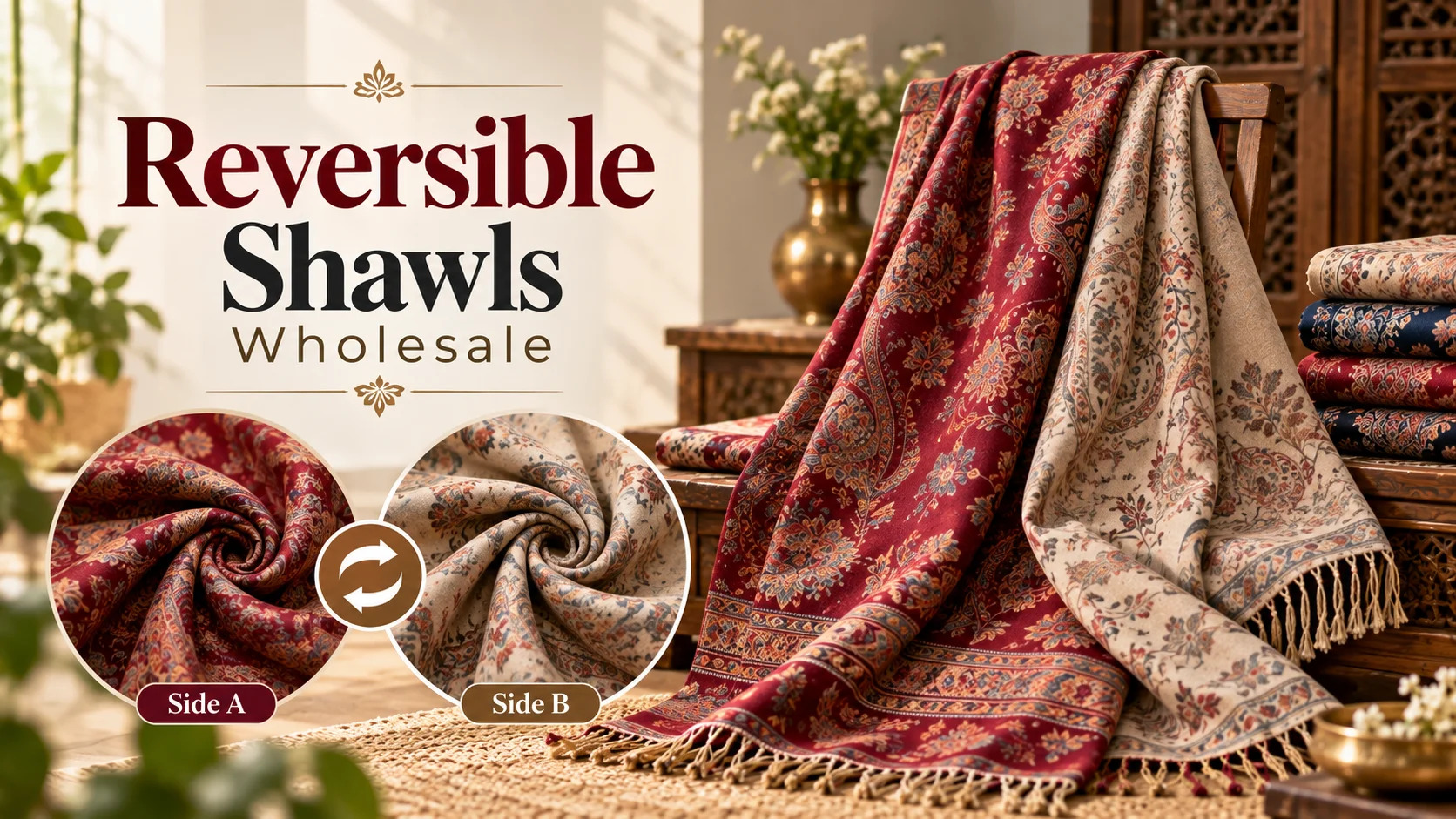
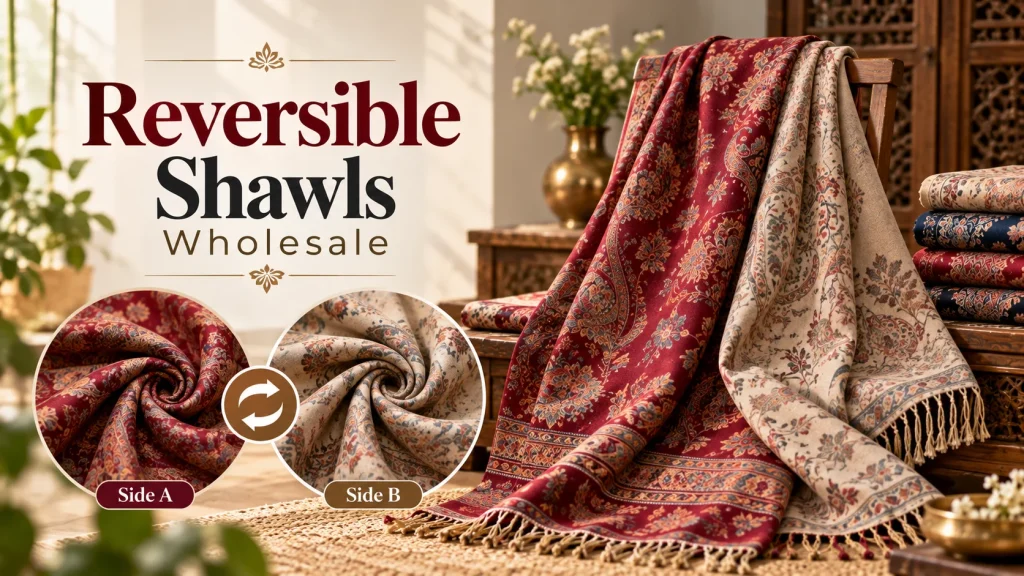
A reversible shawl has two finished faces, so it can be worn either way round with no wrong side showing. For reversible shawls wholesale, the main construction methods are double cloth, reversible jacquard and two-tone twill. Each one gives a different weight, look and price, so the method should be agreed before you compare quotes.
Key takeaways
- Double cloth gives two fully independent faces but uses roughly twice the yarn, so it is the warmest and the most expensive option.
- Reversible jacquard flips the pattern colours on the back and stays lighter, which suits stoles and mid-price ranges.
- Labels and fringes need planning, because a shawl with no inside has nowhere to hide a sewn label.
- Inspect both faces, the edges and colour bleed between faces on a washed sample before bulk.
What is a reversible shawl?
A reversible shawl is woven or finished so that both sides are presentable and different from each other. One face might be a solid colour and the other a pattern, or the same pattern might appear in opposite colours. Because a shawl folds back on itself when draped, the reverse always shows, which is why a properly finished back adds real value.
Retail names for the same product include double-sided shawls, two-tone shawls, dual-face wraps and reversible stoles.
How are double-sided shawls made?
Four construction methods are sold as reversible. The weave method sets the weight, the look and most of the cost.
| Method | How it works | Weight | Look | Relative cost |
|---|---|---|---|---|
| Double cloth | Two layers woven at once and stitched together by the loom | Heaviest | Two independent faces | Highest |
| Reversible jacquard | One cloth, pattern colours swap on the back | Medium | Same motif in opposite colours | Medium |
| Two-tone twill | Warp shows on one face, weft on the other | Light to medium | Different solid colour each side | Lower |
| Bonded or stitched | Two finished fabrics joined at the edges | Varies | Any two fabrics | Varies |
Double cloth and reversible jacquard are both made on jacquard looms, so they share sampling steps with jacquard stoles. Our overview of the shawl manufacturing process in India shows where weaving, finishing and inspection fit.
Why do reversible shawls sell well?
Reversible shawls sell because customers see two products for one price.
- Two looks in one piece: a neutral side for daytime and a richer side for evenings or festive wear.
- No wrong side when draped: the back shows on every wrap, and a finished reverse looks better in photographs and in store.
- Strong gifting appeal: the second face is easy to demonstrate at the point of sale. See our guide to shawls for gifting.
- Higher perceived value: retailers can usually price a reversible shawl above a single-faced shawl in the same fibre.
That last point makes reversible styles a useful step up in an affordable luxury shawl range.
Which fibres work best for reversible shawls?
Fibre choice depends on the method and the season.
- Fine wool and merino: the standard choice for double cloth winter shawls, giving warmth without stiffness. See our woolen stoles guide.
- Pashmina and cashmere blends: used for two-tone and double cloth in very fine yarns, so the shawl stays light. Browse our pashmina shawls.
- Acrylic and wool-acrylic blends: keep double cloth affordable for price-led winter retail.
- Viscose and modal: suit reversible jacquard stoles for milder climates, where a heavy double cloth would not sell.
What affects the wholesale price of reversible shawls?
Five factors explain most of the difference between quotes.
- Construction method. Double cloth uses about twice the yarn of a single cloth, so it costs the most.
- Fibre and yarn count. Finer yarns weave more slowly but keep a two-layer shawl light.
- Number of colours. Each extra weft colour adds yarn and loom time.
- Size. A full shawl uses far more yarn than a 70 x 200 cm stole, and the gap widens in double cloth.
- Finishing. Fringes, tassels and edge binding must look right from both sides, which can add handwork.
Our guide to GSM and fabric weight explains how to fix weight in your specification so quotes compare fairly.
Where do labels go on a shawl with no wrong side?
A sewn label in the middle of one face spoils the reversible look. Agree label placement before production:
- A small woven label sewn into a corner or hem, visible from one side only.
- A printed or woven label on the fringe binding.
- A hang tag carrying brand, fibre content, size and care, attached with a removable fastener.
Check that your chosen option still meets the care label requirements for textile export in your market, as some markets require a permanent fibre and care label.
What should buyers check before a bulk order?
Check these six points on a washed sample before you approve production.
- Both faces. Inspect each side for weaving faults, floats and colour accuracy against your approved shades.
- Layer bonding. On double cloth, press the shawl flat and look for loose pockets where the layers separate.
- Colour bleed. Wash the sample and check that a dark face has not stained a light one.
- Edges and fringes. Make sure fringe colour and edge finish look intentional from either side.
- Weight and size. Confirm GSM and dimensions after washing, since two layers can shrink at different rates.
- Approved sample per colourway. Here is how to request samples from a shawl manufacturer.
MOQ and lead time at Savita Shawls
| Term | Savita Shawls standard |
|---|---|
| MOQ | 100 pieces per design, lower on some stock styles |
| Stock styles with your label | 10 to 15 working days |
| Custom woven designs | 45 to 60 working days after sample approval |
| Samples | Delivered internationally in 7 to 10 working days |
| Payment | 30 to 50 percent advance, balance before dispatch |
| Shipping | FOB, CIF or DDP with export documents |
Reversible shawls are folded so both faces show in the pack. Our notes on export shawl packaging cover retail-ready options.
How should retailers display and list reversible shawls?
The second face only sells if customers can see it. In store, fold the shawl in half lengthways on the hanger so both faces show at once. Online, photograph each face flat and add one draped shot that shows the two sides together.
Name both colours in the product title, for example “Blush and Gold Reversible Shawl”, and keep it as one SKU rather than two. Our guide to shawl designs that sell fast covers colour choices that move quickly.
Who should stock reversible shawls?
- Winter fashion retailers: double cloth wool shawls in contrasting neutrals. See our winter wear shawls.
- Boutiques: patterned reversible jacquard in festive colours, such as a blush face with a gold patterned back.
- Menswear stores: two-tone shawls in grey, navy and camel. Browse men’s shawls.
- Corporate gifting buyers: boxed reversible stoles, which look generous when opened. Read about corporate gifting shawls in bulk.
Order reversible shawls wholesale from Savita Shawls
Savita Shawls has manufactured shawls and stoles in Gurgaon since 1984 and exports to more than 40 countries. Explore our ladies designer shawls, ask about private label manufacturing, or request a bulk quote with your construction, fibre, size and quantity.
Frequently asked questions
What is the difference between a reversible shawl and a two-tone shawl?
A two-tone shawl is one type of reversible shawl. It shows a different solid colour on each face because the warp and weft are dyed differently. Other reversible shawls use double cloth or reversible jacquard to show patterns on both sides.
Are reversible shawls heavier than normal shawls?
Double cloth reversible shawls are heavier because they contain two layers. Reversible jacquard and two-tone twill shawls weigh about the same as a single-faced shawl in the same yarn.
Can reversible shawls be made in pashmina?
Yes. Reversible pashmina and cashmere-blend shawls are usually woven as two-tone twill or as double cloth in very fine yarns, which keeps them light.
How do you put a brand label on a reversible shawl?
Use a small woven label in a corner or hem, a label on the fringe binding, or a hang tag. Avoid a large label in the centre of either face.
Do reversible shawls need special care?
Dry cleaning is safest for wool and pashmina. If a shawl has one dark and one light face, wash it on its own in cold water the first time so the dark side cannot stain the light side.
What is the minimum order for reversible shawls?
Savita Shawls starts at 100 pieces per design for custom reversible shawls, with lower quantities on some stock styles.
How long does a custom reversible shawl order take?
Custom woven reversible shawls take 45 to 60 working days after sample approval. Stock styles with your label can ship in 10 to 15 working days.