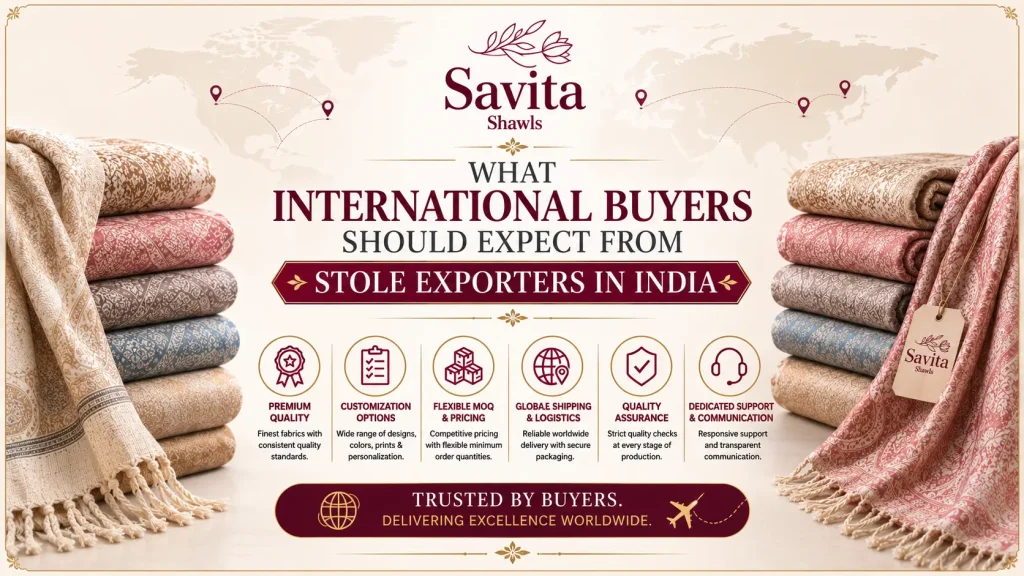
The difference between a supplier who sells domestically and one who exports is paperwork, and paperwork is where first time importers lose money. A shipment held at your port for a missing certificate of origin accrues demurrage daily while somebody in two countries works out whose responsibility it was. Stole exporters in India who have been doing this for decades treat documentation as part of production rather than an afterthought. This guide covers what to verify, what documents to expect, and which shipping terms suit which buyer.
What separates stole exporters in India from domestic suppliers
An exporter holds an Import Export Code issued by India’s Directorate General of Foreign Trade, understands the compliance requirements of your destination market, and prepares customs documentation as a routine part of dispatch. A domestic supplier does none of this and will typically route your order through a third party freight agent, adding cost and removing accountability.
The practical test is simple. Ask which countries they shipped to last quarter and what documentation set they provide. An established exporter answers immediately and specifically. A domestic supplier answers with a general willingness to arrange something.
This distinction sits on top of the manufacturer versus trader question covered in the guide to choosing a stole manufacturer in India. A business can be a manufacturer without being an exporter, and an exporter without manufacturing anything. You want both.
Credentials to verify with stole exporters in India
Four credentials are checkable before you send a single enquiry, and checking them takes about five minutes total.
The Import Export Code is a ten digit number issued by the DGFT and is mandatory for any legal exporter from India. It is verifiable on the DGFT portal. No IEC means no legal export.
GST registration confirms the business is tax registered and can issue compliant invoices. The number is verifiable on the GST portal, which also shows the registered business name and state, so you can confirm the company is who they say they are.
FIEO membership, the Federation of Indian Export Organisations, and AEPC registration, the Apparel Export Promotion Council, are industry bodies rather than legal requirements. They indicate an established exporter rather than an occasional one.
Product certifications are separate again. If your market requires chemical safety compliance, an Oeko-Tex certified supplier is a different question from a legally registered exporter, and one does not imply the other.
Documentation provided by stole exporters in India
Every shipment from India should arrive with a standard document package. Confirm the list before dispatch rather than after, because a document produced retrospectively takes days.
The certificate of origin is the one buyers underestimate. It supports preferential duty claims in markets with trade agreements covering Indian textiles, and the saving on a container can run into thousands. Ask for it as standard rather than as a favour.
Correct customs classification sits alongside the paperwork. The HSN codes for shawls and stoles determine the duty rate you pay, and a misclassified consignment either costs you more than it should or triggers an inspection.
Incoterms offered by stole exporters in India
Incoterms define where the supplier’s responsibility ends and yours begins. Three matter in this trade.
FOB, Free On Board, means the exporter delivers to the Indian port and clears export customs. You arrange and pay for freight, insurance and import clearance from that point. Lowest supplier price, most work at your end, and the right choice if you already have a freight forwarder.
CIF, Cost Insurance and Freight, means the exporter arranges shipping and marine insurance to your destination port. You handle import clearance and duty. Middle option, and the most common for buyers on their second or third order.
DDP, Delivered Duty Paid, means the exporter handles everything including import duty and delivery to your address. Highest total cost, close to zero logistics work for you, and sensible for a first shipment while you learn the process.
The cost comparison between FOB and CIF terms is rarely as clear cut as the quoted numbers suggest, because supplier arranged freight sometimes carries a margin you cannot see.
Compliance requirements by destination market
Textile imports face market specific rules that have nothing to do with quality. Getting these wrong stops goods at the border.
The European Union and United Kingdom require fibre content labelling in the language of the destination country, care symbols to standard formats, and compliance with REACH chemical restrictions. The United States requires fibre content, country of origin and care labelling under Federal Trade Commission rules. Gulf markets have their own conformity requirements which vary by country.
The common thread is labelling, and it is the exporter’s job to produce labels to your market’s specification, not yours to translate afterwards. The detail on care label requirements for textile export covers what each major market expects.
Freight, timelines and what shipping actually costs
Air freight from India runs 3 to 5 working days to the Gulf, 5 to 7 to the UK and Europe, and 7 to 10 to North America, measured from dispatch rather than from order confirmation. Sea freight runs 15 to 20 days to the Middle East and 25 to 35 days to the UK and Europe.
Stoles are light and compress well, which changes the calculation. Air freight on textiles is priced on volumetric weight, and a carton of stoles is bulky relative to its mass. Most buyers use air for a first order to compress the feedback loop, then move to sea for repeat volume once quality is proven.
Build lead time and freight together into your buying calendar. A wool stole order placed in September with 40 working days production and 30 days sea freight arrives in January, which is the wrong side of the season.
Payment, currency and risk
Standard terms across Indian exporters are 30 to 50 percent advance to release production with the balance payable before shipment. Established repeat buyers can access letters of credit or 30 day credit arrangements.
A letter of credit protects both sides on larger orders. The bank releases payment only against the documents specified in the credit, which means the exporter must produce correct paperwork to get paid. It costs a bank fee and adds administrative work, and it is worth it above roughly twenty thousand dollars with a supplier you have not worked with before.
Currency is negotiable. Indian exporters commonly quote in USD, GBP, EUR or INR. Quoting in your own currency moves exchange risk to the supplier, who will price it in, so the cheaper option is usually to accept USD and hedge separately if the amount justifies it.
Problems that come up with stole exporters in India
Shade variation between cartons is the most common export complaint, and it comes from dyeing across separate lots. Specify single dye lot in the purchase order for any order under a few thousand pieces.
Short shipment, where the carton count does not match the packing list, is usually a counting error rather than anything worse, but it is only correctable if you inspect on arrival and document it immediately.
Document mismatches, where the invoice value does not match the shipping bill or the HS code differs between documents, trigger customs inspection and delay. This is entirely on the exporter and a good one does not make the mistake.
The safeguard against all three is a pre-shipment inspection on first orders. Commissioning one costs a few hundred dollars and catches problems while the goods are still the exporter’s responsibility. Reading the sampling and pre-production process first will tell you what to specify.
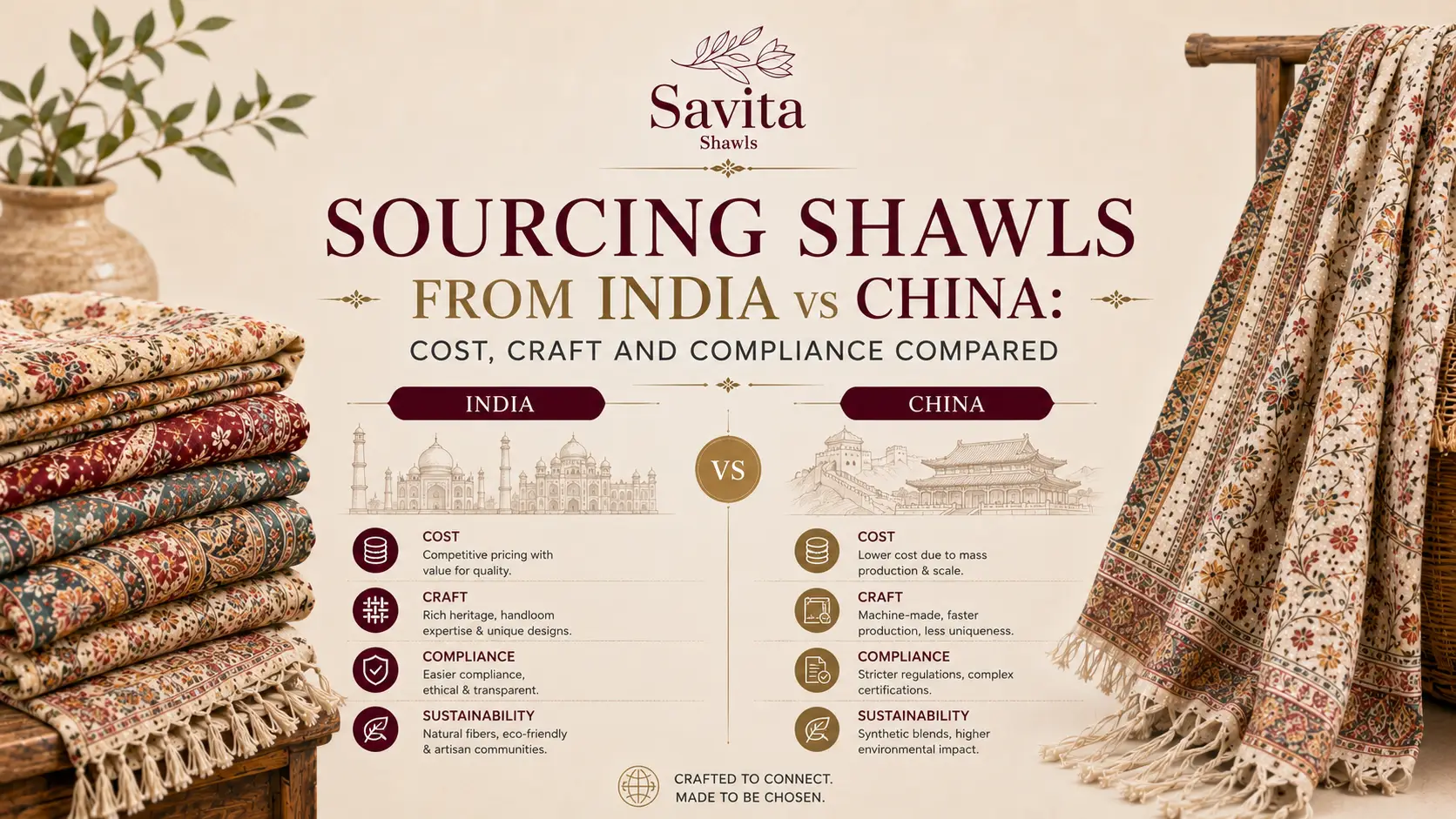
Buyers weighing India against other sourcing origins will find the comparison of Indian and Chinese sourcing covers cost, craft capability and compliance side by side.
Savita Shawls among stole exporters in India
Savita Fashions LLP, trading as Savita Shawls, has been one of the stole exporters in India operating continuously since 1984, shipping stoles, shawls and scarves from Gurgaon, Haryana to more than 20 countries including the UK, USA, UAE, Saudi Arabia, Germany, France, Italy, Spain, Netherlands, Sweden, Denmark, Australia, Japan and Canada. IEC is AFPFS3876N and GST registration is 06AFPFS3876N1Z0, both verifiable on the respective government portals. The company is registered with FIEO and AEPC.
Every consignment ships with a commercial invoice, packing list, bill of lading or airway bill, certificate of origin, GST invoice and shipping bill, with a pre-shipment inspection certificate available on request. Shipping terms available are FOB, CIF and DDP. Payment is 30 to 50 percent advance with the balance before shipment, with letters of credit and 30 day terms available to established repeat buyers. Quotes are issued in USD, GBP, EUR or INR.
Quality control runs in three stages before anything is packed: raw material inspection before production, in line checks during weaving, dyeing and finishing, and a final pre-shipment inspection. The manufacturer and exporter product range covers viscose, modal, cotton, linen, silk, fine wool, pashmina and cashmere. Buyers new to bulk sourcing should also read the guide to wholesale stole supply alongside this one.
Frequently asked questions
What credentials should stole exporters in India hold?
An Import Export Code issued by the DGFT is mandatory for legal export from India, alongside GST registration. Both numbers are verifiable on Indian government portals in about a minute each. FIEO and AEPC membership indicate an established exporter but are not legal requirements. Savita Shawls holds IEC AFPFS3876N, GST 06AFPFS3876N1Z0, and FIEO and AEPC registration.
What documents come with a stole export shipment from India?
A standard shipment includes a commercial invoice, packing list, bill of lading or airway bill, certificate of origin, GST invoice and shipping bill. A pre-shipment inspection certificate and insurance certificate are available on request. Confirm which additional documents your destination customs authority requires before dispatch, since producing a document retrospectively takes several days.
Should I choose FOB, CIF or DDP terms?
Choose FOB if you have your own freight forwarder and want the lowest supplier price. Choose CIF if you want the exporter to arrange shipping and insurance to your port while you handle import clearance. Choose DDP for a first shipment, where the exporter handles everything including duty and delivery, at a higher total cost but with minimal logistics work at your end.
How long does shipping take from India?
Air freight takes 3 to 5 working days to the Gulf, 5 to 7 to the UK and Europe, and 7 to 10 to North America, measured from dispatch. Sea freight takes 15 to 20 days to the Middle East and 25 to 35 days to the UK and Europe. Add production lead time, which runs 10 to 60 working days depending on customisation.
What is a certificate of origin and why does it matter?
A certificate of origin establishes that goods were manufactured in India. It supports your customs clearance and lets you claim preferential duty rates in markets holding trade agreements covering Indian textiles. On a container load the duty saving can run to several thousand dollars, so request it as a standard document rather than treating it as optional.
Do Indian exporters handle destination market labelling?
Established exporters produce labels to your destination market specification, including fibre content, care symbols and country of origin in the required language. This matters because incorrect labelling is a customs problem rather than a cosmetic one. Confirm the labelling specification in writing at purchase order stage and check it on the pre-production sample.
What payment protection is available on large export orders?
A letter of credit is the standard protection above roughly twenty thousand dollars with an unfamiliar supplier. The bank releases payment only against the documents named in the credit, so the exporter must produce correct paperwork to be paid. It carries a bank fee and administrative work. Below that value, staged payment of 30 to 50 percent advance with the balance before shipment is normal.
How do I avoid shade variation across an export order?
Specify a single dye lot in the purchase order, which prevents the supplier splitting production across separate dye baths. Approve a lab dip in writing before bulk dyeing begins. On first orders above a few thousand pieces, commission a third party pre-shipment inspection to check shade consistency across cartons while the goods are still in India.
Ready to export
Send your requirement with product type, quantity, destination market and preferred shipping terms, and Savita Shawls will return pricing on FOB, CIF or DDP basis with confirmed lead times. Samples dispatch within 5 to 7 business days with the cost credited against your bulk order. Start with an export quote request, email sales@savitashawls.com or call +91 7696677766.