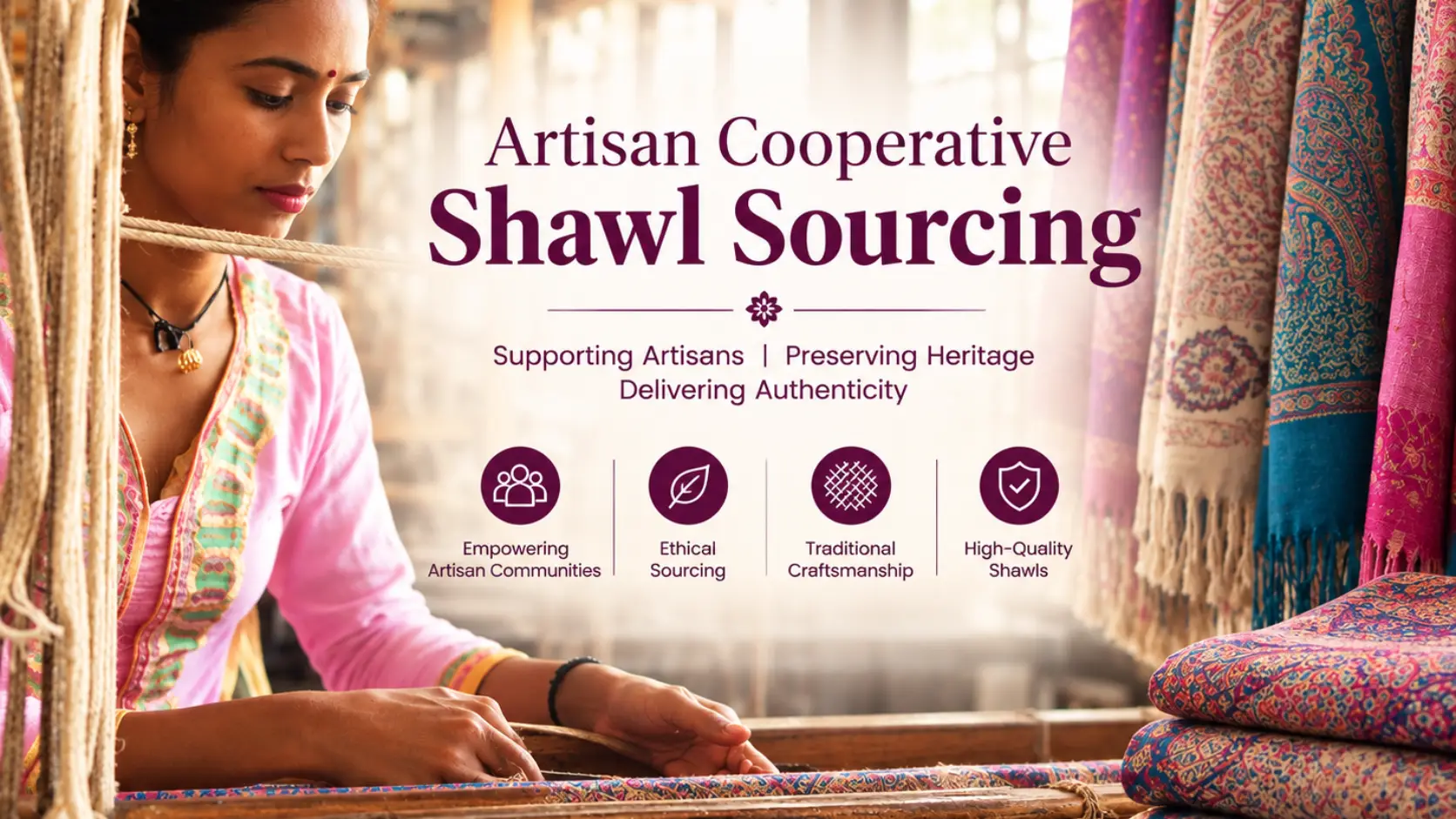
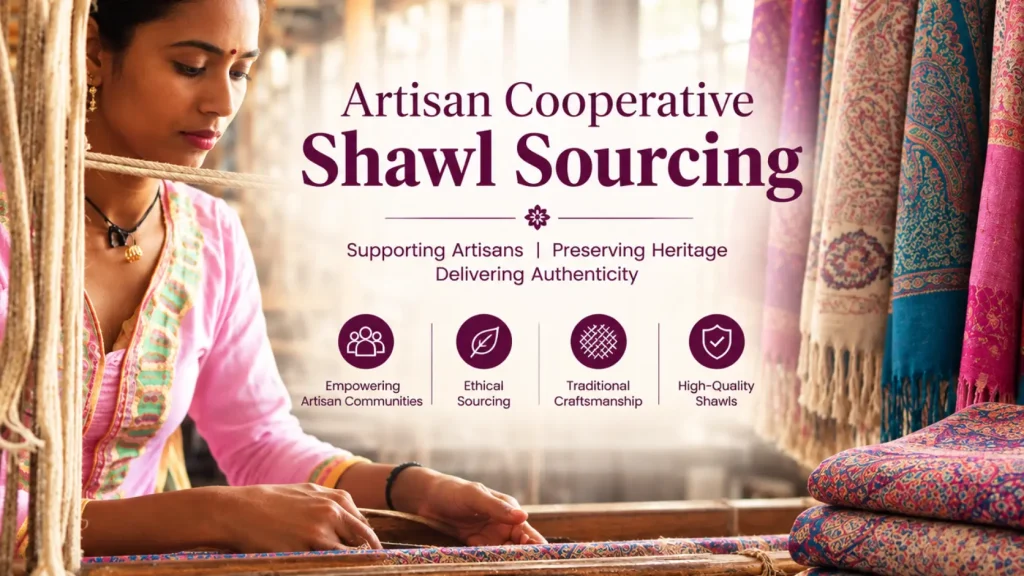
Artisan cooperative sourcing connects B2B buyers directly with organized weaver and embroidery communities, rather than through multiple layers of subcontracting. For buyers, this typically means more consistent quality accountability, verifiable fair wage practices, and a stronger, more marketable provenance story, without necessarily costing more than sourcing through less transparent supply chains.
As retail and corporate buyers face growing pressure to demonstrate ethical sourcing, artisan cooperative models offer a practical way to meet that expectation while also strengthening product quality and supply chain reliability.
What an Artisan Cooperative Sourcing Model Actually Looks Like
Traditional textile subcontracting often involves multiple intermediaries between a buyer and the actual weaver or embroiderer: an exporter, a subcontracted workshop, and sometimes individual home-based artisans working piece-rate. Each layer adds cost, reduces transparency, and makes quality accountability harder to trace.
An artisan cooperative model typically involves:
- A registered cooperative or weaver collective, often with formal membership and documented production standards
- Direct commissioning from a manufacturer or exporter to the cooperative, reducing the number of intermediary layers
- Standardized wage structures agreed within the cooperative, rather than informal piece-rate negotiation with individual artisans
- Shared quality and skill development resources, since cooperatives often pool training, tools, and sometimes raw material purchasing
This structure is common in Kashmiri Pashmina weaving, Kani shawl production, and hand embroidery (Sozni, Aari) work, where skilled hand techniques remain central to production quality.
Why This Matters for Product Quality, Not Just Ethics
Buyers sometimes treat artisan sourcing purely as a sustainability or CSR consideration, but it has direct quality implications:
- Skill consistency: Cooperatives with structured training and quality benchmarks tend to produce more consistent hand-work than loosely coordinated individual home-based artisans
- Traceable accountability: When a defect appears in a batch, a cooperative structure makes it easier to trace back to the specific production group and address the root cause, unlike diffuse subcontracting chains
- Technique preservation: Complex traditional techniques like Kani weaving and hand embroidery are increasingly rare skills; cooperatives play a significant role in training the next generation of artisans, which protects the long-term availability of these products for buyers. Our guide to Kashmiri weaving techniques covers how these specialized methods differ from standard machine weaving
Fair Wage Verification: What Buyers Should Actually Ask
“Ethical sourcing” claims are easy to make and harder to verify. Buyers evaluating a supplier’s artisan cooperative partnerships should ask specific, verifiable questions rather than accepting general assurances:
- Is the cooperative formally registered, and can documentation be provided?
- How is wage structure determined: per-piece, hourly, or a hybrid model, and how does it compare to regional textile industry benchmarks?
- Are wages paid directly to artisans, or routed through intermediaries who may take an undisclosed cut?
- Is there a grievance or dispute resolution process available to cooperative members?
- What percentage of the final product’s wholesale price reaches the artisan cooperative, even as an approximate figure?
- Can the buyer visit the cooperative or request third-party verification, particularly for larger, ongoing purchasing relationships?
A supplier that can answer these specifically, rather than deflecting to general statements about “supporting local communities,” is generally a more credible ethical sourcing partner.
How Artisan Cooperative Sourcing Fits into Your Brand Story
For retail and private label buyers, provenance is an increasingly important part of product marketing, particularly for premium and gifting categories. Artisan cooperative sourcing supports:
- Authentic storytelling for product listings, packaging inserts, or marketing content, provided claims are accurate and specific rather than generic
- Differentiation from mass-produced alternatives, particularly relevant alongside GI-certified Pashmina claims; see our guide to the GI tag for Kashmir Pashmina for how certification and artisan provenance can work together in a credible sourcing narrative
- Alignment with sustainability-conscious retail partners, who increasingly ask for supply chain documentation as a condition of stocking a product line
Buyers building a private label Pashmina line in particular can use verified artisan sourcing as a genuine point of differentiation, provided the claims are backed by real documentation rather than marketing language alone.
The Trade-Offs Buyers Should Understand
Artisan cooperative sourcing isn’t without its practical considerations:
- Longer production timelines for hand-woven and hand-embroidered products compared to machine production, which needs to be factored into order planning
- Less flexibility for very small custom orders, since cooperative production is often organized in batches tied to artisan availability
- Potential for higher per-unit costs on some techniques, offset by stronger differentiation and typically lower long-term quality risk
These trade-offs are worth weighing against your specific product positioning. A value-tier product line moving high volume at tight margins may not be the right fit for cooperative-sourced hand-woven Pashmina, while a premium or private label line focused on authenticity and story will often find the trade-off worthwhile.
How This Connects to the Broader Production Process
Artisan cooperative sourcing is one part of the larger production chain covered in our guide to the shawl manufacturing process. Understanding where cooperative-based hand-work fits (typically spinning, weaving, and embroidery stages) helps buyers ask more precise questions about which parts of their order involve artisan labour versus machine production, since many suppliers use a hybrid model combining both.
Sustainability Beyond Fair Wages
Ethical sourcing conversations increasingly extend beyond wages to environmental practices, including natural dyeing processes, water usage in scouring and dyeing, and waste fibre reuse. For buyers interested in this broader picture, our guide to sustainable Pashmina shawls and handloom shawls covers how traditional hand-production methods often carry a naturally lower environmental footprint than large-scale machine manufacturing, independent of the wage and labour considerations.
How Savita Shawls Works with Artisan Communities
Savita Shawls partners with Kashmiri weaving and embroidery communities across its Pashmina, Kani, and hand-embroidered shawl lines, maintaining direct relationships that reduce intermediary layers between artisan and buyer. Learn more on our about us and company profile pages, or explore artisan-produced collections in our Kani shawls manufacturer and embroidered shawls manufacturer categories.
Frequently Asked Questions
What is the difference between artisan cooperative sourcing and standard factory sourcing?
Artisan cooperative sourcing works directly with organized weaver or embroidery collectives, often with fewer intermediary layers and more standardized wage structures, while standard factory sourcing may rely on subcontracted workshops or individual piece-rate artisans with less transparency.
Does artisan cooperative sourcing cost more than standard sourcing?
Not necessarily. While some hand-produced techniques carry inherently higher production costs due to labour intensity, cooperative sourcing itself, by reducing intermediary layers, can offset some of this difference compared to heavily subcontracted supply chains.
How can I verify a supplier’s ethical sourcing claims?
Ask specific, verifiable questions about cooperative registration, wage structure, payment methods, and grievance processes, rather than accepting general statements. Where possible, request documentation or third-party verification for significant, ongoing purchasing relationships.
Are artisan-produced shawls suitable for large-volume orders?
They can be, but production timelines are typically longer than machine-made alternatives, and very large volumes may need to be planned further in advance to align with artisan cooperative capacity and scheduling.
Can I use artisan sourcing as part of my product marketing?
Yes, provided the claims are accurate and specific. Vague ethical sourcing language without supporting detail is increasingly scrutinized by consumers and retail partners, so specificity (which cooperative, what techniques, what wage practices) strengthens the credibility of the story.
Does artisan cooperative sourcing apply to all shawl types, or just Pashmina?
It’s most commonly associated with Pashmina, Kani, and hand-embroidered shawls due to the specialized hand skills involved, but cooperative models exist across various traditional textile crafts in India, including handloom wool and cotton production.
Interested in sourcing artisan-produced shawls with verified, transparent practices? Get a wholesale quote from Savita Shawls and ask about our artisan partnership documentation.