A scarf can be beautifully made and still get stuck at a retailer’s receiving dock. The usual reasons have nothing to do with the fabric: a barcode that will not scan, one barcode used across six colours, a missing fibre content label, or hang tags attached so loosely that half of them fall off in transit.
This guide explains how hang tags for scarves, UPC and EAN barcodes and product labels work together on a wholesale order. It is written for brands, boutiques and importers who want stock that arrives ready for the shop floor, the stockroom scanner and the online listing, without re-tagging anything after delivery.
Quick Answer
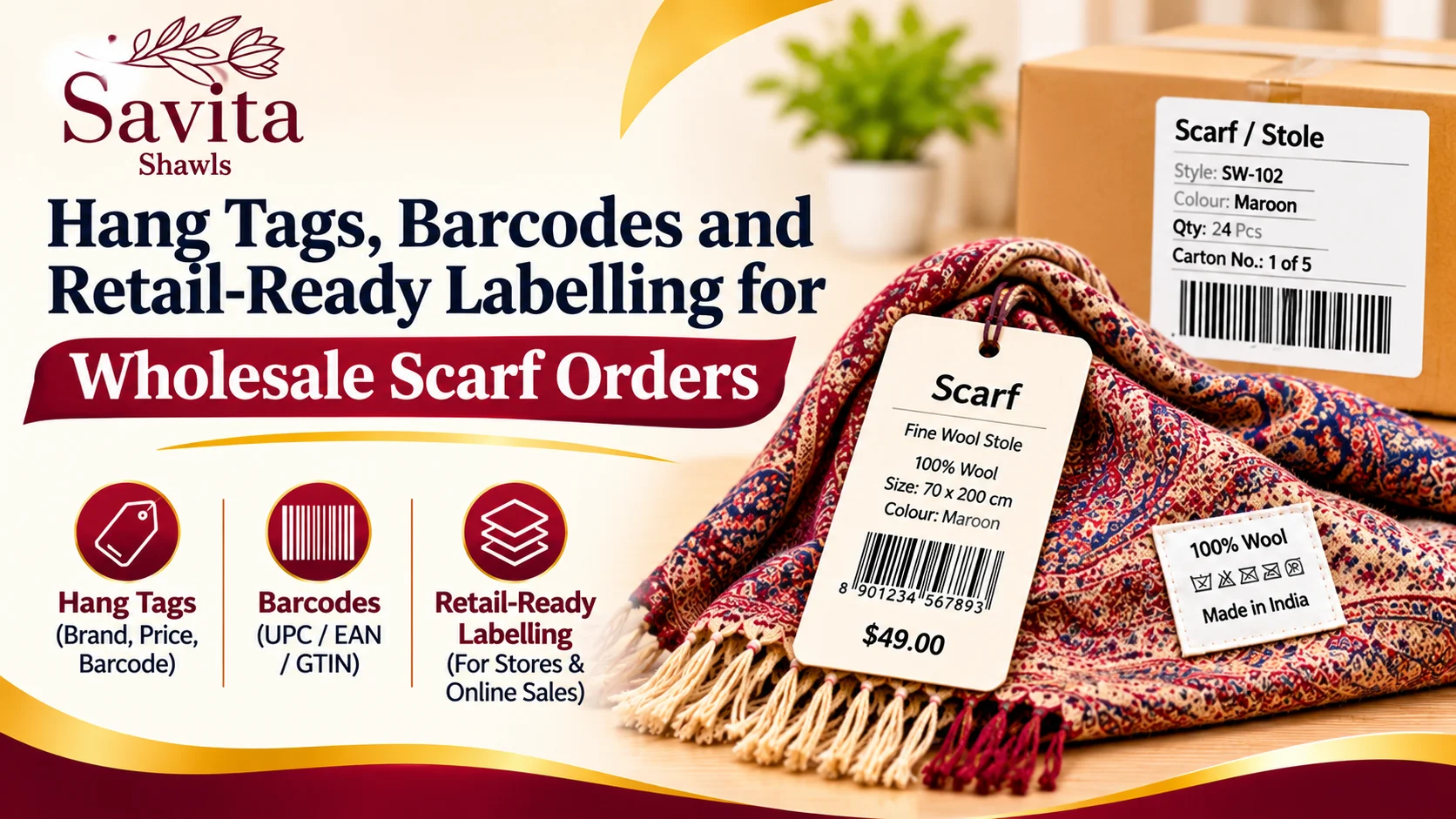
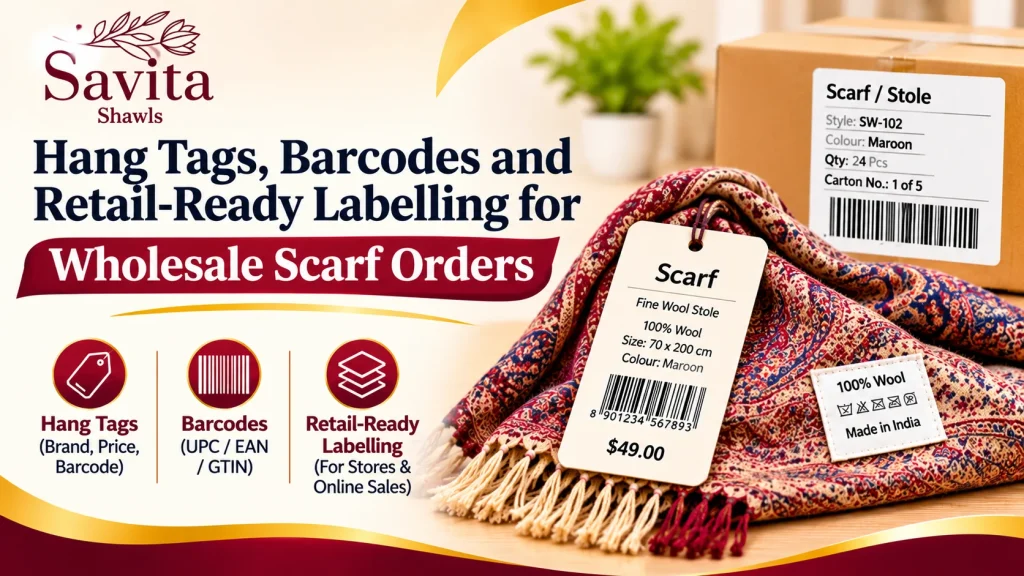
Retail-ready labelling for scarves usually means three things: a sewn-in label with fibre content, care and country of origin; a hang tag with your brand, price and barcode; and carton labels for the warehouse. Every colour and size needs its own GTIN, shown as a UPC-A barcode for the US and Canada or an EAN-13 barcode for most other markets. Send final artwork, barcode files and a colour-to-barcode list to your manufacturer before production, so hang tags for scarves are attached at the factory and checked before packing.
The Three Layers of Scarf Labelling
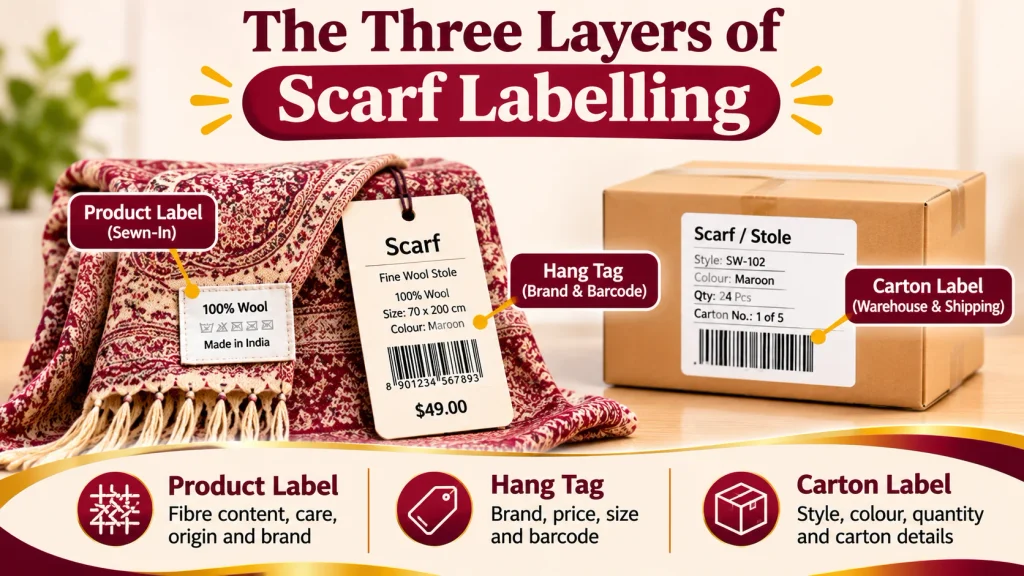
It helps to think of labelling as three separate layers, each with a different job. Hang tags for scarves are only one of them.
| Layer | Where it goes | What it carries | Who reads it |
|---|---|---|---|
| Product label | Sewn into a hem or edge | Fibre content, care, origin, brand | The end customer and customs |
| Hang tag | Attached with a string or tag pin | Brand story, price, size, barcode | Shoppers and the checkout scanner |
| Carton label | Outside of each export carton | Style, colour, quantity, carton number, case code | Warehouses and receiving teams |
For the sewn-in label rules in different export markets, read our guide to care label requirements for textile export.
What Hang Tags for Scarves Should Include
Good hang tags for scarves do two jobs at once. They sell the product to a shopper in a few seconds, and they give the store the data it needs to scan and price it. A practical tag carries:
- Brand name and logo, clearly readable from a short distance
- Product name, such as “Fine Wool Stole” or “Printed Modal Scarf”
- Fibre content in plain words, matching the sewn-in label exactly
- Size, for example 70 x 200 cm
- Colour name or code, so staff can match stock to the system
- Barcode with the human-readable digits below it
- Price, either printed or left blank for a price sticker. Our guide on how to price shawls helps you set it
- Short brand line or care note on the back, if space allows
Keep fibre names honest. If a scarf is viscose, do not call it pashmina on the tag. Our comparison of pashmina vs cashmere vs wool vs acrylic shawls explains the differences retailers and customers look for.
Tag Size, Material and Attachment
Hang tags for scarves are usually small rectangles or squares in the 2 to 3.5 inch range, printed on thick card so they do not crease in a bag. A few practical points from the factory floor:
- Attach to the fringe or corner, not the body. A string loop through the fringe or a tag pin at a corner avoids holes in delicate fabric.
- Use a soft string for fine fabrics. Plastic tag pins can snag modal, silk blends and fine wool.
- Keep the barcode flat and visible. If the scarf is folded in a bag, the tag should sit on top so it can be scanned through the plastic.
- Match finish to brand. Kraft card suits natural fibre ranges, while matte coated card with foil suits premium stoles.
UPC vs EAN: Which Barcode Do Scarves Need?
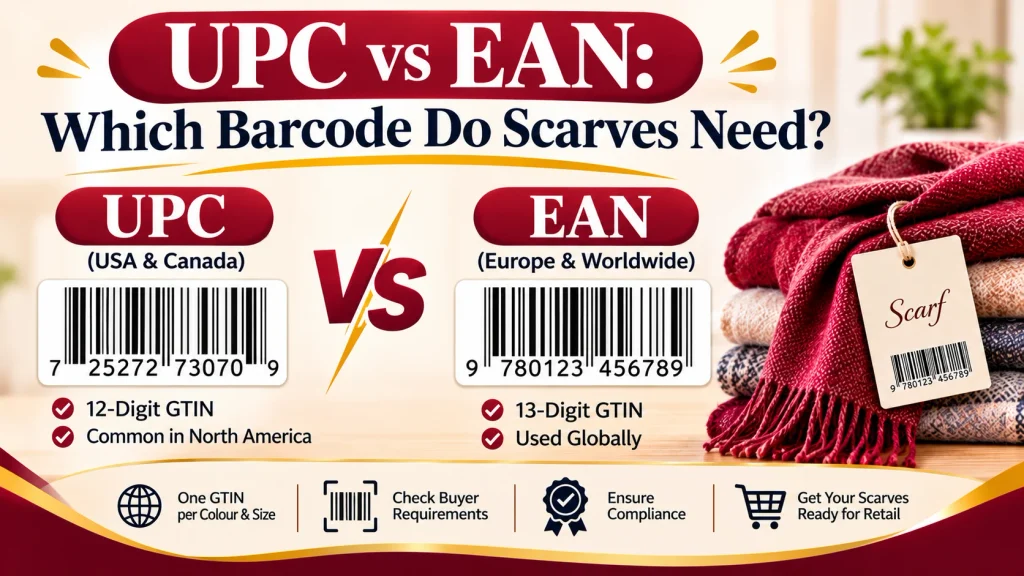
The barcode is the part of hang tags for scarves that retailers check most closely. UPC and EAN are both GS1 barcodes that carry a GTIN, the Global Trade Item Number that identifies one specific sellable product.
- UPC-A carries a 12-digit GTIN and is the standard for most retailers in the US and Canada.
- EAN-13 carries a 13-digit GTIN and is used by most retailers in Europe, the UK, the Middle East and much of Asia.
Many retailers accept both, but some vendor guides ask for one format specifically. Always check each buyer’s vendor manual before printing hang tags for scarves.
One GTIN per Colour and Size
This is the rule that trips up most first-time brands. GS1 requires a unique GTIN for every variation. If you sell one stole design in five colours, you need five barcodes. Using one barcode for all colours means the store cannot tell which colour sold, and online orders get the wrong shade.
Where the Barcode Numbers Come From
The brand owner should license GTINs from GS1 in its own company name. Barcodes bought cheaply from resellers can be rejected by some retailers and marketplaces because they do not match the brand on the product. Once you have your numbers, give your manufacturer the barcode files or a list of GTINs per colour, and keep the numbers in your own records for reorders.
Case Codes on Cartons
Some large retailers also ask for a separate carton-level code, often a GTIN-14 printed as an ITF-14 or GS1-128 barcode on each carton. If your buyer’s vendor guide mentions case codes, share that requirement with the factory before packing starts.
Retail-Ready Labelling Checklist for Wholesale Orders
Send this checklist to your manufacturer when you confirm the order. It covers everything needed for hang tags for scarves, product labels and cartons.
- Final artwork for the hang tag front and back, with tag size and card type
- Barcode files or a GTIN list, matched to each colour and size
- Sewn-in label artwork with fibre content, care symbols and country of origin
- Attachment method: string loop, tag pin or ribbon, and exact placement
- Fold and bagging instructions, so the tag stays visible
- Carton label format, including style, colour, quantity per carton and any case code
- Sample approval: one fully tagged and packed unit per colour before bulk packing
Approving a fully tagged sample is the single best way to catch mistakes before hang tags for scarves go onto the whole order. If you sell in Europe, ask whether your buyers expect an Oeko-Tex certified supplier. Our sample request guide explains what to inspect, and our notes on export-ready shawl packaging cover cartons and inner packing.
Common Labelling Mistakes to Avoid
These are the problems we see most often when buyers send hang tags for scarves and labels for a wholesale order.
- Same barcode on every colour. Leads to stock errors and wrong online orders.
- Fibre content that does not match. The hang tag says “wool blend” while the sewn label says “100% acrylic”. Customs and customers both notice.
- Barcodes printed too small or too light. Low-contrast colours, such as gold on cream, often fail to scan.
- Late artwork. If artwork arrives after production, tagging delays the whole dispatch.
- Mixed colours in one carton without carton labels. Receiving teams have to open every box.
Private Label and Hang Tags
If you sell under your own name, hang tags for scarves are part of your brand, not just a sticker for the till. Pair them with woven brand labels and branded packaging through private label shawls and scarves. For the wider picture, read our guides to private label shawl manufacturers in India and white label shawls manufacturing.
Corporate and promotional orders follow the same rules. Branded tags work well on promotional scarves and corporate gift shawls.
Labelling With Savita Shawls
Savita Fashions LLP is a shawl, stole and scarf manufacturer based in Gurgaon, founded in 1984, and an IEC-licensed exporter supplying buyers in more than 40 countries. All our production is machine-made, so size and weight stay consistent, which keeps tag and barcode data accurate across reorders.
- Ready stock: dispatched the next day after payment.
- Made-to-order: 15 working days of production after order confirmation.
- Payment: 100% advance on your first five orders, then 50% advance and 50% before dispatch. Wire transfer or Wise, invoiced in USD or EUR.
Send us your hang tag artwork, barcode files and label requirements with your order, and we will confirm the tagging and labelling options before production starts. For the full ordering process, see our wholesale shawl and stole buyer guide.
Get Retail-Ready Stock
Planning a scarf order that needs to arrive tagged and ready for the shop floor? Send us your product list, colours, quantities and labelling requirements. Request a wholesale quote, contact our team, or message us on WhatsApp.
Frequently Asked Questions
Do scarves need barcodes on hang tags?
If you sell through retail stores or marketplaces, yes. Most retailers scan a UPC or EAN barcode at checkout and at receiving. The barcode usually sits on the hang tag so it can be scanned without unfolding the scarf.
What is the difference between UPC and EAN for scarves?
Both carry a GS1 GTIN. UPC-A uses 12 digits and is standard in the US and Canada. EAN-13 uses 13 digits and is used by most retailers elsewhere. Check each buyer’s vendor guide for the format they want.
Do I need a different barcode for each scarf colour?
Yes. GS1 rules require a unique GTIN for each colour and size, so a design in five colours needs five barcodes.
How should hang tags be attached to scarves?
Attach hang tags for scarves through the fringe or at a corner, using a soft string for fine fabrics so the fabric does not snag. Keep the barcode facing out so it can be scanned through the bag.
Can the manufacturer attach my hang tags?
Many manufacturers can, if you send final artwork, barcode files and a colour-to-barcode list before production. Ask for photos of a tagged sample in each colour before bulk packing.