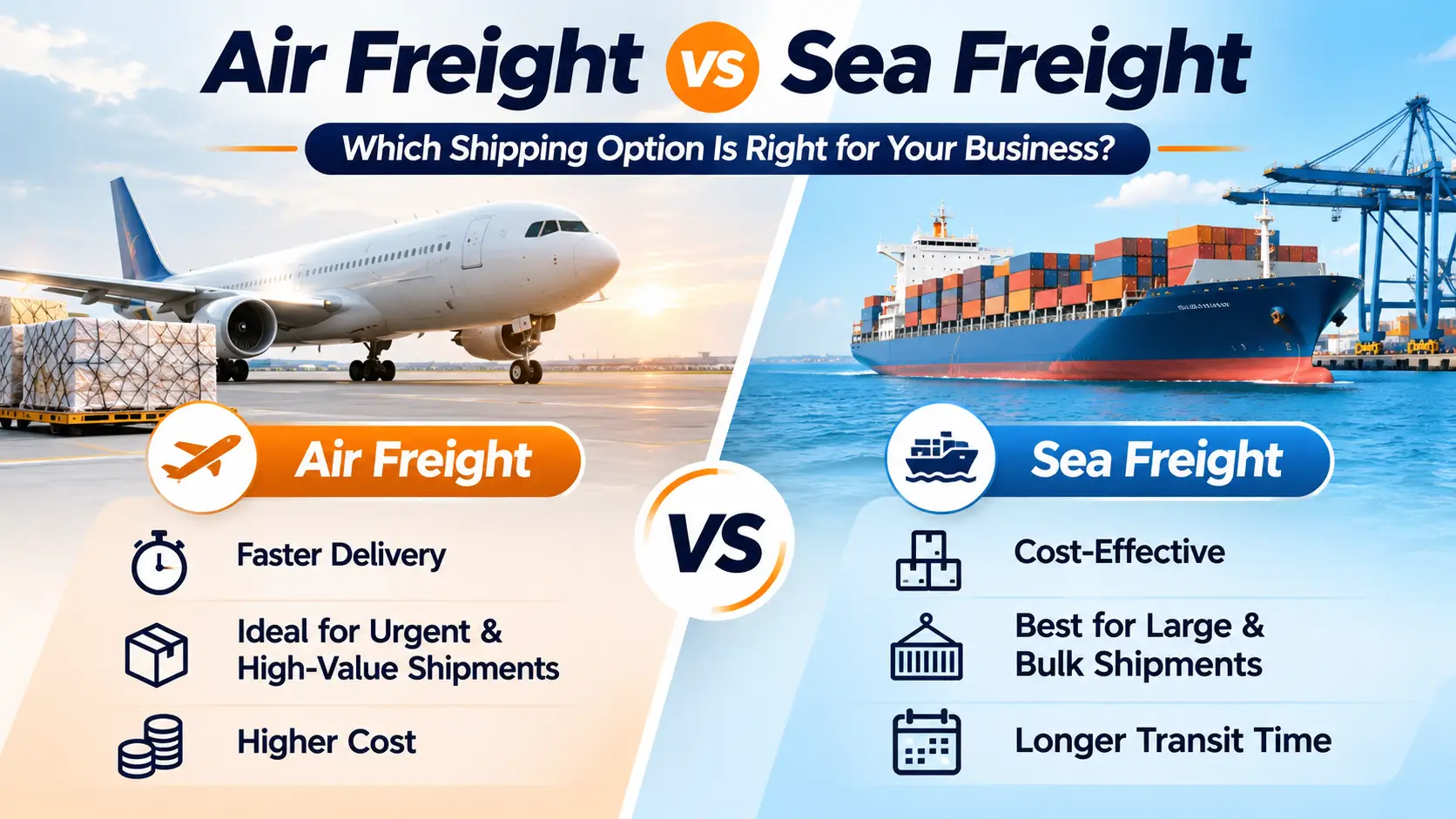
When you compare air freight vs sea freight from India, the choice comes down to weight, time and cash flow. Air freight costs more per kg but reaches the USA, Europe or Australia in about 5 to 9 days door to door. Sea freight is far cheaper per kg but takes 4 to 8 weeks once port handling is included. Sea freight also carries fixed charges at both ends, so it rarely saves money on small orders. For wholesale shawls and stoles, air usually wins below about 300 kg. Between 300 and 1,000 kg it depends on your timeline. Above about 1,000 kg, or 5 cubic metres, sea freight is clearly cheaper.
Below, we compare costs, transit times and hidden charges, and show how to work out which mode suits your order. For the full sourcing process, start with our wholesale shawl and stole buyer’s guide.
Air freight vs sea freight from India at a glance
| Factor | Air freight | Sea freight |
|---|---|---|
| Indicative cost | About USD 3 to 12 per kg, falling as weight rises | Well under USD 1 per kg for ocean freight, plus fixed port charges |
| Door-to-door time (USA, Europe, Australia) | 5 to 9 days | 4 to 8 weeks |
| How it’s charged | Per kg, on actual or volumetric weight, whichever is higher | Per cubic metre (LCL) or per container (FCL) |
| Minimum charge | Low; courier works from 1 kg | Usually a 1 CBM minimum, plus fixed origin and destination fees |
| Best order size | Up to about 300 kg | About 1,000 kg and above |
| Transport document | Air waybill (AWB) | Bill of lading (B/L) |
| Correct Incoterm for “free on board” style pricing | FCA (airport) | FOB (seaport) |
| Cash tied up in transit | About a week | 1 to 2 months |
How air freight is priced
Air freight from India is charged per kg in weight bands. The heavier the shipment, the lower the rate per kg. Small orders go by express courier, door to door. Larger orders go as air cargo through a freight forwarder, usually from Delhi’s Indira Gandhi International Airport.
| Shipment weight | Method | USA (USD/kg) | Europe (EUR/kg) | Australia (USD/kg) |
|---|---|---|---|---|
| Up to 20 kg (about 100 stoles) | Express courier | 9 to 12 | 7 to 10 | 8 to 11 |
| 21 to 45 kg | Express courier | 7 to 9 | 5.50 to 7.50 | 6 to 8.50 |
| 45 to 100 kg | Air cargo | 5 to 6.50 | 4 to 5.50 | 4.50 to 6 |
| 100 to 300 kg | Air cargo | 4 to 5 | 3.30 to 4.50 | 3.50 to 5 |
| 300 kg and above | Air cargo | 3 to 4 | 2.60 to 3.60 | 3 to 4 |
These rates are indicative for late 2026 and include fuel surcharges. Courier rates are door to door. Air cargo is usually airport to airport, so add customs clearance and local delivery at your end.
Volumetric weight. Airlines charge on actual weight or volumetric weight, whichever is higher. Volumetric weight is usually length x width x height in cm, divided by 6,000. Folded shawls pack densely, so actual weight normally applies. Rigid gift boxes and loose packing can push you onto volumetric weight. Our guide to shawl packaging for export explains how to keep cartons efficient.
How sea freight is priced
Sea freight comes in two forms:
- LCL (less than container load): your cartons share a container with other shippers’ goods. You pay per cubic metre (CBM), usually with a 1 CBM minimum.
- FCL (full container load): you book a whole 20-foot or 40-foot container. A 20-foot container holds about 28 to 33 CBM.
The ocean freight itself is cheap. The cost of sea freight is mostly in the fixed charges on either side of the voyage:
- Origin charges in India: trucking from the factory to the port or inland container depot, CFS handling, documentation and export customs clearance.
- Ocean freight: the port-to-port rate, plus fuel and seasonal surcharges.
- Destination charges: terminal handling, CFS de-stuffing, document fees, customs clearance and delivery to your warehouse.
For a small LCL shipment, the origin and destination charges together can easily cost more than the ocean freight. That’s why sea freight rarely saves money on orders of a few hundred kilos.
From the Delhi region, sea cargo is usually moved by rail or truck to Mundra or Nhava Sheva on the west coast. It is often consolidated at an inland container depot near Delhi first. Allow 5 to 10 days for this before the ship even sails.
Transit times by destination
Transit time is where air freight vs sea freight from India differs most. These are typical door-to-door times, including handling at both ends.
| Destination | Air freight, door to door | Sea freight, port to port | Sea freight, door to door |
|---|---|---|---|
| USA, East Coast | 5 to 8 days | 30 to 40 days | 6 to 8 weeks |
| USA, West Coast | 5 to 8 days | 35 to 45 days | 6 to 8 weeks |
| Europe (Rotterdam, Hamburg, Antwerp) | 4 to 7 days | 25 to 35 days | 5 to 7 weeks |
| United Kingdom | 4 to 7 days | 25 to 35 days | 5 to 7 weeks |
| Australia | 5 to 9 days | 20 to 30 days | 4 to 6 weeks |
| UAE | 2 to 4 days | 4 to 7 days | 2 to 3 weeks |
Sea times can stretch further when vessels are rerouted around the Cape of Good Hope, as they have been during Red Sea disruptions. That adds roughly 10 to 14 days on India to Europe and US East Coast routes. Always add a buffer to sea freight plans.
The break-even point: when sea freight becomes cheaper
Wholesale shawls weigh roughly 150 to 200 kg per cubic metre packed. That density puts them close to the line where air volumetric weight and actual weight meet. It also means each cubic metre of sea space carries a lot of product. Here’s how a typical comparison works out for an order to Europe:
| Shipment size | Air freight (indicative total) | Sea LCL (indicative total, door to door) | Which wins |
|---|---|---|---|
| 100 kg (about 0.6 CBM) | EUR 400 to 550 | EUR 600 to 900, mostly fixed charges | Air |
| 300 kg (about 1.8 CBM) | EUR 800 to 1,100 | EUR 700 to 1,000 | Close; air wins on time |
| 1,000 kg (about 6 CBM) | EUR 2,600 to 3,600 | EUR 1,000 to 1,500 | Sea |
| 5,000 kg (about 30 CBM) | EUR 13,000 or more | One 20-foot container, roughly EUR 2,500 to 4,500 all in | Sea, by a wide margin |
All figures are illustrative ranges for late 2026, not quotes. The pattern holds for the USA and Australia too. Below about 300 kg, sea’s fixed charges cancel out its cheap ocean rate. Above about 1,000 kg, sea freight saves enough to justify the extra weeks.
Hidden costs on both sides
Air freight extras to check:
- Fuel and security surcharges, which are sometimes quoted separately
- Airport handling and storage if clearance is delayed
- Peak-season surcharges from October to December
Sea freight extras to check:
- Inland haulage from the factory to the port or container depot
- CFS and terminal handling charges at both ends
- Destination document and delivery order fees
- Demurrage and detention if containers are not cleared or returned on time
- Cargo insurance, which matters more over a longer voyage
Ask every forwarder for an all-in, door-to-door quote, so you are comparing like with like.
How shipping mode affects your import duty
In the EU and UK, import duty is charged on the CIF value, which includes freight. Cheaper sea freight therefore lowers your duty bill slightly as well. In the USA and Australia, duty is charged on the value of the goods only, so the freight mode doesn’t change the duty. For duty rates by market, see our guides to the cost to order shawls from India to the USA, Europe and Australia.
Use the right Incoterm for each mode
A common mistake when weighing air freight vs sea freight from India is using sea terms for an air shipment. FOB and CIF are sea-only terms. For air freight, use FCA (Free Carrier) at Delhi airport, or CPT and CIP if the seller pays the freight. For door-to-door pricing on either mode, use DAP or DDP. Our articles on Ex Works vs FOB pricing, FOB vs CIF for textile exports and DDP shipping from India explain each term.
When to choose air freight
- Orders under about 300 kg, which covers most boutique and first orders
- Ready stock and top-up orders that need to reach your shelves within days
- Seasonal stock that’s running late, where a missed season costs more than freight
- Samples and new styles you want to test quickly
- When cash flow matters, because goods arrive and sell sooner
When to choose sea freight
- Orders above about 1,000 kg or 5 CBM
- Planned seasonal buys placed two to three months ahead
- Core styles you reorder regularly, where timing is predictable
- Full-container programmes for larger retailers and distributors
Many established buyers use both. They ship the main seasonal order by sea and send top-ups and new styles by air. Our guide to ready stock vs made-to-order shawls explains how to plan that split.
Planning your timeline: order to shelf
Savita Shawls dispatches ready stock the next day after payment. Made-to-order shawls and stoles are produced in 15 working days. Here’s how that turns into total lead time by shipping mode:
| Order type | By air | By sea (Europe or USA) |
|---|---|---|
| Ready stock | About 1 week | About 5 to 8 weeks |
| Made-to-order | About 4 weeks | About 8 to 11 weeks |
For winter ranges going by sea to Europe or North America, place made-to-order orders by mid-summer. For Australian winter stock by sea, order by early February.
Payment terms
| Item | Terms |
|---|---|
| Orders 1 to 5 | 100% advance payment |
| Order 6 onward | 50% advance, 50% before dispatch |
| Payment options | Wire transfer, Wise (wise.com), or card through a payment gateway at extra cost |
| Currencies accepted | USD and EUR |
| Ready stock | Next-day dispatch after payment |
| Made-to-order shawls and stoles | 15 working days |
Full details are in our payment terms guide.
Getting the right freight option from Savita Shawls
Savita Shawls is a Gurugram-based manufacturer and IEC-registered exporter shipping to more than 40 countries, by air and by sea. With every quote we provide carton counts, weights and dimensions, so you can compare air freight vs sea freight from India with your own forwarder, or let us quote it for you. We handle export clearance and supply the commercial invoice, packing list, certificate of origin, and air waybill or bill of lading.
Work out your full landed cost with our landed cost guide, browse bulk order shawls and scarves, or request a quote by air or sea.
Prices and rates shown are indicative as of November 2026 and may change. They are not a quotation. Contact us for current pricing on your order.
Frequently asked questions
Which is cheaper, air freight or sea freight from India?
Sea freight is cheaper per kg, but it has fixed port charges at both ends. For orders under about 300 kg, air freight is usually cheaper overall. Above about 1,000 kg, sea freight costs far less.
How long does sea freight from India take?
Port to port, sea freight takes about 20 to 30 days to Australia, 25 to 35 days to Europe and 30 to 45 days to the USA. Door to door, allow 4 to 8 weeks, including inland transport and port handling.
How long does air freight from India take?
About 4 to 9 days door to door to the USA, Europe or Australia, and 2 to 4 days to the UAE.
What is the minimum shipment for sea freight?
LCL sea freight is usually charged with a 1 CBM minimum, roughly 150 to 200 kg of packed shawls. Fixed origin and destination charges make small LCL shipments poor value.
Is air freight vs sea freight from India different for duty?
In the EU and UK, duty is charged on goods plus freight, so cheaper sea freight lowers duty slightly. In the USA and Australia, duty is charged on the goods only, so the mode makes no difference.
Can I use FOB for air freight?
No. FOB is a sea freight term. For air shipments, FCA is the correct equivalent, named at the departure airport.
How fast can Savita Shawls ship my order?
Ready stock is dispatched the next day after payment. Made-to-order shawls and stoles are produced in 15 working days, then shipped by air or sea.