Labelling is the cheapest thing on a shawl and the most expensive thing to get wrong. A consignment held at customs over a missing fibre content declaration costs storage, delay and occasionally the season, and the fix would have cost a few cents per piece at production. Care label requirements for textile export vary by destination market and they are not optional in most of them. This guide covers what has to appear, how the rules differ between major markets, and what to confirm with your manufacturer before production starts.
What a care label has to carry
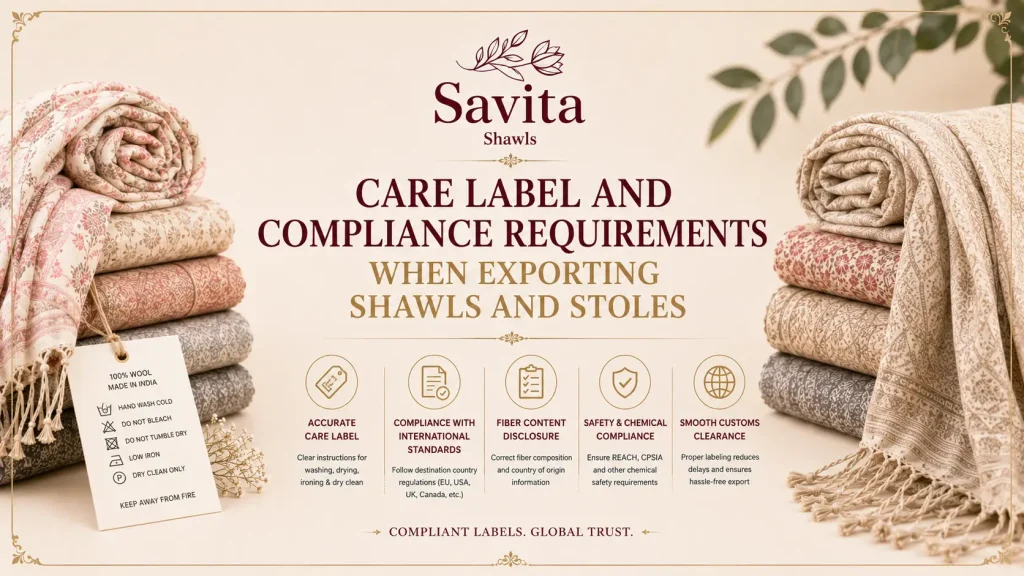
Four elements appear in almost every market’s rules, though the detail differs.
Fibre content with percentages by weight, listed in descending order. A label reading pashmina blend satisfies nobody. A label reading 70 percent cashmere 30 percent silk does.
Care instructions covering washing, bleaching, drying, ironing and professional cleaning, usually as standardised symbols.
Country of origin, meaning where the product was manufactured rather than where the fibre came from.
Manufacturer, importer or responsible party identification, with the specific requirement varying by market.
Size and dimensions are required for some product categories and not for accessories in most markets, though buyers frequently include them anyway.
Care symbols and what they mean
Symbols exist so a label works across languages, and there are two main systems.
ISO 3758 symbols are used across Europe, the UK and most international markets, covering washing, bleaching, tumble drying, ironing and professional textile care in a standard order.
ASTM symbols are used in North America and differ visually while conveying similar information. A label built for Europe is not automatically correct for the United States.
Symbol order matters. The conventional sequence runs wash, bleach, dry, iron, professional care, and a label presenting them in a different order reads as incorrect to an inspector even where each individual symbol is right.
Instructions must be achievable. Labelling a viscose stole machine washable when the fibre loses roughly half its strength when wet produces returns you cannot defend, as covered in the guide to viscose stole sourcing.
Requirements change. Confirm the current position for your destination with your customs broker or the relevant national authority before production, since a label printed to superseded rules still fails at the border.
Market specific points worth knowing
The European Union operates a textile labelling regulation covering fibre names and composition declarations, with defined terms that cannot be applied loosely. Labels must appear in the official language of each member state where the product is sold, which means a multi market range needs multi language labels.
The United Kingdom applies broadly equivalent rules post transition, in English.
The United States operates rules administered by the Federal Trade Commission covering fibre content, country of origin and the identity of the responsible company, with wool products subject to additional requirements.
Canada requires bilingual labelling in English and French, which catches out buyers who prepare a US label and assume it travels north.
GCC markets require Arabic alongside English in most cases and carry conformity requirements that vary between member states.
The full documentation picture that accompanies labelling is set out in the guide to stole export from India.
Fibre naming: where claims become compliance problems
Fibre names are regulated terms in most markets, which turns a marketing description into a legal statement.
Cashmere means fibre from cashmere goats. It cannot be applied to a wool blend because the wool is soft, and the grading detail is covered in the guide to cashmere stole sourcing.
Pashmina is used in some markets as a style descriptor for a large lightweight wrap and in others as a fibre claim. Where it is used as a fibre claim it must be accurate, as covered in the guide to pashmina stole sourcing.
Silk means filament from silkworms and cannot describe polyester satin.
Wool, new wool and virgin wool carry defined meanings and are not interchangeable.
Organic requires certification. Chemical descriptors similarly require support, as covered in the guide to Oeko-Tex certified sourcing.
The practical rule: whatever appears on the label must match what appears on the customs documentation and what is actually in the product. Inconsistency between the three is what triggers investigation.
Label construction and placement
Woven labels last the life of the product and read as more premium. Printed satin or nylon labels cost less and can fade or become illegible over time, which matters because durability of the label is itself a requirement in some markets.
Placement conventions put the main brand label at the centre of one end or along an edge, with the care label attached behind it or as a separate tab.
Comfort matters on a product worn at the neck. A stiff label at an edge that contacts skin generates complaints and sometimes removal, which then removes the compliance information.
Multi language labels for multi market ranges get long. A folded or booklet label handles this better than a single flat tag.
Hangtags are marketing rather than compliance. They can carry brand story, provenance and care guidance, but they do not substitute for a sewn in care label in markets that require one.
Getting it right with your manufacturer
Specify labelling at purchase order stage rather than after sampling. Retro fitting labels to produced goods means unpicking and resewing, which costs more than doing it right and delays dispatch.
Supply artwork for brand labels in AI or PDF. Supply the exact care instruction text and symbol set you require rather than leaving the manufacturer to select them.
Confirm fibre percentages in writing and check they match the composition on your commercial invoice.
Approve a physical label sample, sewn into a pre production piece, before bulk production. Reading a label on screen and seeing it stitched into a product are different experiences.
Confirm the language set for each destination market you supply. The full custom specification process is covered in the guide to custom stole development.
What Savita Shawls provides
Savita Fashions LLP, trading as Savita Shawls, has manufactured stoles, shawls and scarves from Gurgaon, Haryana since 1984 and supplies buyers in more than 20 countries including the UK, USA, Canada, UAE, Saudi Arabia, Germany, France, Italy, Spain, Netherlands, Sweden, Denmark, Australia and Japan. GST registration is 06AFPFS3876N1Z0 and IEC is AFPFS3876N, verifiable on the GST portal and the DGFT portal. The company is registered with FIEO and AEPC.
Labelling is produced to buyer specification covering woven inner labels, printed care labels in the destination market language, hangtags with buyer artwork, and barcode and SKU labelling to buyer format. Care instruction text and symbol set are applied as specified by the buyer, and a physical label sample is provided in the pre production sample for written approval before bulk.
Fibre composition with percentages is stated on shipping documentation, matching what appears on the product label, which is what prevents the inconsistency that triggers customs queries. Terms are 100 pieces per stock design and 200 pieces per custom or OEM design, with samples dispatched within 5 to 7 business days and the cost credited against the bulk order. Buyers new to sourcing should read the guide to choosing a stole manufacturer.
Frequently asked questions
What must appear on a care label for textile export?
Fibre content with percentages by weight in descending order, care instructions usually as standardised symbols covering washing, bleaching, drying, ironing and professional cleaning, country of manufacture, and identification of the manufacturer, importer or responsible party. Specific requirements vary by destination market, so confirm the current rules before production.
Do care symbols differ between markets?
Yes. ISO 3758 symbols are used across Europe, the UK and most international markets. ASTM symbols are used in North America and differ visually. A label built for the European market is not automatically correct for the United States. Canada accepts either system but requires bilingual English and French text.
What language must care labels be in?
The official language of each market where the product is sold. European Union sales require the official language of each member state, which means multi market ranges need multi language labels. Canada requires English and French. GCC markets generally require Arabic alongside English. The United States and United Kingdom require English.
Can I use a hangtag instead of a sewn in label?
No, in markets requiring a permanent care label. Hangtags are marketing material and can carry brand story, provenance and care guidance, but they do not substitute for a sewn in label where one is required. Label durability is itself a requirement in some markets, which affects whether printed or woven labels are appropriate.
What happens if labelling is wrong?
Goods can be held at customs, which costs storage and delay and occasionally a selling season. Incorrect fibre claims can attract regulatory action in markets where fibre names are defined terms. Care instructions that damage the product generate returns you cannot defend. The fix costs a few cents per piece at production stage.
Are fibre names legally defined?
In most major markets, yes. Cashmere, silk, wool, new wool and virgin wool all carry defined meanings that cannot be applied loosely. Organic requires certification to substantiate. Whatever appears on the label must match the customs documentation and the actual product, since inconsistency between the three is what triggers investigation.
When should I specify labelling to my manufacturer?
At purchase order stage, before sampling rather than after. Retro fitting labels to produced goods means unpicking and resewing, which costs more than doing it correctly and delays dispatch. Supply brand label artwork in AI or PDF, the exact care instruction text and symbol set, and confirmed fibre percentages in writing.
Should I use woven or printed care labels?
Woven labels last the life of the product, read as more premium and satisfy durability requirements comfortably. Printed satin or nylon labels cost less but can fade or become illegible, which matters where label durability is itself regulated. For products worn at the neck, consider label stiffness, since an uncomfortable label often gets removed along with its compliance information.
Ready to order
Send your labelling specification alongside your product requirement, including destination markets, required languages, care instruction text and brand artwork, and Savita Shawls will confirm pricing and provide a physical label sample with the pre production piece for approval. Samples ship within 5 to 7 business days. Start with a production enquiry, email sales@savitashawls.com or call +91 7696677766.