Certification claims are easy to make and easy to check, which is a combination that catches out more suppliers than it should. A buyer who takes thirty seconds to verify a certificate number occasionally finds it belongs to a different company, covers a different product, or expired two years ago. Working with an Oeko-Tex certified shawl supplier means understanding what the certification actually covers, which is narrower than most buyers assume, and knowing how to verify a claim rather than repeating it in your own listings. This guide covers both.
What Oeko-Tex certification actually covers
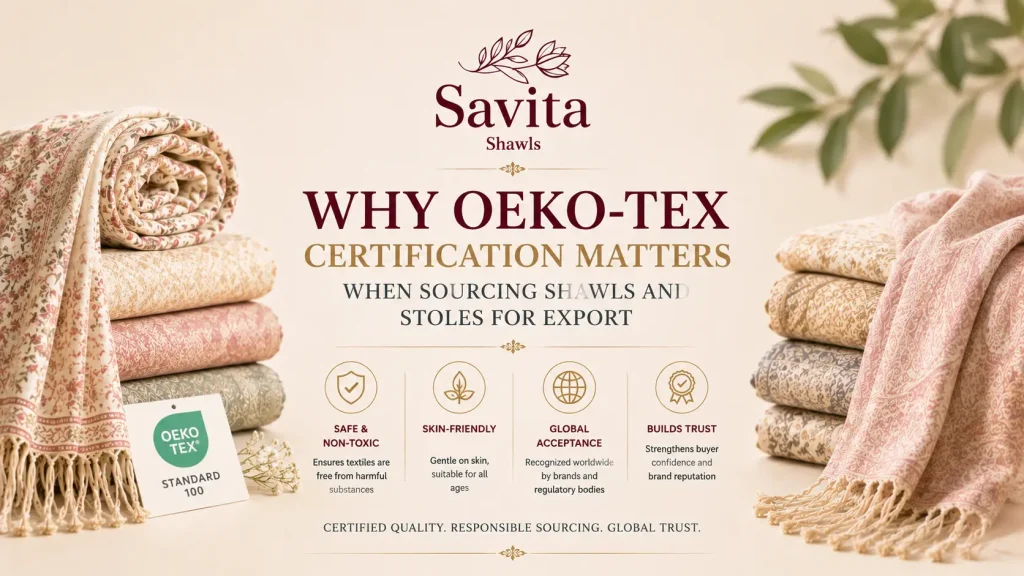
Oeko-Tex is a testing and certification system for textiles, administered by an international association of testing institutes. The most commonly referenced version is Standard 100.
Standard 100 tests finished textiles for harmful substances, covering regulated chemicals, restricted dyes, heavy metals, formaldehyde, pesticide residues and pH. A certified product has been laboratory tested against limit values set for the product class.
What it does not cover matters as much. Oeko-Tex Standard 100 is a chemical safety certification. It is not an organic certification, not a fair trade certification, not a proof of fibre content, and not a statement about working conditions or environmental impact of production.
Buyers who conflate these make claims in their own marketing that the certificate does not support, which is a reputational risk rather than merely an inaccuracy.
Product classes matter. Class I covers items for babies and toddlers with the strictest limits. Class II covers items worn against the skin, which is where most stoles and shawls sit. Class III covers items not worn against skin. Class IV covers furnishings.
The certification system is documented at Oeko-Tex.
Which markets and buyers require it
European retail asks for it most consistently, particularly in Germany, the Netherlands and Scandinavia, where consumer awareness of textile chemical safety is highest.
Large retail groups and department stores frequently require certification as a supplier onboarding condition regardless of market, since it simplifies their own compliance position.
Baby and children’s product buyers require Class I certification without exception, and this is a genuine hard requirement rather than a preference.
Sustainability positioned brands request it as part of a broader documentation package, usually alongside other certifications covering the parts Oeko-Tex does not.
Buyers in markets without a strong certification culture often do not ask, which does not mean an Oeko-Tex certified shawl supplier is not worth choosing. It means the certification is not the deciding factor for that buyer.
How to verify a certification claim
This takes under a minute and should be routine on every supplier claiming certification.
Ask for the certificate number and the name of the issuing institute. A supplier who cannot produce both is claiming something they do not hold.
Check the number against the public verification tool maintained by the certification body. It will show the certificate holder, the covered products, the product class and the expiry date.
Confirm the certificate covers the actual products you are buying. A certificate covering cotton fabric does not cover a wool stole. This is the most common gap between a claim and reality.
Confirm the certificate is current. Certificates carry expiry dates and require renewal, so a valid looking document may have lapsed.
Confirm the certificate holder matches your supplier. Certificates sometimes belong to a fabric mill upstream rather than to the manufacturer quoting you, which is legitimate to state accurately and misleading to state loosely.
Costs and who bears them
Certification carries a real cost, covering laboratory testing, application fees and annual renewal, and it applies per product class and material group rather than once for a whole business.
That cost reaches your price. An Oeko-Tex certified shawl supplier is generally quoting slightly higher than an uncertified one for equivalent goods, and the gap is the certification overhead rather than a quality difference in itself.
For buyers whose market requires certification, this is simply a cost of access. For buyers whose market does not, it is worth deciding deliberately rather than accepting a premium for a document your customers will never ask about.
Where a manufacturer sources certified fabric from a certified mill, the certification attaches to the material rather than to the finished piece unless the finished article is separately certified. Ask which applies, because the distinction matters if you intend to display a certification mark on your own product.
Other certifications worth knowing
GOTS, the Global Organic Textile Standard, covers organic fibre content and processing along with social criteria. It is the certification buyers usually mean when they say organic.
Responsible Wool Standard covers animal welfare and land management in wool production, and addresses the mulesing question directly, as covered in the guide to merino wool sourcing.
Fair trade certifications cover producer payment and working conditions, which matters most in hand craft categories, as covered in the guide to kantha stole sourcing.
Geographical Indication registration covers provenance rather than quality or safety, and is relevant for Kashmir pashmina claims, as covered in the guide to pashmina stole sourcing.
No single certification covers everything, which is why buyers with a strong sustainability position usually assemble several rather than relying on one.
Making claims in your own listings
Repeat only what the certificate supports.
Certified against Oeko-Tex Standard 100 is accurate if the certificate covers your product and is current. Chemical free is not accurate and is not what the standard says. Organic is a different certification entirely.
Keep a copy of the certificate on file for every certified line you sell. If a customer or a regulator asks, producing the document immediately is the difference between a query and a problem.
Update your records when certificates renew, since a lapsed certificate supporting a live product claim is a genuine compliance exposure.
Labelling requirements sit separately from certification and apply regardless, as covered in the guide to care label requirements for export.
What Savita Shawls provides
Savita Fashions LLP, trading as Savita Shawls, has manufactured stoles, shawls and scarves from Gurgaon, Haryana since 1984 and supplies buyers in more than 20 countries including Germany, France, the Netherlands, Sweden, Denmark, the UK and the USA. GST registration is 06AFPFS3876N1Z0 and IEC is AFPFS3876N, verifiable on the GST portal and the DGFT portal. The company is registered with FIEO and AEPC.
Buyers requiring Oeko-Tex certified fabric or other testing documentation should raise the requirement at enquiry stage rather than after quotation, since certified material sourcing affects both price and lead time and cannot be applied retrospectively to goods already in production.
Fibre composition documentation is provided on request for customs and retail compliance. Quality control runs in three stages: raw material inspection before production, in line checks during weaving, dyeing and finishing, and pre-shipment inspection. Third party inspection can be arranged where a buyer requires independent verification.
Terms are 100 pieces per stock design and 200 pieces per custom or OEM design, with samples dispatched within 5 to 7 business days and the cost credited against the bulk order. Buyers new to sourcing should read the guide to stole export from India.
Frequently asked questions
What does Oeko-Tex Standard 100 certification cover?
It certifies that a finished textile has been laboratory tested against limit values for harmful substances, including regulated chemicals, restricted dyes, heavy metals, formaldehyde, pesticide residues and pH. It is a chemical safety certification. It does not verify fibre content, organic status, working conditions or environmental impact of production.
How do I verify an Oeko-Tex certified shawl supplier’s claim?
Ask for the certificate number and issuing institute, then check the number against the certification body’s public verification tool. Confirm the certificate covers the specific products you are buying, that it is current rather than expired, and that the certificate holder is your supplier rather than an upstream fabric mill.
Is Oeko-Tex the same as organic certification?
No. Oeko-Tex Standard 100 tests for harmful substances in the finished textile regardless of whether fibres are organic. GOTS, the Global Organic Textile Standard, is the certification covering organic fibre content and processing. Buyers who describe Oeko-Tex certified goods as organic are making a claim the certificate does not support.
Which product class applies to shawls and stoles?
Class II generally applies, covering items worn against the skin. Class I applies to products for babies and toddlers and carries the strictest limits, which is a hard requirement for children’s product buyers. Confirm the class on the certificate matches the intended use of the product you are buying.
Does certification increase the price?
Yes, modestly. Certification carries laboratory testing, application and annual renewal costs applied per product class and material group. That overhead reaches the quoted price. For buyers in markets that require certification it is a cost of access. For buyers whose customers never ask, it is worth deciding on deliberately.
Which markets require Oeko-Tex certification?
European retail asks most consistently, particularly Germany, the Netherlands and Scandinavia. Large retail groups often require it as a supplier onboarding condition regardless of market. Baby and children’s product buyers require Class I without exception. Many markets do not ask at all, which does not make certification worthless but does change its priority.
Can I display the certification mark on my own products?
Only if the finished article itself is certified and you are authorised to use the mark. Where a manufacturer uses certified fabric from a certified mill, the certification attaches to the material rather than the finished piece unless separately certified. Confirm which applies before printing anything on a hangtag.
What other certifications should I consider?
GOTS covers organic fibre content and processing with social criteria. Responsible Wool Standard covers animal welfare and addresses mulesing. Fair trade certifications cover producer payment and working conditions, which matters in hand craft categories. Geographical Indication registration covers provenance. No single certification covers everything.
Ready to order
If your market requires certified material, raise it at enquiry stage so it can be built into sourcing, pricing and lead time rather than applied afterwards. Send your requirement with product type, quantity, destination market and any certification your buyers require. Samples ship within 5 to 7 business days with the cost credited against your bulk order. Start with a sourcing enquiry, email sales@savitashawls.com or call +91 7696677766.