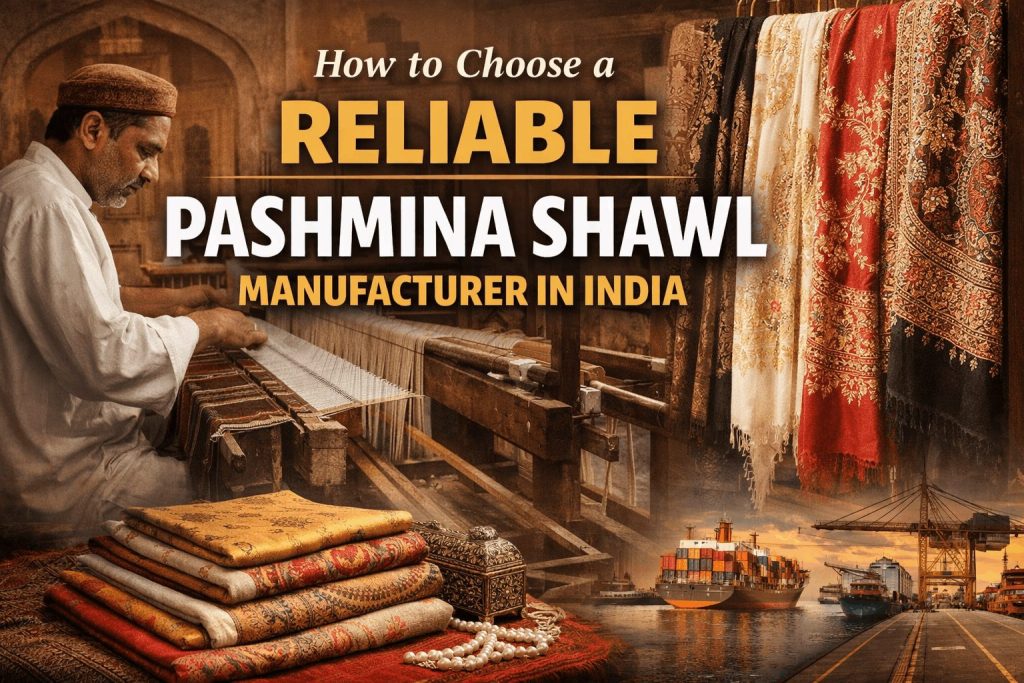
There has been a spike in the demand for pashmina shawls on a worldwide scale. There are many individuals namely luxury boutique owners located in Paris and wholesale traders located in Dubai as well as logos of brands located in New York who are in search of a competent pashmina shawl manufacturer in India. They seek someone who has a proven track record of producing genuine products at a reasonable price and who also has a reliable mechanism of exports in place.
Pashmina is a very exquisite and elite end product in the spectrum of textiles that there is today because all three components; aged handicrafts, superfine animal hair and branding, converge. There are high-paying consumers in Europe, North America, Middle East, Japan and Australia when it comes to paying for genuine pashmina product. In this context, it is a viable business for the B2B suppliers or buyers as as long as there is a possibility of establishing the right manufacturing partnership arrangements in India.
The cashmere industry is worth approximately US$3.5 billion, while the bulk of world’s pashmina processing and export takes place in India and is growing. More than 80 countries are the destination for Indian pashmina exports annually, which is why India is the most commercialized source of pashmina in the world.
In order for importers, wholesalers, boutique owners and private label brands alike to flourish in this segment, finding and procuring a good pashmina shawl manufacturer in India is possibly their best business decision. This guide provides you with all the necessary information in order to make such a decision in a clear and decisive manner, with all the facts and the chances fully understood.
Why India is the Leading Hub for Pashmina Shawl Manufacturing?
The history of being capable to be the world’s largest pashmina shawl manufacturer in India does not begin in our age with the efforts of these entrepreneurs; it is built on an age-old heritage of skills, a source of fiber available from nowhere else in the world, and an extensive magnitude in garment export. There is no other nation in the world that would have these benefits in one sustainable mode.
The Kashmir valley is known worldwide for its historic association with pashmina production in its purest form. The raw material for a pashmina is bred from the fine hairy underbelly of Changthangi goat, a Ladakhi and Tibetan plateau breed, which grows between 12-16 microns in diameter, thus exceedingly finer and, of course, softer than regular cashmere which portends up to 19 microns in thickness. And it is the Indians or those who learned from Indians as Indians have already used this fibre to its maximum potential spanning centuries that it is not information that shall be transferred to any low-cost textiles produced elsewhere.
Aside from most of the Kashmir area, some manufacturing areas of India like Ludhiana, Amritsar and Delhi NCR, open up international buyers to a wider variety of pashmina blends, jacquard wraps, printed shawls, and embroidery designs at different cost levels. All these geographical locations turn India into a hugely and diversely inclusive, a one- stop destination for every buyer sourcing different kinds of shawls.
Another fundamental aspect that gives India competitive advantages arises from the textile exports. DGFT policy, trade claims with those major importers and efficient transport structures as well as experienced people in preparing export documentation just to name a few, enable foreign buyers to break their reservations. Also, the sourcing process is easier when the pashmina shawl manufacturer in India has long been in business and has served many foreign customers before.
Understanding the Role of a Pashmina Shawl Manufacturer in India
Roles of various players in India’s complicated pashmina business differ, and understanding the roles of each is an important aspect for a foreign buyer because of the allied costs. So, when you are dealing with a pashmina shawl manufacturer in India, make sure that they are of this particular category as this is the only level of the supply chain where they manage all processes related to production.
They take care that all the processes of spinning, dyeing, weaving, or knitting, finishing and finally inspection are done in-house. This vertical integration assists in maintaining consistent levels of quality across large quantities, in the timely management of the production schedules, seamless handling of the customization orders, and cost-effectiveness with the disappearance of the middlemen poised at every stage of production and distribution.
Greater cost-effectiveness per unit price, quick processing of orders, higher focus on quality control, and availability of authentic documents characteristic of the product – these are the causes why B2B clients prefer to deal with a direct manufacturing company rather than a merchant or an agent who only pretends to be so. Such manufacturers are able to issue certificates based on fiber testing in laboratories, geographical indications, export regulations, and even compliance inspection sheets for the market towards which one is exporting.
The influence of such a person on the process of personalized evaluation affects what to ask under what circumstances. A bottom-up approach to the evaluation of a supplier who is a pashmina shawl manufacturer in India will boast of the loom number in use, the number of production cycles every month, fiber patterns used in production or every single control point and most notably, the finesse of the end product. In contrast, exporters and traders, when probed about the above mentioned activities, will beat around the bush or avoid answering, and that is a noble symptom.
Key Qualities of a Reliable Pashmina Shawl Manufacturer
Whenever you are looking for a supplier, there are some superficial elements that you’ll do well not to attach too much importance to (such as a highly developed website, very competitive first sample prices, quick email response). When one is dealing with the shal pashmina market, the excellence of a producer is only measured by internal structure and operations, proof, consistency, and practices.
Manufacturing facilities: All reliable producers have their own weaving, dyeing and finishing sections which can be ascertained through factory audit, videos tours or also inspection by third parties.
Open and organized fiber procurement: Pashmina and all other specialty fibers being used and the methods adopted in pre-weaving and post weaving stages are shown.
Quality assurance is clearly delineated: All efficient producers perform several checks throughout the production process – raw fiber compliance – then weaving – and finally post-weaving finishing.
In case of pashmina shawl manufacturer in India also falls into the same category of woven crafts, this list includes apasionarie.com, heena exports.
Export expertise and the ability to prepare all necessary documentation: The supplier should be experienced in exporting to the desired market and should be in a position to provide all the required documentation including but not limited to the GI certificates, the fiber tests, the country of origin and destination compliance where applicable.
The ability to consistently sample: This means being able to reproduce very fine accurate samples which represent the specifications of the bulk order as regards texture, color, size and pattern.
Low minimum order quantity and the ease of scaling production: Reliable suppliers enable their customers to increase their order size over time and implement minimum order quantities (MOQ) that are appropriate at different stages of a buyer-seller relationship.
Effective and foreseeable communication: It would be impossible for a long lasting manufacturing partnership to exist without proper and relevant communication including the progress of production and the delivery dates.
pashmina shawl manufacturer in India
Accredited buyer references: The giants that break through the national market will not spare a minute to provide the direct contacts of their clients in the markets similar to those of their potential customers.
These all features together differentiate all the very professional pashmina shawl manufacturer in India from a norm of cunning dealers and non validated entities that are busy infiltrating, registering and trying to better trade in B2B platforms globally.
The Unmatched Softness and Warmth of a Pashmina Shawl Gift
When people first attempt putting on a pashmina shawl gift their experience is almost always discerned as being special in some way. It’s all in the texture. Pashmina refers typically to a wool that is very, very fine with 16 microns in diameter or even less – just not every other wool on the planet is so fine – which affords a different Imaginary “feel” to the body. The skin does not itch or roughen up or start prickling.
All it does is gently cover over the skin’s already covering heat, completed and augmented with something smooth as silk. It is noteworthy, that this softness is not a surface attribute which disappears after a couple of washes; it is rather a structure of the wool that endures as long as the shawl is appropriately maintained. A pashmina shawl gift carries with it this feature on top of its softness.
Despite the extremely lightweight nature of the shawl – a good quality pashmina shawl can be as scanty as hundred grams – the warmth it gives is unrivaled. All these marvelous functions of the pashmina wool owe their existence to the fact that the pashmina wool is very light and hollow. Thus, it is able to retain warm air within the hollow and therefore makes the wearer comfortable even in the coldest weather.
This is the reason why giving this wonderful soft on touch and shocking hot pashmina shawl gift is a practical luxury, and this binomial better defines pashmina shawl as excess and necessity in equal measure as is the case with most of the polygons. The idea of giving a pashmina gift goes hand in hand with a luxury since it comes with a nice touch and a utility which causes its owner overjoy at the prospect of repeatedly reaching out to it.
Difference Between Manufacturers, Suppliers, and Exporters
This variation appears basic but very important for effective sourcing decisions with many international purchases – both first-time and repeat buyers – in which some aspects get mangled.
A manufacturer is who makes products. They own and run looms and have weavers and dyers and ensure production quality and time control. Buying directly from a pashmina shawl manufacturer in India enables you to have maximum control, best pricing, and enhanced quality stability.
A supplier, on the other hand, in the most general sense is not the manufacturer rather, a company that gathers finished products, or semi-finished ones from different manufacturers and sells them. These suppliers are useful if you want a variety of goods from one contact but they often increase the manufacturer prices, ranging 15%-35%, and have little to no power at the manufacturing level to enhance quality.
The primary concern of an exporter is ensuring that the goods move through customs and arrive at the port of destination. While some exporters, in house, operating, have production companies, most of them do not. Thus, engaging with an exporter will be getting stuck in such a circle of functions where the center of the circle is the production and yet there is still no closer approach to the production.
The best source of suppliers on the other hand is an integrated company that is able to produce and export the best quality products. An integrated firm gives you the security of getting your goods manufactured, saving you cost, and solving all your logistic operations in one supplier.
Alluded to this, one important question that should always be asked mentality when talking to potential suppliers on the likes of IndiaMart, Alibaba or TradeIndia is “Are these shawls your own production in your own factory or do they get sourced from somewhere else?” The ease and accuracy of their response will reveal much more about what you are actually dealing with.
How to Verify a Certified Pashmina Exporter
Verification cannot be an option in pashmina business. It is this initial step that safeguards your money and your reputation. In India as well, as elsewhere in the world and in the more expensive cloth industry, there is no shortage of falsehood. As there are fabrics that are not cashmere, mixture of synthetic with cashmere sold as pure, there are also machine-made shawls passed off as handmade. There are also non-registered sellers who claim to be corporate companies.
GSTIN Verification: Any corporation that exists in India is mandatory to apply for the stance of the Goods and Services Tax. As soon as on receipt of GSTIN refer to the government’s website to ascertain the number.
IEC (Import Export Code): Export is only possible for a registered Indian firm which posseses an active IEC from DGFT. This contains the most convenient yet important licensure. Seek it at the beginning.
GI Tag Certification: In case of Kashmir valley pashmina shalle try to find either Craftmark or handicraft “Kashmir Pashmina” of GI Sport issued by Craft Development Institute, Srinagar. It is a geographical indicator.
Third-Party Factory Audit: Potential first large orders should be preceded by a factory audit executed by a credible inspection agency – Bureau Veritas, SGS or Intertek. The price charged for this protection is marginal.
ISO Certification: The manufacturer is ISO 9001:2015 certified – this is a strong signal, as it means the formal quality management principles are already executed.
Bank References and Export History: Obtain a letter from the bank or ‘bank reference letter’ as well as a traceable list of exports such as previous shipping bills and export invoices.
Do not let a glitzy pamphlet or a stunning website fool you into skipping the verification procedures. The best deceptions in this trade are the most appealing ones. Do not hesitate to spend some time of about two to three weeks in decent preparations, for that will save you from horrendous loss while making your first large order.
Importance of Quality Standards in Pashmina Shawl Production
Various facets define quality when it comes to the making of the best pashmina shawl manufacturer in India. These include fiber quality, spinning, weaving tightness and wearability of colors, and quality of finish, last but equally important shrinking and stretching of the garment. For international B2B manufacturers these factors determine the selling price, the satisfaction of the customers, product returns and word of mouth about their organization.
Now the most important issue- fiber quality. Genuine pashmina fabric should have fibers within 12 – 16 microns in diameter. The thinner it is, the softer, lighter and without any density, yet warm and lustrous which qualifies it as top pashmina. Once that threshold is crossed, say anything more than 18 – 19 microns, it becomes comparable to cashmere, accordingly affecting the effective prices – particularly when reviewing suppliers’ quotations.
The thickness of weaving is evaluated by the number of threads per inch (TPI), and it impacts the strength as well as how the shawl will lie on the body. The weaving density of an average pashmina shawl ranges from 48 to 56 TPI. With high quality items, this number can rise up to – 64 TPI. A higher weaving density indicates an increase in longevity and appreciation of the cloth’s texture that can also warrant a higher price.
Manufacturers and exporters also have to consider colorfastness as an important aspect of consumer safety, especially in areas where the legislation is strict, such as the EU and the USA. Ask your supplier for wash fastness and light fastness certificates, which comply with either the AATCC or ISO standards. Also, a pashmina shawl manufacturer in India with good reputation will not have any problem providing these.
The need for REACH compliance documents is growing among European retailers that distribute through luxury department stores and boutiques. Do not commence any supply contracts with European Union countries without first checking that the factory has knowledge of REACH regulations and can provide the relevant Declarations.
Handmade vs Machine-Made Pashmina Shawls
This comparison has significant business consequences and one that foreign clients need to be aware of before engaging in price or product negotiations. The retail prices of Handcrafted pashmina shawls made through traditional weaving techniques by the expert hands of Kashmiri or any other skilled craftsmen are way higher, what more they acquire the geographical indications certificates and cater for a niche upper class clientele. On the other hand, with Machine made pashmina shawls there is greater control and standardization of production at a lower cost per piece, which also allows integration in the mass flexible retail trade.
The craft of weaving pashmina on the handloom is still very much alive. A weaver may take as long as three to six months to complete a Kani shawl. The selling point for such products is their authenticity, their curriculum and their guarantee of origin and other factors which bring a lot of additional margins in the sale of such products in luxury shops, designer outfits and in outlets dealing with expensive souvenirs and gifts.
Before buying a pashmina shawl, one must assess whether the shawl has been made by a machine or manually on a loom as these two different processes affect the pricing and the classification hence the market sitting position of a pashmina shawl manufacturer in India strategies.
Powerlooms and semi-automatic machines can make a lot of Pashmina shawls at great speeds; handloom production cannot compete with this. Machine-made options, on the other hand, are a tempting mix of quality and commercial sense for wholesale buyers looking to create wide and affordable product ranges. Indian pashmina shawl manufacturer in India has many top companies catering to both low and high-end consumers by having both handlooms and powerlooms in their factories.
Savviest B2B buyers create multiple product levels – the expensive SKUs are usually produced using handmade GI indication certified Pashmina . On the contrary, when there are many pattern lines these are produced using high quality machine based pashmina blends in that order to preserve business organs and stretch profits to all their customers.
Whenever you want to buy handmade goods, ask for the Handloom Mark of the Government of India, or a GI certificate to confirm genuineness –– and prepare yourself for the higher cost that comes with real craft. If producers show very low prices while offering supposed handmade goods, it is evidently misrepresentation.
All this aspires to create a hand woven product – either a sarong, a scarf, a fiber embroidery, a basket – or an item for the house.
Handmade items recently gaining popularity, as well as pashmina shawl manufacturer in India can assist in producing custom designs. Filament textiles have resilient and soft primary materials that give it its elegance and fastness in wear; therefore why it does not have any hard segments on their ends. Most silk is now used for making light/NON-specialist type garments.
Indeed, people are in quagmire. India being a developing country is distinguished with a narrative of fraudulent acts, excessive festivities and corruption especially owing to the perception that citizens uphold morals. Hand made products from this region are also suspect of being ‘cheap imitations’ of the genuine products that originate from other countries. It is a dilemma as how this image should be changed while maintaining the core practices.
Informative illustrations of most Kurdish clothing designs, with various dresses, headpieces, and scarves under different periods of history can be found.
How to Evaluate Fabric Authenticity and Purity?
The pashmina industry faces a major crisis in terms of maintaining the quality of the fabric. The word ‘pashmina’ is commonly used – especially by those who tend to be more unscrupulous – to label a fabric that has hardly (if at all) any Pashm fiber in it. Some of the commonly used substances in the market today include viscose, acrylic and polyester woven into the regular wool, together with a proportion of the real pashmina fiber, hence achieving a great deal of softness but at much lower costs than the actual material.
A B2B customer found in an unacceptable position of handling or rather delivering fake pashmina shawls to the members of the public puts one into a precarious position commercially and hardly run away from public backlash and condemnation especially when the public awareness penetrates and laws on luxury textile standards are tightened both in Europe and North America and beyond.
In India, especially in Jammu & Kashmir, the art of hand-weaving pashmina is an essential part of culture. A pashmina shawl manufacturer in India is usually able to allocate such costs into the price of the product by recovering them through other means.
Perhaps the surest way of ascertaining fiber contents is subjecting it to the tests available in a laboratory. A SEM (Scanning Electron Microscopy) and a fiber dermal: which are the two lab assays in a textile laboratory which measure the fibers of the assayed item regarding count and composition. These are promoted by well-established producers in advance. If B supplier is unable to show any of these, either they are faking it or providing falsified documents, as such consider them as such.
Get an NABL certified laboratory in India and ask them for fiber composition certificates. You should also verify the mean of these microns for the fiber test to be in the range of 12-16 for pashmina. Search whether the specific identification is in line with the analysis since this is critical for the products ship to the EU and US markets where such finished goods are always labeled.
So as long as the Chinese spun that is stretched in order not to warp can be distinguished from the one that is sold in handloom pashmina shawl manufacturers piste, it should be fake.
Integrating mandatory pre-shipment lab testing clauses into the standard purchase orders is one of the best commercial moves you can make as a pashmina shawl manufacturer in India. The costs of quality control testing a shipment are a drop in the sea as compared to what quality disagreements, or returned order, or regulatory compliance in your target retail market.
Bulk Ordering Process from Wholesale Pashmina Suppliers
Learning the correct approach to order in volumes prior to starting the search for a supplier will save a lot of time, minimize resistance, and increase chances for a successful initial deal. The ordering procedure from trustworthy pashmina suppliers in India has a set pattern, of which every step is useful for the purpose of planning the sourcing activities and cash management.
Stage 1— Making the first contact and choosing the product. Come up with a precise inquiry to include a description of the goods of interest (type of fibers, weight, dimensions, colors, design), an approximate volume of the order and the timeline, and the country of destination. The clearer your request is, the better the manufacturer is able to offer possible deadlines and prices.
Stage 2 – Sample Making and Authorization: Famous for their quality, pashmina shawl manufacturer in India make samples according to your details within two to four weeks if this is a typical design, or within four to eight weeks if the pashmina shawl is a custom made. Payment in advance of cases is offered, and one should deduct the cost of the samples from the bulk payments. The client should not commit to bulk manufacturing until working samples are approved.
Stage 3 – Issued Purchase Order with Terms of Payment of Invoices: After samples stage, go ahead and issue a purchase order and discuss the terms of receiving discounts and bonus payments. Indian pashmina business’ normal practice is to provide 30–50% of purchase cost upfront before goods are dispatched with remaining amount paid when goods have been shipped.
Stage 4 – Assisting with the Manufacturing Process and In-Line Inspection: Demand progress reports on the production from time to time, and for larger orders, plan for production inspection in the middle of the process so that defects can be detected faster. Agreeable manufacturers accept this arrangement – it benefits them and the customers too.
Stage 5 — Pre-Shipment Inspection and Documentation: Ensuring the buyer before dispatch, perform a pre-shipment visual inspection by hiring an external company. The approved manufacturer then drafts every export document, including a commercial invoice, a packing list, a bill of lading, a certificate of origin, and test reports.
Stage 6 — Shipment and Delivery: Appropriately packaged goods are then dispatched according to the Incoterm that was agreed upon. Reputable manufacturers put a lot of emphasis on arranging transportation and packaging so that no one is disappointed by the shipment and the goods appear on time.
There are many, but Pashma is an industry-leading pashmina shawl manufacturer in India providing the complete process starting from sourcing webs, dyeing and weaving. Also, weaving one thin single comb wool since it protects out of the most howling winds like shalimar and completing with producing the most delicate black Shauls.
Minimum Order Quantity (MOQ) and Pricing Factors Explained
Minimum order quantity is an important subject associated with majority of B2B discussions, and the better grasp you have of the concept, the better possible tactics you can come up with both negotiating and differentiating admissible changes from those which are aspiring impossibles of non reputable business partners.
In case of pashmina shawl manufacturer in India, the minimum order accepted as a business order relates to the item being manufactured and the extent of customization and the size of the factory. Components of designs available off the shelf can be achieved by most including their order samples, where no customization is involved collapses of about 50 – 100 pieces per design belong to the nature of business form which is applications based. However, in the case of any custom design features, such as different colors, brand labels, shape alterations, exquisite embroidery, etc. the minimum quantity goes up to around 200 – 500 pieces per design which justifies the initial investment and development required.
Many influences cause a greater or lesser price of a goods/inclusion of a product such as the fibre class where context is placed in a percentage against the inclusion of impurity, the weight of the product in grams, thread count, whether the design is flat, or prints are there in case of prints or on top circumferential bands or that are woven into a patterned cloth, finishing and packaging details, volume of the order and prices of basic raw materials in the market at that time.
While considering the price, the selling price for high quality real pashmina shawl (100% Pashm, handmade) in beach cities US$80 to US$350 plus, particularly with respect to designs and micro count. If you point to the opposite direction; machine-made pattern with pashmina starts at $8 – 25 considered on a piece FOB basis. In the case of bids which are extremely less than the suggested amounts, caution has to be exercised when considering them for that particular type of commodity.
It’s a good idea or even possible to discuss about reduction of MOQ but look at it as a business meeting where both sides benefit from it. Willingness to pay extra for samples, assurance of increased order volume in the near future, or extending the production period can be persuasive enough for a factory as there is no loss of efficiency in the production line despite reducing the minimum quantity.
You want to find a custom made pashmina shawl manufacturer in India, such is the specialty of this nation.
Customization and Private Label Opportunities for Buyers
Acting as a mediator of many, while promoting pashmina brands brings many advantages that a pashmina shawl manufacturer in India is only one of the costly whereas the capabilities offered by the master designers. For importers, boutique owners, custom brands especially for baby clothes or high styled shoes for example, this customization means a tool for gaining competitive advantage and seeking more exclusivity of the brand in the respective market.
There is no part of product design that is not customizable. Even the fiber options with which manufacturers work will include more binding pashmina to silk proportions or pure pashmina enhanced with cashmere depending on the price brackets and the commercialization of the products. It far extends the design aspect and includes a routine like colorways developed in perfect harmony with PANTONE, along with made to order prints, embroidery as well as jacquard woven products and finally some original designs which can only be termed as designs as they reach a level of design.
The size of the items can also be altered to suit the taste of the audience: for instance the sizing of scarves for Europeans, complete body knit covers for American customers, and even custom travel shawls for the airline or hotel industry. You can decide the density of the edge, the type of fringe and border options so that they meet your brand’s requirements.
It is also worth mentioning that many well-known exporters provide comprehensive and relevant private label services such as labels which are woven or printed, hang tags, swing tickets, tissue paper all of which are branded. What this means is that from the day it arrives at the warehouse, you cut the shelf time by half as you already have your branded product, ready to display.
Some brands that aim for proper exclusives are given an NDA-covered progress ion in some of the manufacturing units, where it is assured that no buyer will use the current patterns and colous that you have made. The main obstacle is that production volumes have to be agreed on, but this is more than possible when working with a pashmina shawl manufacturer in India.
Packaging, Branding, and White Label Services
There have been great changes in the packaging industry, especially with regards to the pashmina trade. Wholesale buyers in contemporary times are alive to the fact that the main purpose of packaging is not only to protect the product rather it enhances the optimization of customer satisfaction and brand awareness. Bulk manufacturers of shawls in India at present understand this fact and they offer a range of packaging and branding services rather than just packaging their products in plain polybags.
A white-label agreement, which is the standard practice among veteran pashmina exporters from India, enables branding of finished products without any mention of the original manufacturer. Included in this are boxes with decorations of your own design, attractive bags, care instructions in several languages, codes that detail care symbols, fiber contents, and fabrication country where each item is produced; Finally, relevant and made-to-order designed presentation materials are available, level coordinated as per your retail philosophy.
Today wrong pashmina shawl not selling аt аll еvеn at the wholesale price of $10 per once. Indians can sell this type of shawls for not less than twenty dollars. The demand for the pashmina shawl Manufacturer in India is increasing at a rapid rate. Therefore exporting firms should begin to look at dynamic pricing as a method payable by the citizen in order t obtain the industries products.
In case of high-end retail outlets, presents packaged in a pleasing manner with bows, ribbons upon boxes, pretty bags and wrapping paper that has the design drawn on it can be done within the maker’s own factory of packaging and thus one does not have to worry about managing any packaging vendor in one’s own country.
Put your packaging requirements explicitly in your order and if necessary, have samples of the packaging for your product approved before any mass production commences. Wrong labelling on the packaging – incorrect text, another language version, labels with banned symbols – are severe problems when going through importation of particular goods into stricter markets, such as the EU or the US.
Export Capabilities and International Shipping Process
It is crucial to be able to promote the goods abroad not less than organization’s capability to produce them qualitatively. While making analysis, the successful pashmina shall exporter should be checked for logistics provisions as much as regarding production.
Professional Indian main pashm india pashmina shawl manufacturer in India was working with the well-known freight forwarders for transhipments both via aircraft and maritime transport. Air cargo is the preferred option for smaller or urgent consignments as transit from Delhi or Mumbai takes three to seven days to any major world destination. For high volume orders, however, speed is not an issue but a reducing cost is, sea shipment is done from JNPT Port (Mumbai) or Chennai Port takes two to six weeks depending on the destination.
Experienced pashmina shawl manufacturer in India struggles to export documentation because it is an important operational area he can add legitimate value. Commercial Invoice, Packing List, Bill of Lading/Airway Bill, Certificate of Origin, Shipping Bill and any country specifics including EUR. 1 form for European markets tariff concession.
The European Union is one of the largest trading partners of India GSP program and it allows India to have lesser duty on importing textile products with Correct GSP. Confirm that GSP reporting and issuance of such documentation is standard practice for your manufacturer to do – custom made GSP documentation is very useful.
The first Incoterm that most buyers in the world want to deal with for such orders is FOB Indian port especially for buyers outside the Basmo trusts geography as the producer still supplies the goods to the port safe and clears Indian customs.
Top Mistakes Buyers Make When Choosing Shawl Manufacturers
Industry experience shows a remarkably consistent tendency toward making avoidable mistakes on the part of first-time as well as well-experienced buyers.
Selection is based uniquely on price: The lowest bid usually leads to compromises with respect to fiber quality, weave density, or final standard. In the luxury fabric trade, chasing the lowest cost naturally leads to quality problems.
Failed factory verification: Ordering with but faith in a supplier’s solitary submission, no factory audit or IEC or somewhere-third-party inspection to back it up is the number-one reason for having a first-time buy fiasco.
Approval of actual samples has not been done: References of the supplier’s own catalogs are inadequate grounds for ordering; or as any form of digital proof is in question.ilty that is hard to argue with considering that you okayed the actual samples to be approved for use.
Ambiguous Purchase Order Specifications: Unclear PO specification terms might end up being interpreted by manufacturers in ways that benefit their efficiency in manufacture-ing quality, thereby failing to meet your quality requirements. Every specification will be put into writing and will be made measurable.
Disregard on Packaging and Label Conformity: Labeling requirements at destination markets are often underestimated, making it imperative for customs to hold up and necessitate product recalls.
Sacrifice on Later Orders: Large first requests placed upon initiating a business relationship with a new supplier can pose immense financial risks as it assumes that reliability might come in the beginning. Begin with small volumes to ascertain the reliability in actual supplier performances before scaling up.
None Pays Security on Payment: Full advance payment with new sellers is not a good idea. Middle Letter of Credit involvement will be helpful. This minimizes the risk of unfulfilled production quality or late deliveries.
NO lead time buffering takes place in creating: Real lead times are required in the Pashmina manufacturing cycle. Buyers placing orders of less lead time often end up in a rush when it comes to the production of their orders, forcing the compromise of quality.
How to Build Long-Term Relationships with Bulk Shawl Manufacturers
Savvy business people who are best able to buy and resell a pashmina do not fall into the trap of shopping around different suppliers in attempts to save some money. They end up providing themselves with supply by working only with a few strong established supply chain partners. These partnerships bear fruit of far more advantages within the textile business in India than dealing on transactional grounds e.g. discounts, production and product modifications priorities, timely advertisements, low MOQ and an understanding as well as dedicated business partner.
No exrtaneous ‘payoff gifts’ are able to form such ties. Stop comparing wool sellers every year and focus on working with a few suppliers you can depend on: respect the deadlines by getting them paid as agreed, give feedback that makes sense and that helps in the development of the product, advise changes in design earlier and same for the orders placed specifying the amount in time. Reciprocity is very important to the Indians and so is trust and it is worth mentioning that their understanding of business relationships is quite similar to what exists in their culture.
Approach a pashmina shawl manufacturer in india to have the pashmina shawls imported or better still show your designs to the manufacturer and have them make for you.
It is important to note that taking a single trip to the manufacturing facility of your partner in India is a game-changer in the business relationship that has a soft barrier that emails cannot cross. Factory tour denotes a certain level of importance and commitments where one gets to witness the most crucial aspect the production site in person and strengthens service and commercial terms.
You may also wish to set procurement as one year agreements or indefinite contracts for each season with tenders predicted. This assures your Indian pashmina shawl beads a design manager that they can make your request a priority, help you get a better deal on importantly raw materials, and reserve the production space specifically for you — all these eventually through back the advantages of enhanced quality, cost and availability.
Latest Trends in the Global Pashmina Shawl Market
The global pashmina market in 2024–2025 is being shaped by a convergence of forces that create both commercial opportunities and sourcing imperatives for B2B buyers.
Sustainability and ethical sourcing have moved from niche market differentiators to mainstream retail expectations, particularly among European and North American consumers. Buyers who can credibly market their pashmina products as ethically sourced, artisan-made, and environmentally responsible are capturing meaningful market share at premium price points.
Customization and personalization continue to drive premium pricing power in retail. Consumers and the boutiques serving them increasingly value products that feel distinctive and tailored. This trend directly benefits buyers who invest in custom design development with their manufacturing partners, creating product exclusivity that competitors cannot easily replicate.
Digital retail and direct-to-consumer growth are changing buying patterns. Many traditional wholesale buyers are building their own D2C channels alongside wholesale businesses, requiring smaller and more frequent reorder quantities alongside annual bulk buys. Manufacturers who can serve both needs are increasingly valuable partners.
Color and design trends for 2025 show strong demand for earth tones and nature-inspired palettes — terracotta, sage, warm sand, burnt sienna — alongside a revival of traditional Indian motifs including Paisley, Sozni embroidery, and Jamawar woven patterns presented in contemporary, globally accessible design languages.
As a result, the designed pashmina shawl gift tends to be exceptional as there has never been nor will be another of such a gift to that person especially and the fact that some skilled woman has actually made it special for that person makes the value of the gift even more substantial than just the price tag. A good alternative for the customized decoration of a pashmina shawl gift will be the custom colorways – contacting a manufacturer or artist for the dyed pashmina of the recipient’s favorite color or that special color which characterizes the two of you.
Custom dyeing in some other high end pashmina manufacturers is also offered, where it is possible to order the exact color the individual wants so that the recipient carries around his or her pashmina gift with joy attesting that it is the only one of its kind with that particular shade. A simple gesture such as writing a note with a description of what the pashmina shawl gift is to the receiver, or more simply topping it with a poem or a photograph in reference of a previous experience or an accessory related to his or her memory, can add to a beautiful gift, making it something truly special and meaningful.
Sustainable and Ethical Manufacturing Practices in India
Sustainability is no longer supplementary in textile sourcing; different retail channels in Europe and North America are adding it as a market entry requirement. Many buyers who ignore sustainability in their supply chain are likely to face greater risks of being delisted by the retailers, adverse publicity by the consumers, and in compliance with the regulations.
The massive Indian pashmina manufacturing sector has come a long way in the practice of sustainable manufacturing. Numerous established manufacturers these days have certain certifications that back up their sustainability stories — for instance, OEKO-TEX Standard 100 (which indicates that the product does not contain any harmful substances), SA8000 (which is a standard for working conditions), and GOTS (refering to Global Organic Textile Standard) for processing of organic fibers.
Dyeing pashmina with plant dyes has been a tradition in Kashmir, which is the main reason why many organisations dealing with luxury pashminas have embraced this practice. Thus, they make certain that all the dyes they use and the processes they apply in creating colours are extracted from natural elements. Consequently, such pashminas attract very high luxury and artisan retail market prices and have a STRONG sustainability appeal and story.
Many works on pashmina shawl manufacturer in India claim that certified practicing ‘fair wage’ or rather ‘writing of projects on artisan welfare’ are facilitated through Fair Trade Certification, the World Crafts Council, and the government, through the Mark Craft. The existence of these certificate schemes prevents the exploitation of poor artisans and greatly appeals to the contemporary luxury consumer.
Why a Pashmina Shawl Gift Outlasts Trends: The Enduring Power of Classic Luxury
With a steady rise in fashion standards, acceptance and disposal of materials, the fast fashion, culture, creating a new class of society has already started. For such a society, a pashmina shawl gift gives the finest response that can be given and affirms the timelessness of a particular item or take. Since the first records in history some three thousand years ago, the pashmina shawl fur has been one of the most desired garments in more than one civilization, and the demands for pashmina shawl has not decreased even to the present day, not because of advertising commitments or even celebrity attention, but for one reason and one reason only – the quality, the beauty and the warmth of the fine enveloping wool have always remained the same.
It is for this reason that, in addition to other reasons, a pashmina shawl gift is appropriate and strategic for any serious presents – this is a present that will not go out of fashion within the next season, it will not become less important, it will not change in appearance, and it will not become any other than what it is for decades to come. The pashmina proffered as a present now will remain just as effective, just as appreciated, and just as posh twenty years after as it was the first day it was opened up and worn.
The most exquisite and endearing forms in the Kashmiri pashmina will always be the paisley, the flowers in bloom and the topological rims, which are not based on the fads within that particular time frame but are beyond and above all that – they are forms of art appreciated and indeed adored over time and space. It is as if this shawl with the traditional motifs is as much exciting and fascinating today as it was in the days when the emperors of the Mughal empire or the Victorian ladies used to add them to many more expensive items.
Since the dense and heavy pashmina fiber is inherently long lasting, it means that if you take good care of a gift in a form of a pashmina shawl, you can safely keep it for generations so much that it will become a property with a family, passing from the mother to a daughter, or a grandmother to a grand kid. Within this shawl are the added memories of all those times, the people and the places in which it kept any of the owners warm on multiple occasions.
This evergreen factor – the fact that it cannot be bettered by any other product within a short time, or it doesn’t wear with time and can even outlive the person who presented it – is one of the most inspiring and eloquent features of why one should even consider a pashmina shawl gift, without any doubt out of all fashionable accessories, only this one has this kind of special attribute.
Benefits of Partnering with Indian Wholesale Shawl Suppliers
It is the question of why the most successful buyers of the market opt for pashmina from India and not Nepal, China or Mongolia and this question is answered by the facts.
India has a unique offering which no one else has – access to authentic raw material via Ladakhi Pashm; expertise of generations of craft that has been concentrated in Kashmir; industrial level production in Punjab and Delhi NCR and richest textile export experience in the whole of Asia.
Range of products from an Indian manufacturer is mind – numbing from hand embroidered Kani Shawls which are museum pieces to contemporary made to print pashmina mixes for the mass retailers. Therefore, almost any pashmina shawl manufacturer in india can be very diverse and supply almost the other shawls in the category, which simplifies both the supply chain and logistics.
The trade infrastructure of India involving structures such as textile export promotion councils including AEPC, TEXPROCIL, and EPCH), export benefit schemes and trade preferences with other countries acts to alleviate the sourcing process cost and the complexity of course at scale. The buyers taking advantage of these systems and fiat currency determined relations getting production orders to a pashmina shawl manufacturer in india, wish to do exactly that, gain certain cost synergies to the competition.
Questions to Ask Before Finalizing Pashmina Shawl Manufacturer
The complexity and challenge of the questions you ask determine the structure and nature of the information you are given – and ultimately, impact the choice of the potential supply supplier. When you are about to determine any manufacturer, make sure the following queries were asked and answered adequately.
Are you able to share your IEC number, GSTIN, and financial institutions for checks? What certifications for exporting do you have available currently? Do you have access to your own production facility or are you engaged in third party manufacturing? Is it possible for me to visit your premises or provide a checked video showing all the premises? Are you able to produce your own monthly capacity? How do you procure raw materials, particularly raw pashmina fiber, which part of the world, at what grade and how much? Will you be willing to offer fiber test results?
What is your stock Items MOQ? Is it comparable to that for Customized Items MOQ? How long does it take on average for the Goods to be Manufactured and do you Include any Allowances During High Season? How do you Check the Quality of your Goods, and can you provide Quality Control Reports? Are you able to offer prova del OEKO-TEX or REACH or other tests such as composition of the fibers and colorfastness?
What are the payment terms for your products and can they be changed for the loyal clients? Do you have payment term including trade finance that you can already offer for your clients and for me. I have customers like to target markets like that, can you provide information on those people or clients with respect to your organization? In case of non-conformity at Delivery what is your procedure and settlement practice? Is it possible that prior to the shipment, the goods undergo an inspection which I will order from any independent agency?
For instance, a pashmina shawl manufacturer in india who responds to these queries thoroughly, at length and with verifiable evidence generates a greater degree of trust where business concerns are involved.
Related Products
Showing 145–153 of 807 results
-

Elegant Embroidered Stoles by Savita Shawls
Read more -
Premium EMBROIDERED SHAWLS by Savita Shawls – Where Elegance Meets Craftsmanship
Read more -

Elegant HASHYA EMBROIDERY SHAWLS by Savita Shawls – A Symphony of Art & Tradition
Read more -

Elegant Phulkari Shawl/Dupatta by Savita Shawls – A Celebration of Heritage & Grace
Read more -

Premium Acro-Wool Stoles by Savita Shawls – Soft, Stylish & Timeless
Read more -

Luxurious Acro-Wool Shawls by Savita Shawls – Redefining Comfort & Elegance
Read more -

Elegant Acro-Wool Scarf by Savita Shawls – The Perfect Blend of Warmth & Style
Read more -

Premium Kani-Pattern Shawls by Savita Shawls – A Fusion of Art & Elegance
Read more -

Elegant Amritsari Jamawar Stoles by Savita Shawls – Where Tradition Meets Luxury
Read more